Earth Day Talk @ MRL

Title slide - Lunchtime Lyceum

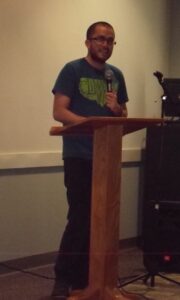
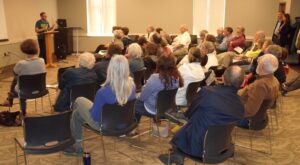
CAAV member and former steering committee chair Les Grady presented a talk about climate change at the Massanutten Regional Library, downtown Harrisonburg, on Monday, April 20, 2015, entitled Help! My Planet’s in Trouble and I Don’t Know What to Do.

The Daily News-Record‘s Elaina Sauber was there along with photographer Nikki Fox. The below article was published in the Daily News-Record on Tuesday, April 21, 2015.

Climate Change Talk Hopes to Educate

by Elaina Sauber

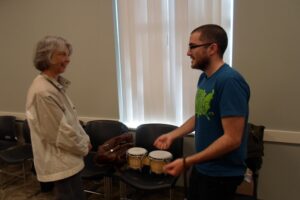
Photo by Nikki Fox for the Daily News Record, April 21, 2015.
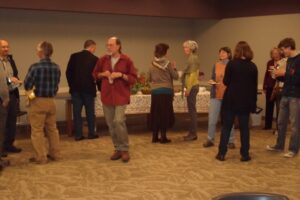
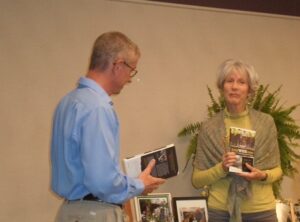
Photo by Nikki Fox for the Daily News-Record, April 21, 2015.

HARRISONBURG – Les Grady thinks the first step to slowing down climate change is simply talking about it.

“Bringing up climate change in a polite society stops the conversation,” said Grady, member of the steering committee for the advocacy group Climate Action Alliance of the Valley. “We just don’t want to think about it, because we feel really helpless.”

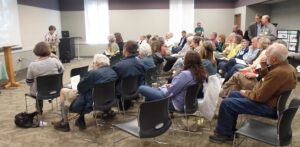
The licensed professional engineer, who has taught environmental engineering at Purdue and Clemson universities, spoke to about 30 people Monday about addressing and alleviating the effects of climate change to commemorate Earth Day, which is Wednesday. The event was held at Massanutten Regional Library’s main branch in Harrisonburg.

Grady has also worked part time for the last two decades for CH2MHILL, the world’s largest environmental engineering consulting firm.

While 97 percent of climate scientists agree that warming trends of the last century are likely due to human activities, he said, a new study from Yale University shows that only 52 percent of Americans are concerned about climate change.

Skeptics argue that the Earth experiences natural shifts in climate, and any perceived changes aren’t being driven by the burning of fossil fuels.

Grady said the first thing to recognize when it comes to climate change is that a variety of research sources confirm its existence – not just temperature records.

“In fact, temperature records are probably the least reliable in the sense of indicators,” he added, due to natural variability and the fact that only about 1 percent of the Earth’s heat is in the atmosphere.

The oceans contain most of the planet’s heat. According to research from the National Oceanic and Atmospheric Administration, oceans’ heat content has risen almost continually since the mid-1990s.

Accepting climate change as reality also means accepting the role carbon dioxide plays in exacerbating it, Grady said.

As rising carbon dioxide levels contribute to higher temperatures, precipitation and sea levels also increase, Grady said.

“The more carbon we put into the atmosphere, the warmer it’s going to be,” he said.

Developing countries in Africa, South America and Indonesia are more vulnerable to issues stemming from climate change because they don’t have the economic resources to deal with the problems it presents, Grady said.

“Many people say this is a moral and ethical question, because their contributions to the problem are negligible – they haven’t emitted very much carbon dioxide,” Grady said.

Grady listed steps people can take to help address climate change in their own lives.

In Virginia, he said, transportation is the major source of carbon dioxide emissions, followed by electricity generation through the burning of coal. While anyone can make changes to their transportation and electricity use, Grady said the political process is crucial in persuading energy providers to follow suit.

“We as citizens need to be active,” he said. “State electric generators really have not done very much, nor are they planning to, about this problem.”

He also encouraged attendees to calculate their carbon footprint using programs found on the Environmental Protection Agency’s website.

But the main course of action Grady advocates is implementing a carbon fee and dividend.

“We allow all of us to dump the waste from burning fossil fuels into the atmosphere,” he said.

A better solution, he said, is to charge households a fee commensurate with the impact of their carbon footprint, “so that when we buy it, we’re not socializing those costs anymore; they become privatized, just like the profits are.”

Contact Elaina Sauber at 574-6278 or esauber@dnronline.com

Climate News Roundup 4/10/2015

  • Doug Hendren has a new song entitled “Fracking’s Just a Bad Dream.”
  • Here is a brief, hopeful essay about why the “Merchants of Doubt” will lose in the end.
  • In a Guardian column, economics editor Larry Elliott asks “Can we imagine a future that is cleaner, greener and sustainable – one that avoids climate Armageddon – without abandoning the idea of growth and, thus, forcing living standards into decline?” To see what he concludes, go here. It is a very thought-provoking essay.
  • Libertarian science writer and author Ronald Bailey asks what evidence would it take to persuade you that man-made climate change is real. His essay is one you might want to share with your conservative and/or libertarian friends and relatives.
  • The Post Carbon Institute is releasing a series of four videos by Richard Heinberg in conjunction with the release of his new book, Afterburn: Society beyond Fossil Fuels. The first is here.
  • The Yale Project on Climate Change has released an interactive map that shows public opinion on a variety of climate change issues down to the county level. It is interesting to note that Rockingham County is more accepting of man-made climate change than surrounding counties.
  • The Risky Business Project issued its third report, this one on the economic impacts of climate change. This report focuses on California, particularly the impacts on agriculture.
  • The National Environmental Education Foundation is offering a free course entitled “Extreme Weather 101” through UDEMY.
  • Two members of the Natural Resource’s Defense Council staff have published a paper outlining how the federal flood insurance program can be used to encourage people to retreat from shore lines and move away from flood prone areas.
  • A new study shows that cities with extensive urban sprawl will have a difficult time decreasing their CO2 emissions from transportation, even if they increase housing in the city center.
  • The Rocky Mountain Institute, an energy policy think tank, has issued a new report on how we will get our electricity in the future. Chris Mooney has a description of the major findings from the report.
  • As Shell moves drilling equipment near Alaska, environmental groups maintain that drilling for oil in the Arctic is just not compatible with President Obama’s pledge to lead on climate change.
  • A new study confirms that significant amounts of organic carbon are stored in permafrost. While it is unlikely that they will be abruptly emitted as CO2 or methane, they are expected to serve as a continuous carbon source over long time periods.
  • One impact of increasing the CO2 content of the atmosphere is to make the oceans more acidic. BBC News summarized a recently published study that provided evidence that the Permian-Triassic mass extinction (252 million years ago), in which over 90% of marine species went extinct, was likely caused by increased ocean acidity caused by CO2 released by volcanic activity.
  • A recent study demonstrated that marine ecosystems can be disrupted by climate events on timescales of multiple decades, but recovery can require a thousand years.

These news items have been compiled by Les Grady, member and former chair of the CAAV steering committee. He is a licensed professional engineer (retired) who taught environmental engineering at Purdue and Clemson Universities and engaged in private practice with CH2M Hill, the world’s largest environmental engineering consulting firm. Since his retirement in 2003 he has devoted much of his time to the study of climate science and the question of global warming and makes himself available to speak to groups about this subject. More here.

Celebrate & Renew on Earth Day 2015

Thanks to Lee and everyone who joined us to honor this Earth Day 2015.

Here is Kelsey Erickson’s video Lee played but which got cut off a bit early:

[youtube https://www.youtube.com/watch?v=xJY2kuoMgzY]

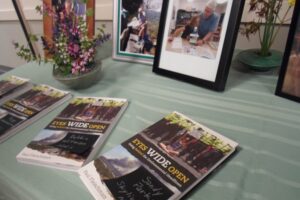
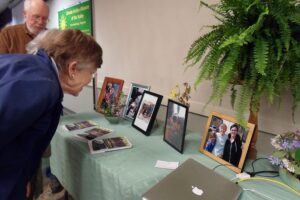
See photos from the event below.

~~~~~~~~~~~~~~~~~~~~~~~~~~~~~~~~~~~~~~~~~~~~~~~~~~~~~~~~~~~~~~~~

LeeEarthDay3.400pxWed., April 22
5:30-7:15 PM
MRL
174 S. Main St.
Harrisonburg

Climate Action Alliance of the Valley invites you to join a 35th anniversary celebration of Earth Day at Massanutten Regional Library in downtown Harrisonburg!

We’ll have:

Lee will share his experiences walking across the U.S. from Los Angeles to Washington DC last year in order to bring awareness of the challenge of climate change. We’ll also find out how this journey has inspired his current work with Beyond Extreme Energy and Loudoun 350.org.

All welcome! Free and open to the public. Bring your friends and family!

After our library program, we’ll continue the party at Ruby’s Lounge, 153 S. Main St., across the street from the library, to socialize, visit with Lee and find out more about Beyond Extreme Energy and how we can support them with their work.

In January 2014, Climate Action Alliance of the Valley collaborated with  iMatter Kids vs. Global Warming, JMU Mahatma Gandhi Center for Global Nonviolence, and the Shenandoah Group of the Sierra Club to throw a Party for Climate Action which succeeded in raising over $2300 for Lee (Jerry) Stewart to help send him on his cross country trek raising awareness for climate change issues.

See the Daily News-Record article: ‘Extraordinary Action’: Climate Alliance To Host Events April 22 In Celebration Of Earth Day, by Hannah Pitstick, published on April 21, 2015.

~~~~~~~~~~~~~~~~~~~~~~~~~~~~~~~~~~~~~~~~~~~~~~~~~~~~~~~~~~~~~~~~~

Climate News Roundup 4/3/2015

  • Let’s start with some good news.
    • Robert Shiller, a professor of economics at Yale, argues that individual actions can have a beneficial effect fighting climate change.
    • Utilities are making progress in reducing leaks from their natural gas distribution systems.
    • There was an unprecedented boom in renewables across the globe in 2014, but it still isn’t fast enough.
  • There were several interesting article in The Guardian this week.
    • A new study has shown that limiting climate change could have huge economic benefits.
    • The U.S. Episcopal Bishop said that climate change denial is immoral.
    • The drought in California is having a major impact on the state and global warming is thought to be influencing it. (The second article is from The Washington Post).
    • So far, corporate America is reluctant to sign on to EPA’s Clean Power Plan.
  • Other items of interest:
    • There is a new book examining the economic consequences of a hotter planet.
    • Two stations in Antarctica have reported what may well be record high temperatures.
    • The amount of water used for fracking gas wells is twice that used for oil wells.
    • The Washington Post has an interesting graphic showing where the world’s CO2 is coming from.
    • Polar bears were back in the news with articles discussing the impacts of a need for a change in their diet as a result of sea ice loss.
    • Blue crabs have been found further north than they typically live.
    • Ivy Main has a new post, this one about sea level rise and coastal property.

These news items have been compiled by Les Grady, member and former chair of the CAAV steering committee. He is a licensed professional engineer (retired) who taught environmental engineering at Purdue and Clemson Universities and engaged in private practice with CH2M Hill, the world’s largest environmental engineering consulting firm. Since his retirement in 2003 he has devoted much of his time to the study of climate science and the question of global warming and makes himself available to speak to groups about this subject. More here.

Climate News Roundup 3/27/2015

This week has been a very busy one in terms of the number of articles about climate change in the news. Before getting into them I want to start with a few links to bolster our spirits and give us hope.
  • Sierra Club has a really nice service you can sign up for. Called the Daily Ray of Hope it sends a picture and a thought-provoking quote to your inbox each weekday.
  • Audubon provides advice from seven environmentalists about how to stay positive in the face of perpetual bad news.
  • A new group called More than Scientists provides short videos by climate scientists explaining why they do what they do.
  • Peter Dykstra at Environmental Health News offered seven reasons to be hopeful.
  • David Roberts at Grist had a good post about a way to get power to the world’s poor without making climate change worse.
  • Cara Pike, also at Grist, had advice about how to talk with almost anyone about climate change.

On the local scene, Saturday night will mark the wrap-up of Starry Nights for 2015 with a program at Edith J. Carrier Arboretum beginning at 7:30.

Ivy Main had a new blog post about the recent General Assembly session and its impact on solar energy.

Several scientific papers were published during the past week about ice conditions in both the Arctic and the Antarctic, as well as changes in the speed of the Gulf Stream. Consequently, there were several posts regarding those papers.

  • The National Snow and Ice Data Center reported that the maximum ice extent in the Arctic was the smallest ever reported. The implications of this were discussed Derek Watkins in the New York Times.
  • University of Washington researchers have compiled data over several decades to show the progression of Arctic sea ice thinning.
  • An article in the March 27 issue of Science reported that the floating ice shelves that circle Antarctica are deteriorating. They act like doorstops holding back the flow of the land-based glaciers. While it will take quite a long time for them to lose that function, there is still concern for the long-term impacts. Articles in both the Washington Post and Scientific American discuss this.
  • A new scientific paper about a slowdown in the Gulf Stream was published on-line this week in the journal Nature Climate Change. The article is pay-walled but since I subscribe to the journal I will share the article with anyone wanting to read it. You can learn more about it at several sources, including these. Chris Mooney at The Washington Post has an article about it as does the blogger Robert Scribbler. A new video by Peter Sinclair, “A Nasty Surprise in the Greenhouse” addresses the new paper on the Gulf Stream. Finally, a video on “Forecasting Sea Level Rise in Maryland” is equally applicable to Virginia and explains how the Gulf Stream influences sea level rise.
  • While the following didn’t come out this week, I thought I should call it to your attention. People who don’t think that increases in CO2 levels in the atmosphere are causing global warming often say that there is no proof that it does. While there have been many lines of evidence to link global warming with increased CO2 levels, now there is direct proof. Scientists measured incoming radiation from the greenhouse over an 11 year period in two locations (Oklahoma and Alaska) and showed that its increase was due to increases in the CO2 level over the same period. The study was published on-line in the journal Nature on Feb 25, 2015. You can read a short summary of the research at LiveScience or read the full press release from Berkeley Labs.

These news items have been compiled by Les Grady, member and former chair of the CAAV steering committee. He is a licensed professional engineer (retired) who taught environmental engineering at Purdue and Clemson Universities and engaged in private practice with CH2M Hill, the world’s largest environmental engineering consulting firm. Since his retirement in 2003 he has devoted much of his time to the study of climate science and the question of global warming and makes himself available to speak to groups about this subject. More here.

Columnist Williams Wrong On CO2

sunColumnist Williams Wrong On CO2
Les Grady
March 23, 2015, Daily News-Record

In a recent column, Walter Williams tried to discredit the idea that atmospheric CO2 levels are causing climate change (“Climate Change a Ruse for Socialism,” March14). He did so by noting that “460 million years ago, CO2 concentrations were 4400 ppm, and temperatures were about the same as they are today,” thereby implying that CO2 levels and Earth’s temperature are not connected.

Mr. Williams failed to add that another determinant of Earth’s temperature, the sun, was weaker 460 million years ago. The sun was so weak that at least 3000 ppm of CO2 was needed in the atmosphere just to prevent an ice age. Thus, rather than discrediting the role of CO2 in regulating Earth’s temperature, his example affirmed it.

Today, the level of CO2 in the atmosphere is the highest since the development of human civilization. Humanity’s greatest challenge is stopping its increase.

Leslie Grady Jr.
Harrisonburg

Public Weatherization Meeting Press Release

Press release March 17, 2015

Public Weatherization meeting planned for Thursday, March 26, at 7:00pm at Simms Center.

Low- to moderate-income households often have a hard time balancing the costs of high utility bills with other necessities like food and medical care, especially during winters as hard as the one we just had. Joni Grady of the Climate Action Alliance of the Valley has announced that the Weatherization H/R subcommittee is working with the NorthEast Neighborhood Association, Community Housing Partners (CHP) of Waynesboro, and other local groups to begin to address this problem.

Through the federally-funded Weatherization Assistance Program (WAP) administered by the Virginia Department of Housing and Development (DHCD), Community Housing Partners’ weatherization services reduce energy costs for families by improving the energy efficiency of their homes, while also looking for and eliminating related health and safety issues.

According to Bill Beachy, VP of the CHP Energy Solutions division, an audit team completes an on-site energy audit of a home that includes a blower-door air leakage test, heating system safety and efficiency check, duct leakage examination, and estimation of insulation needs. Following the energy audit, CHP’s weatherization team performs repairs and improvements to home heating and cooling systems and provides for the installation of energy-saving measures in the house, such as improved insulation and air sealing.

CHP’s weatherization services are for low-income families, particularly for households with elderly residents, individuals with disabilities, and families with children. Households are typically qualified based on income and recipients must be residents of the state of Virginia.

Meghan McMillen and Karen Vincent from the Waynesboro CHP office will explain the program at the public meeting Thursday evening, March 26th at 7:00. Karen Thomas, head of the NorthEast Neighborhood Association urges any residents who believe they might qualify to come to the Simms Center, 620 Simms Avenue, Harrisonburg, to learn about the program and how to apply for it.

Climate News Roundup 3/20/2015

Below is a roundup of things I’ve seen this week that I thought you would find of interest.
  • Northeast Neighborhood Association Public Meeting on Home Weatherizing with Community Housing Partners
    Thursday, March 26, 7:00PM, Lucy F. Simms Center, 620 Simms Ave., Harrisonburg

    If you qualify as a low-to-moderate income household, Community Housing Partners can help reduce your energy bills, make your home more comfortable, energy efficient and affordable year round. Clients approved for the Weatherization Assistance Program will receive a free energy audit which will determine the work that can be done in their home.

    Learn more and obtain an application. Join this Northeast Neighborhood Association meeting with representatives of Community Housing Partners and Weatherize Harrisonburg/Rockingham. This effort is being organized by CAAV, with Joni Grady chairing the committee. Please pass the word on to anyone you think might be interested.

  • If you would like to know more about the human face of climate scientists, there is a neat new website you can go to.
  • As part of the Reel Change Film Festival, the movie Cowspiracy will be playing free-of-charge at Court Square Theater on Wednesday, March 25 at 7:00 pm.
  • Dave Pruett has a new post on Huffington Post about Solarize Harrisonburg.
  • Doug Hendren has a new song about divestment.
  • The Wild and Scenic Film Festival will be April 18 at Blue Ridge Community College in Weyers cave.
  • The Guardian has a petition urging the Bill and Melinda Gates Foundation and the Wellcome Trust to divest from fossil fuels.
  • The Guardian also had an Article about the true costs of fossil fuels that is based on a research paper in Climatic Change.
  • Not all oil is alike, so where oil comes from has a big impact on the emissions from its use.
  • The Union of Concerned Scientists has an infographic on climate science vs. fossil fuel fiction.
  • In 2014, for the first time in 40 years, the global CO2 emission rate did not increase.
  • Changes in refrigerants to reduce their potency as greenhouse gasses shows that nothing is simple.
  • Scientists have found evidence for possible warm water channels under East Antarctic glacier.
  • At the same time, sea ice in the Antarctic has been growing.
  • The maximum Arctic sea ice extent this winter is the smallest ever measured.

These news items have been compiled by Les Grady, member and former chair of the CAAV steering committee. He is a licensed professional engineer (retired) who taught environmental engineering at Purdue and Clemson Universities and engaged in private practice with CH2M Hill, the world’s largest environmental engineering consulting firm. Since his retirement in 2003 he has devoted much of his time to the study of climate science and the question of global warming and makes himself available to speak to groups about this subject. More here.

The Burning Question

Book Review by Les Grady
The Burning Question: We can’t burn half the world’s
coal and gas.  So how do we quit?
Mike Berners-Lee and Duncan Clark
Greystone Books, Vancouver/Berkeley, 2013
ISBN 13:9781771640077

TheBurningQuestionAs popularized in 2012 by Bill McKibben in Rolling Stone, science has made it clear that humans can put just so much CO2 in the atmosphere without causing catastrophic global warming.  This means that we must stop burning fossil fuels and leave the bulk of them in the ground.  The burning question, therefore, is how to do that without disrupting the global economy?  This book addresses that question.

Having read a bit about global energy supplies and the unimaginable quantities of energy that humans use, I have been pondering that question for some time.  Thus, I started reading this book with a great deal of anticipation, hoping for some clear guidance on the path forward.  Perhaps my expectations were too great, but they were not met.  This probably speaks more to the enormity of the task than to the quality of this book.  The authors have done a good job of pulling together a large amount of material in a logical manner and with an easily readable writing style (if one can overlook a few quizzical phrases that seem to be common to British English).  They have also been willing to speculate about technologies and strategies that might unlock the stranglehold that the fossil fuel industry has on the world, for which they are to be commended.  Thus, all in all, I recommend the book, particularly if you have only recently begun to grapple with the problem and want a good summary of all of the issues involved.

The text is 200 pages long with another 68 pages of notes and index.  It is organized into five parts comprising 19 chapters.  Both Amazon and Google Books have samples from the book, including the table of contents, so you can go to either to learn more about the organization.

Part 5, “What now?” was the part of the book that resonated most with me, and of course is what the rest of the book prepares the reader for.  I particularly liked the first chapter in it, “Waking up – Facing the facts.”  Unlike many articles you read about how to communicate with the public about climate change, these authors recommend a straight-on approach.  “Given where we are now, it’s crucial that more people hear the simple facts load and clear: that climate change presents huge risks; that our efforts to solve it so far haven’t worked; and that there’s a moral imperative to constrain unabated fossil fuel use on behalf of current and especially future generations.  It’s often assumed that the world isn’t ready for this kind of message – that it’s too negative or scary or confrontational.  But reality needs facing head on – and anyhow the truth may be more interesting and inspiring than the watered down version.”  This is a conclusion I have come to myself, so you can see why I liked this chapter.

I also liked Chapter 16, “Pushing the right technologies – hard”, perhaps because it also conveys some thoughts I’ve been having lately.  One concerns carbon capture and storage (CCS).  CCS faces some huge hurdles, both technological and physical.  For example, a physical limitation, which the authors don’t mention, is that each gallon of oil burned results in three gallons of (liquefied) CO2.  Consequently, it will be a real challenge to find sufficient appropriate subsurface space into which to put the stuff.  Nevertheless, the authors see CCS as the key to getting the big fossil fuel companies and countries on board as part of the solution.  They state “… no one is better placed to dominate the world of carbon sequestration than the big oil companies.  A plausible global market in carbon capture could therefore give some of the world’s most powerful countries and companies – and the companies with the most to lose from scaling down fossil fuel use – a powerful incentive to support climate legislation.”  While this idea will doubtless grate on some who view the fossil fuel industry as the enemy, there could well be some wisdom in it.  We need to be focused on the main objective – reducing CO2 in the atmosphere – and if this requires some uncomfortable compromises, so be it.

Another uncomfortable compromise that Berners-Lee and Clark think bears consideration concerns nuclear energy.  “The key point about the nuclear debate, therefore, is that we shouldn’t allow it to distract us from the question of how to leave fossil fuels in the ground.  That said, it is important to ask whether nuclear should be part of the energy mix that replaces fossil fuels, ….”  After admitting the well-known downsides of nuclear, they then point out that France converted almost all of its electric generating capacity to nuclear in only 11 years, demonstrating that rapid deployment is, indeed, possible.  Furthermore, “… most mainstream energy analysts believe that rejecting nuclear would make an already difficult task even tougher and more expensive ….”  They go on to say, “Our own view, given the profound threat of climate change, is that we’d be foolish to limit our options.  At the very least campaigning against nuclear seems like an odd use of time and effort.”  Finally, after more discussion of the new generations of nuclear reactors they conclude “Both in terms of technology and what’s at stake, the context of the nuclear discussion is very different today from how it was a few decades ago and at a minimum it is important that all those with long held views consider the issue with fresh eyes.”  To which I say, Amen!

The concluding chapter of the book deals with the fact that we all have a role in solving this problem.  No efforts are too small.  Rather than all of us taking on the responsibility to act, “we could keep on as we are: ignoring or playing down the risks and putting responsibility for action elsewhere.  But that would mean taking a monumental gamble with our children’s future, and a species as intelligent as ours surely wouldn’t do that.  Would it?”

The Burning Question poses many interesting questions.  Hence it is well worth reading if you are concerned about how to address the root cause of climate change, our use of fossil fuels.

The views expressed are mine alone and should not be interpreted as the views of the Climate Action Alliance of the Valley or its Steering Committee.

March 2015

I Am One Of The Alarmed

Daily News-Record (Harrisonburg, VA); March 3, 2015
Open Forum
Leslie Grady, Jr.

fuelalarmAmericans can be divided into six groups, depending on their concern about climate change, ranging from the Alarmed to the Dismissive. I belong to The Alarmed.

I am an engineer. For more than 40 years I taught, conducted research, and published in engineering and science journals. I also was a consultant to major chemical companies and was employed by a large environmental engineering consulting firm. So how can I be among the Alarmed?

The birth of our granddaughter in 2005 focused my attention on global warming because I realized that if the scientists were right, she would experience significant human-caused climate change during her lifetime. To educate myself I first read two books, both written by scientists, that summarized the state of climate science. Then I began to read papers from the scientific literature, as well as additional books and documents prepared by expert groups convened by the National Academy of Sciences and the Intergovernmental Panel on Climate Change (IPCC).

I have a sound layman’s understanding of climate science. That understanding convinces me that humanity faces dire problems if we do not move rapidly and efficiently to limit atmospheric emissions of carbon dioxide from fossil fuels. Since we are currently doing little, yes, I am alarmed.

An important finding in the latest IPCC report is that Earth’s warming is directly proportional to the total amount of fossil fuel-derived CO2 put into the atmosphere. This sets an upper limit on the CO2 we can emit while staying within a given degree of warming, i.e., it sets a CO2 budget. Governments worldwide have agreed to limit global warming to 3.6 degrees. At the current rate of CO2 emissions, the budget associated with that limit will be reached in around 25 years, a very short time within which to make major changes in our energy economy. This is another cause for my alarm.

If we immediately start significantly reducing our emission rate we extend the time before the limit is reached. PricewaterhouseCoopers estimates that if we cut our emissions per unit of GDP by 6.2 percent a year we can achieve zero emissions by 2100 while staying within the 3.6-degree limit. Although this is a steep cut, it still gives me hope.

I love modern society and all the benefits that readily available and “inexpensive” fossil fuels have brought us. However, fossil fuels have only been inexpensive because their users don’t pay their full costs. Rather, they are borne indirectly by society through the impacts of climate change. The artificially low price of fossil fuels makes it difficult for alternative energy sources, such as renewable and nuclear energy, to compete in the market place. Consequently, innovation is stifled and it becomes more difficult to move ideas from the laboratory into practice.

In spite of that, many innovative things are being done that can revolutionize our energy systems if given a level playing field to compete on. These include more efficient solar cells, better energy storage devices, wireless battery charging technology, and even carbon nanotubes capable of absorbing the sun’s radiation and storing it in chemical form. Technical advances like these give me hope.

People worldwide aspire to a standard of living like ours and have every right to pursue it. However, if they do so with fossil fuels, we face disaster. Thus, we must put fossil fuels aside. This will be an enormous task, but we can accomplish it if we begin now. We must put a price on carbon. If done through a revenue-neutral fee and dividend approach, warming can be kept within 3.6 degrees and our economy can be strengthened. This also gives me hope.

Although I am willing to be called alarmed, it is time to quit the finger pointing and name-calling. It does no good to dismiss climate change as if it doesn’t exist or to rail against nonexistent conspiracies, as this newspaper does. Neither does it do any good to think the problem can be solved easily. Rather, we need to put the past behind us and create an environment where innovation can flourish.

Dr. Grady lives in Harrisonburg.

Find a link to I Am One Of The Alarmed here. A printable pdf version is here.

Les Grady is an active member of the Climate Action Alliance of the Valley Steering Committee. He currently heads up the organization’s Speakers Bureau. He served as Steering Committee Chairman from 2012 through 2014.