
Climate and Energy News Roundup – November 2024

Area Climate News

The Friendly City Food Co-op received the 2024 Valley Treasure Award from the Alliance for the Shenandoah Valley.  The award was a recognition of the co-op’s effect on the local community and beyond by offering a wide variety of organic foods from local farmers and producers. This supports the local economy and cuts down on greenhouse gas emissions.

Harrisonburg City Schools are celebrating Farm to School Week by recognizing an initiative to bring more natural foods into schools. In partnership with Vine and Fig Educational Outreach Program, a local nonprofit dedicated to educating local youth about food and gardening, they will hold several events to promote education around nutrition. These will include honoring cafeteria staff and visiting local farms.

The Central Shenandoah Planning District Commission has begun a Rural EV Charging Infrastructure Study as part of its Rural Transportation Program. The study will help strategically plan for infrastructure development by identifying optimal locations for EV charging stations, assessing grid capacity, and developing implementation strategies.

Brooke Imber, who teaches art at Keister Elementary School in Harrisonburg, received an International Society of Arboriculture Gold Leaf Award for creating a school garden called the mindfulness meadow. She accomplished this with a $30,000 grant from the Virginia Department of Forestry and $5,000 from the Harrisonburg Education Foundation along with input from students.

Our Climate Crisis

The concentration of greenhouse gases in the Earth’s atmosphere reached the highest level ever last year according to the World Meteorological Organization. The increase is linked to continuing stubbornly high rates of fossil fuel consumption. The UN reports that countries essentially made no progress in cutting emissions and tackling global warming last year.

Climate change affects where water goes. It helps to cause extreme floods and droughts. 2023 was the hottest year on record compounded by severe droughts, but it also brought devastating floods across the globe. Less recognized is that rivers dried up at the highest rate in three decades in 2023, putting global water supply at risk.

Rising costs from more frequent storms, droughts, wildfires and other extreme weather events related to climate change are confronting the U.S. with fiscal risks. It poses risks to homeowners in disaster-prone areas through soaring insurance costs and declining property values. It is also exacerbating the many financial strains on the federal government at a time when our national debt exceeds $35 trillion.

Biodiversity is declining faster than at any time in human history and the biggest drivers are habitat loss on land, overfishing the ocean, and climate change. In response, delegates from around the world are meeting in Colombia in what is expected to be the biggest United Nations biodiversity conference in history. The theme of the conference is “Peace With Nature.”

Politics and Policy

Clean energy is booming in the US but the upcoming presidential election could change that.  Donald Trump has suggested he would gut the funding, which is expected to pour as much as $1.2 trillion into technologies to fight climate change. He said, “My plan will terminate the Green New Deal, which I call the Green New Scam.”

While viewing the storm damage in Southwest Virginia, Gov. Glenn Youngkin asserted that blaming Hurricane Helene and the future unpredictability of weather on climate change was a distraction.

BP is preparing to drop an ambitious target to cut its oil and gas production by 40% by 2030 as it battles to close a valuation gap with rivals in the energy industry. Investors are pressuring BP to increase its oil and gas production and stop investing in any more “ill-conceived” wind projects.

Mexico’s new president, Claudia Sheinbaum, has promised a strong shift toward renewable energy and climate action, breaking away from her predecessor’s fossil fuel-centered policies. The goal is that renewable energy will have a 45% share of total electricity production by 2030.

Dominion Energy filed an update to its long-term electricity generation plan showing the majority of energy it expects to produce will come from renewable sources but also an increased reliance on natural gas. The revised 15 year plan drops the proposed target of using  renewable energy from 95% to 80%.

Energy

Global renewable energy capacity is set to contribute almost half of global electricity demand by 2030 according to the International Energy Agency. India and China are leading the way. China will be responsible for almost 60% of all new renewables added in this time frame.

Federal regulators gave a huge 2.8 gigawatt offshore wind project the green light to start construction off the coast of New Jersey. When completed as planned in 2028-2029 it will be one of the largest clean energy projects in the US. It still faces legal hurdles from offshore wind opponents.

The US Department of Energy hopes to meet its grid decarbonization goals by tripling our current 100 gigawatts of nuclear power to 300 gigawatts by 2050. But is that even possible? The most recent expansion of nuclear generation by Georgia Power cost more than twice its original budget and took 15 years to build, causing the original contractors to go bankrupt.

The last operating coal power plant in the UK closed last month, ending more than 140 years of coal-fired electricity. It was able to end its reliance on coal by setting legally binding greenhouse gas emissions targets, regulating air pollution, and encouraging the expansion of renewable energy.  

Five of our country’s 10 largest coal-fired power plants now have retirement dates. Coal generated 16% of the country’s electricity last year, down about half from a decade ago. It has lost market share because of rising costs. In some cases, state regulators have allowed coal-fired plants to stay open and pass high costs along to consumers.

US electric utilities are planning a huge expansion of fossil gas-plants to meet booming power demands. This is incompatible with climate goals. Most are well off track to meet the Paris Accord goal of cutting electricity-sector emissions by 80% by 2030. The growth in demand is driven by new data centers, factories, and EV cars. Utilities have been slow to develop clean energy capacity.

Building a green hydrogen production hub in Mississippi has hit headwinds. Hy Stor Energy, the company building the hub, has abruptly canceled its order for electrolyzers, an essential component of making hydrogen from renewables. A series of unanticipated complications have made it necessary to extend the time needed to develop the hub.

Amazon has signed an agreement with Dominion Energy to explore the development of Small Modular Reactors, a kind of nuclear reactor with a smaller physical footprint. The project would be near Dominion’s existing nuclear power facilities at Virginia’s Lake Anna.

Food and Agriculture

An analysis by the World Resources Institute finds that one-quarter of the world’s crops are grown in places facing high levels of water stress. These challenges could contribute to increased levels of food insecurity as climate change puts more stress on water resources. One out of every 11 people in the world already doesn’t get enough food to maintain basic health.

A changing climate takes a toll on harvests in Kenya because farmers can no longer depend on regular weather patterns. They end up planting blindly, guessing, and taking risks. Now with a basic cellphone, they can receive weekly text messages from a nonprofit called Tomorrow Now that gives them insights into the week’s weather and advice on the best farming strategies.

A Kansas State University study has shown soil treated with manure or compost fertilizer stores more carbon than soil treated with chemical fertilizers or no fertilizer. This underscores the benefits of sustainable farming by highlighting how organic compost and manure not only support the health of the soil but also directly fight rising global temperatures through carbon sequestration.

Dominion Energy is pursuing agrivoltaics—combining solar installations with agriculture. Smaller solar installations are planted with native pollinators and then include honeybee hives at the site. Larger sites include sheep grazing, and they are looking into planting crops between rows of solar panels in the future.

Warmer winters, followed by snap freezes, are making it more challenging to grow conventional fruit crops such as apples and peaches. Some fruit growers are, therefore, experimenting with growing pawpaws, North America’s largest native fruit, because of its low maintenance and adaptability.

Climate Justice

Researchers estimate tens of millions of Americans may ultimately move away from areas of our country affected by climate disasters. The South stands to be especially transformed as extreme weather and flooding make the region less comfortable and more expensive. It will leave behind large swaths of coastal and other vulnerable land where seniors and the poor are very likely to disproportionately remain.

The Lancet, a leading scientific journal, just published a survey of US youth, which found that 85% have climate distress and are concerned about how climate change is impacting their lives and futures. Almost 40% indicated that anxiety about climate change negatively affects their daily life.

Climate Action

Energy efficiency upgrades can save the average Virginia household $729 annually on utility bills. They are generally the lowest-cost way to lower electricity demand and reduce costs. It also decreases pressure on the grid, minimizing the chance of electric service disruptions.

Cities are turning to sheep to graze and maintain urban landscapes sustainably, and people love it. Urban sheepherder Zach Richardson and his Chew Crew flock in Nashville sometimes become a tourist attraction. Nashville Parks’ staff say that it’s a cheaper and more environmentally sustainable way to care for their greenspace.

All incoming first-year students at UC San Diego—no matter their major—will be required to take a climate class. They will have more than 40 courses to choose from, which will equip them with a strong understanding of climate change and how they can contribute to meaningful solutions.

Cement production accounts for nearly 7% of energy-related emissions, presenting one of the knottiest problems for reducing carbon emissions. A cement plant in Norway is now investing in technology to capture the carbon dioxide emitted in the production process.  A startup company in England is also developing a way to produce low-carbon cement from slag.

Nearly every household in American has a car. How can we break free? Nearly 70% of federal transportation dollars goes to highways while a meager 20% goes to public transit and almost none to walking and biking. Living without a car depends on creating walkable neighborhoods, mixed zoning that allows small groceries and convenience stores, and the availability of reliable public transit.

Electric vehicle sales have hit another record in the third quarter of this year, accounting for 8.9% of the total auto sales. With improving infrastructure, far more choices, and excellent deals to be had, a 10% share is well within reach.

Earl Zimmerman
CAAV Steering Committee
Climate and Energy News Roundup – October 2024

Area Climate News

Harrisonburg will add three new electric school buses to its fleet. It will own five electric buses after this purchase and has enough space to hold up to 10 in the transportation department’s garage. It plans to add infrastructure to support more electric buses in the future.

At the request of Harrisonburg’s Mayor Deanna Reed, leaders of eight local environmental groups met with her last month. She wanted the group to identify actionable items the city could accomplish in a reasonable amount of time. Four possible actions related to housing/zoning, transportation, energy, and conservation/resilience were identified. The Mayor then proposed follow-up meetings focused on defining and planning specific actions.

Valley Friends Meeting in Dayton is a national Interfaith Power and Light Certified Cool Congregation at the 80% and above reduction level. They achieved that by first replacing their old oil furnace with an energy efficient electric heat pump. They then added a solar panel installation to their roof to reduce their carbon emissions by 93%.

Our Climate Crisis

Hurricane Helene, which killed more than 100 people and caused catastrophic damage, was made worse because of global heating. Drawing energy from the warm waters of the Gulf of Mexico, it quickly accelerated to a category 4 storm before making landfall in the Florida panhandle. It then raced inland where it stalled over western North Carolina and quickly dropped more than two feet of rain over the Asheville area.

Much of our nation’s infrastructure, from highways to runways, has suffered as temperatures reached the hottest in recorded history this year. Bridges face particular risks. A quarter of them were built before 1960 and already in need of repair. Now extreme heat and increased flooding linked to climate change are accelerating their disintegration.

Coastal flooding is getting more common in most parts of the United States, as climate change causes sea levels to rise. In the last 25 years, the number of days with high-tide flooding has increased by a whopping 250% or more in many regions, including along the Gulf of Mexico, and in the Mid-Atlantic and the Pacific Islands.

Global temperatures this summer climbed to the highest levels on record. Temperatures between June and August were 1.5 degrees Celsius (2.7 degrees Fahrenheit) above the preindustrial average—just edging out the previous record set last summer.

Politics and Policy

The US presidential debate took place against a backdrop of wildfires and floods. Donald Trump flat out ignored the question about fighting climate change. Kamala Harris slammed Trump for having called climate change a “hoax” and touted the Biden administration’s investments in renewable energy. Conversely, she also applauded our record domestic gas production and reiterated her support for fracking.

After a sluggish start this year, environmental groups raised over $11 million in July, more than double their fundraising at the same time in the 2020 presidential election. The shift came as Harris replaced Biden on the ticket, energizing climate advocates to focus on swing states and key congressional races.

Major automakers are now walking back aggressive electrification goals they set just a few years ago in response to a perceived slowdown in EV interest and sales. To be clear, EV sales are up overall, and the transition away from internal combustion is still happening, just with a little less momentum than once predicted.

Various states and cities started adopting climate goals nearly 20 years ago, setting themselves on a path toward reducing emissions and rolling out clean energy. Whether they’re actually on track to meet those goals is now up for debate. Advocates across the country are now suing states and municipalities they say are failing on their climate commitments.

Donald Trump announced his intention to pull back unspent funds from the Inflation Reduction Act (IRA), a key climate law, should he win the 2024 election. The IRA is funneling billions into renewable energy projects, electric vehicles, and cleaner industry across the U.S.—including a lot of Republican-led states that could really use the cash.

Over the course of the past year, the Orange County, Virginia board of supervisors shot down multiple attempts to bring renewable energy solar installations to the area. No matter the size or location, they claim solar projects would harm the county’s rural character and agritourism industry.

After vetoing similar legislation earlier this year, the Youngkin administration is launching a green bank, with $10 million in seed funds, to fund clean energy initiatives in Virginia. Because it has no legislative guardrails, environmental groups fear that the fund will be used for Youngkin’s pet projects. 

Energy

The Three Mile Island nuclear plant in Pennsylvania, the site of the worst nuclear accident in US history, is preparing to reopen. The plant operator has signed a 20-year deal with Microsoft to purchase clean energy to power its power-hungry and rapidly expanding data centers for artificial intelligence.

The United Kingdom will shut down its last operational coal-fired power plant this month. This major milestone was made possible by the U.K.’s embrace of wind power, both on- and offshore. Over the last decade, this form of renewable energy has surged in the U.K., from generating around 8% of the country’s electricity in 2013 to 29% in 2023.

Data centers threaten to overwhelm the local ecosystem in Prince Williams County, Virginia. They already occupy 8 million square feet of space in the county. If all the proposed new data centers are built, that number could balloon to 80 million. Some predict that the amount of electricity these centers would need is enough to power five New York Cities.

Texas has become a clean energy juggernaut and plans to build the most clean energy of any state. It intends to build 35 gigawatts of clean energy over the next 18 months, more than the next nine states combined. Texas, however, still lags behind California and plenty of other states in terms of how clean its grid actually is.

Food and Agriculture

Virginia farmers struggled with drought and an incredibly long hot spell during a tough growing season this year. Beyond the drought and the heat, climate change brings weather weirding and instability including warm winter weather followed by cold snaps.

Some restaurants are forging stronger bonds with regional food systems and regenerative farms in response to our growing ecological and climate crisis. The switch to regional sourcing comes from the stark realization that many staples used in most restaurants have wreaked havoc on the ecosystems and livelihoods of people in other countries.

Cows belch methane at alarming rates but can also help farms capture more carbon in soil. Farms with a mixture of arable crops and grazing livestock store about a third more carbon within their soil and also increase biodiversity.

A 485-megawatt solar project in Spotsylvania Virginia is running smoothly today while playing host to a flock of sheep, creating new opportunities for local farmers while pumping out clean kilowatts. It almost died because fierce opposition from local residents who, it turns out, were enabled by fossil industry stakeholders.

Solar farms fight climate change and can help with another global crisis—the collapse of nature. Planting pollinator friendly plants on solar farms can decrease erosion, nourish the soil and store planet-warming carbon. They can also attract insects that improve pollination of nearby crops.

Restoration Bioproducts is opening a biochar production facility in Sussex County, Virginia. The facility heats waste wood to high temperatures in an environment without oxygen to transform the material into syngas—a combustible gas that can be used for fuel—and biochar, a charcoal-like substance commonly used to improve soil health and as an animal food additive.

Climate Justice

Productive uses of solar powered mini-grid electricity in Africa are making farmers richer and energy cheaper. Mini-grids allow rural entrepreneurs to utilize clean electricity to support their businesses and increase their incomes. They also boost revenues for rural utilities struggling to achieve profitability and maintain reliable energy services because of limited demand.

Virginia solar developers are again asking regulators to force Dominion Energy to suspend its rules that hold up mid-size projects for governments, schools and nonprofits. Under Dominion’s newer requirements for connecting solar projects, some projects could be facing up to 3.5 years of delay before coming online, with ballooning costs.

The Environmental Protection Agency, in a new initiative called the Green Bank for Rural America is channeling $500 million to nonprofit lenders, with priority given to those in the Appalachian mountain region. The funds will support community solar arrays, apprenticeships in renewable energy fields, electrified public transit, and other projects.

Climate Action

Textile waste in the US amounts to just under 6% of all municipal solid waste and is growing with the explosion of so-called “fast fashion.” That’s why no-frills Maine congresswoman Chellie Pingree is seeking to bring the fashion and textile industries into the fold of climate change discussions. It’s her effort to fight climate change one darned pair of jeans at a time.

School bus fleets are the largest mass transit system in the US and due for an upgrade. The first all-electric school bus fleet to serve a major school district started ferrying kids to class in Oakland, California this fall. The 74 buses also act as giant batteries when they’re not moving. They’re plugged in and supplying enough electricity to the local grid to power about 400 homes.

The United States Postal Service’s new EV mail truck is making its debut to rave reviews from carriers. Within a few years, the fleet will have expanded to 60,000, most of them EVs, serving as the Postal Service’s primary delivery truck.

The US Department of Energy announced $38.8 million in funding for research and development of high-impact technologies and practices aimed at decarbonizing buildings. This includes next-generation retrofits for building envelopes, lighting, and heating, ventilation, and air conditioning.

A British science agency will provide about $75 million for researchers to examine solar geoengineering ideas for artificially cooling the planet. This includes outdoor experiments of injecting particles into the air to deflect some of the sun’s radiation back into space with the goal of reducing the Earth’s temperature.

At Climate Week NYC, tech giants and real estate firms announced a new initiative asking steelmakers to deliver a total of 1 million metric tons per year of ​“near-zero emissions” steel to North America by 2028.

EV charging stations aren’t just better for the environment, they’re also cash cows for nearby businesses. The 15-60 minutes that people wait to charge their car gives them time to grab a drink, a bite to eat, or do some quick shopping.

Earl Zimmerman
CAAV Steering Committee

Climate and Energy News Roundup – September 2024

Area Climate News

The JMU Center for the Advancement of Sustainable Energy is hosting a local tour as part of The American Solar Energy Society’s National Solar Tour. The tour will take place on Saturday, October 5th from 1pm to 4pm. Click here for more information and to register.

The JMU Environmental Management Club is organizing a climate march on Friday, September 20th from 1:00pm to 3:00pm. Marchers will meet in front of Wilson Hall on JMU’s campus, march to the Rockingham County Courthouse in downtown Harrisonburg, listen to a few speakers, allow time for an open mic, and return to campus. People from the community are invited to participate.

Steven David Johnson is a conservation photographer and a professor of visual and communication arts at Eastern Mennonite University. He described his conservation photography as “nature photography, PLUS.” The “plus” part is environmental advocacy, and an ecosystems approach. His photographs have appeared in the Nature Conservancy and Virgina Wildlife magazines as well as the children’s magazine Ranger Rick.

Shenandoah Valley Faith & Climate and Climate Resilience Trainings organized a viewing of The Grab, a documentary film at Court Square Theatre in Harrisonburg on Sunday, August 18. The film exposes how governments, private investors, and mercenaries are reacting to our climate crisis by seizing food and water resources at the expense of entire populations. The group of 22 people then met in an outdoor setting to discuss the film and propose concrete actions.

Our Climate Crisis

While we have become preoccupied with severe summer heat and drought, winter is actually warming considerably faster over most of the earth. Here in the central Shenandoah Valley winter is warming about 1.8 times faster than summer. Our summer temperatures are warming about 0.36 degrees per decade while our winter temperatures are warming about 0.64 degrees per decade.

Vermont keeps flooding and experts say the state could see catastrophic events like these for the foreseeable future. Climate change is fueling stronger, more persistent storms and a combination of factors leaves the state susceptible. Among them are random, short-term natural weather patterns fueled by a warming atmosphere, water saturated soil, and mountainous terrain.

Politics and Policy

The US is now pumping more oil than any country ever has even though President Biden had campaigned on a pledge of “no more drilling.” No president since 2008 has slowed the U.S. oil boom. While Donald Trump argues that Biden and Harris have waged “a war on energy,” the Biden administration actually gave more permits to drill on federal lands than the Trump administration had, partially because a federal judge blocked efforts to pause permits.

Kamala Harris brings hope for a new chapter in climate action if she wins the presidential election. At a campaign event in North Carolina she said, “When we invest in climate, we create jobs, we lower costs, and we invest in families.

Democratic vice-presidential candidate Tim Walz quietly emerged as one of the nation’s most forceful advocates for tackling climate change. As governor of Minnesota, he signed a law requiring the state to get all of its electricity from wind, solar and other carbon-free sources by 2040.

World leaders are worried about the US climate role if Donald Trump wins the presidential election. They are, therefore, strategizing to maintain climate initiatives and international agreements in his potential second term. “He will be a domestic and international climate wrecking ball. It would be malpractice to be unprepared,” says climate advocate Alden Meyer.

The U.S. Congress has 100 representatives and 23 senators who are climate deniers. Together, they wield significant influence on public perceptions of climate change as well as on the speed and direction of climate policy in the United States. They have received $52 million in lifetime campaign contributions from the fossil fuel industry.

Eighteen House Republicans recently wrote to Speaker Mike Johnson, warning him against fully gutting IRA clean energy incentives as their party works to repeal the law. They’re concerned that doing so could upend energy projects already under construction and jeopardize billions of dollars of investments, including some in their districts.

The 2024 Democratic Party platform makes the case that addressing climate change is not only vital for the environment but also crucial for economic growth. Framing climate action as an economic win could attract voters wary of environmental regulations. This is in sharp contrast to Republican arguments that addressing climate change will hurt the middle class.

Energy

Supercharged by the IRA climate law, public and private clean energy investment in the US soared in the first half of this year—hitting $147 billion, more than a 30% jump from the first half of 2023. The yearly total grew from $78 billion in 2018 to $247 billion in 2023. Clean energy jobs grew at more than twice the rate of overall US employment.

Wind generated more electricity than coal across the US in March and April, outstripping the dirtiest fuel for two consecutive months for the first time. From 2000 to 2024, total coal capacity in the United States dropped by nearly half, while wind capacity increased by more than 60 times. Natural gas capacity nearly tripled during that time as it started to replace coal.

Solid-state batteries—which pack more energy into each unit of volume than current lithium-ion batteries—have long felt just out of reach. Samsung has now announced that it will produce solid-state batteries for use in high-end vehicles by 2027. The vehicles would be able to travel more than 600 miles before needing to be recharged.

Startup company Solarix plans to invest $63 million to build a solar panel manufacturing facility in Bedford County outside of Lynchburg. The company hopes to support Virginia’s renewable energy needs and reduce reliance on solar panels from other countries. CEO Carlos Class said, “As a 100% American-owned and managed company, we are immensely proud to contribute to our nation’s energy independence.”

United Airlines is starting to use a small percentage of sustainable aviation fuel (SAF) for its operations around the world. It recently purchased up to 1 million gallons for flights at the Chicago airport, a meaningful expansion of SAF use in the U.S. Despite this progress, only 0.1 percent of United’s overall fuel use currently comes from SAF.

Despite its efforts to expand renewable energy, India is relying on its coal-fired plants in response to major energy demand from its growing population and greater cooling needs because of extreme heat. It also has plans to add more coal plants. The country’s coal demand rose nearly 10% in 2023, the biggest jump by percentage for any country.

Northern Virginia will benefit from tens of millions of dollars in federal funding for grid battery energy storage for data centers. Clean energy advocates hope this program can help address the rising energy demand from data centers without the need for new energy generation from fossil fuels.

Dominion Energy’s wind farm project, off the coast of Virginia, will be the largest U.S. offshore wind project when completed—it is expected to be operational in 2026. The project has helped to build out the weak US supply chain and jump-start the flagging offshore wind industry.

Generative A.I. can do a lot but also needs a lot of energy. A query to ChatGPT requires nearly 10 times as much electricity as a regular Google search. Data centers account for about 1-2% percent of total electricity demand, which is estimated to increase to 3-4% by 2030. Yet some make the case for A.I. as a green technology that, if used wisely, could reduce greenhouse gas emissions by 5-10% by 2030.

Climate Justice

Progress toward expanding global food access is backsliding—a big reason is our warming world. About one in 11 people worldwide went hungry last year, while one in three struggled to afford a healthy diet. Governments are increasingly challenged to achieve the goal of eradicating hunger.

Psychiatrist Lise van Susteren began thinking about climate anxiety and mental health almost 20 years ago. She has helped organize two professional organizations, surveyed thousands of children and concluded that it’s perfectly normal to be freaked out. “On a good day, I’m angry,” she says . “Being angry is actually one of the healthiest emotions that you can have.”

Appalachian Community Capital in Southwest Virginia  is using half a billion dollars in funding from the EPA to launch the Green Bank for rural America. It will leverage that money to fund more than 2,000 green energy projects, creating 13,000 jobs. Projects will be prioritized in Appalachia as well as other rural areas, including those with communities of color and Native populations.

Climate Action

The U.N. Food and Agriculture Organization says up to 31% of all food gets wasted. Food waste is estimated to cause between 6 to 8% of global greenhouse gas emissions. Jonathan Foley, executive director of Project Drawdown, calls it, “One of the biggest — and dumbest — environmental problems we have today.”

Virginia is receiving two federal grants to capture climate changing emissions. The funds, about $150 million from the U.S. Environmental Protection Agency, are focused on capturing methane from mined lands and on promoting natural solutions to capture carbon. This is part of a collaborative effort going to The Nature Conservancy’s operations in Virginia.

A big challenge in the clean energy transition is mining the minerals needed to manufacture the batteries for EVs, electric grid batteries, and other applications. Even so, mining for these minerals does not even get close to our extraction of fossil fuels. An analysis lays out a path from extraction to circularity where we may even avoid mineral extraction altogether by 2050.

A huge EV battery recycling facility came online in Ohio and another wing of the facility is slated to be operational by 2026. At full scale, the recycling plant will be able to churn out enough battery-grade metal salts to power 250,000 new electric vehicle batteries every year.

Loam Bio, an Australian start-up is hoping fungi can pull carbon dioxide from the air and stash it underground. As they sow their crops, farmers are adding a pulverized dust of fungal spores. The fungus latches on to the crop roots, takes carbon that is absorbed by the plants from the air and locks it away in the soil.  

Using sheep to mow and maintain solar installations is a booming business in Texas. One company is scrambling to get 6,000 sheep to maintain 10,000 acres of solar fields. Using sheep as a vegetation maintenance crew is a win-win. It is a profitable business that reduces the cost of maintenance, while improving the soil and increasing biodiversity.

The Chinese company COSCO Shipping has launched what it calls the “world’s largest” river-to-sea fully electric container ship. It can save 8,600 pounds of fuel for every 100 nautical miles traveled, cutting carbon dioxide emissions by 12.4 tons. This is good news because shipping is currently responsible for 3% of global emissions annually and could easily triple by 2050 if nothing is done.

Earl Zimmerman
CAAV Steering Committee

Climate and Energy News Roundup – August 2024

Active Hope is not wishful thinking. Active Hope is not waiting to be rescued by the Lone Ranger or some savior. Active Hope is waking up to the beauty of life on whose behalf we can act. We belong to this world. –Joanna Macy & Chris Johnstone.

Area Climate News

The Climate Action Alliance of the Valley is a 2024 Clean Virginia Community Giving Program recipient. The $75,000 grant will help fund their Climate Justice Outreach and Engagement effort, which is an ongoing collaboration with CHP Energy Solutions. In 2023, they were able to work with four local nonprofits to parlay a $35,000 grant into more than $250,000 of weatherization and energy efficiency investment in more than 20 energy-burdened homes.

Harrisonburg will apply for an Environmental Protection Agency grant aimed at helping disadvantaged communities reduce pollution and make neighborhoods more resilient to climate change. The city will be the lead applicant along with Church World Service and the Northeast Neighborhood Association. Other groups and organizations may still be added as partners after the grant has been awarded.

The Virginia Department of Rail and Public Transportation will be expanding the Virginia Breeze bus lines with a new east-west route connecting Harrisonburg and Virginia Beach in 2025. This bus route called the Tidewater Current will be the fifth Virginia Breeze route. Another route serving Harrisonburg is the Valley Flyer traveling from Blacksburg to Washington, D.C.

Our Climate Crisis

June 2024 marked the 12th month of average global temperatures reaching 1.5°C above pre-industrial levels. It was also warmer than any previous June in the data record at 0.14°C above the previous high set in June 2023. The extreme heat is wilting and burning forests, making it harder to curb climate change. 

Another year of heat and floods has spurred China to make adapting to extreme weather a policy priority. This summer has begun with a massive emergency response effort in multiple provinces to prevent extreme heat and flooding, now routine, from turning into a political and humanitarian crisis. China is now building two-thirds of the world’s wind and solar projects.

Hurricane Beryl, which hit Houston as a Category 1 hurricane, knocked out power to more than 2 million people and dumped nearly a foot of rain in parts of the city. The flooding and destruction are expected to drive up insurance costs in a city that already pays more than twice the national average. Climate change is making such severe weather events more common.

Politics and Policy

A Trump appointed federal judge reversed the Department of Energy’s freeze on new liquefied natural gas export approvals, handing a win to the oil industry and a coalition of 16 Republican-led states that had challenged the Biden administration plan. The U.S. is the largest LNG exporter in the world and has plans to more than triple its export capacity.

Despite record-breaking heat and rising public concern, the Republican National Convention focused on expanding fossil fuel use while dismissing climate science. Former President Trump joked, “Global warming is fine. In fact, I heard it was going to be very warm today. It’s fine.”

The Biden administration is awarding nearly $2 billion in grants to help restart or expand electric vehicle manufacturing and assembly sites in eight states including Virginia. The grants cover a broad range of the automotive supply chain, including parts for electric motorcycles and school buses, hybrid powertrains, heavy-duty commercial truck batteries and electric SUVs.

The United Kingdom’s new Labor government has confirmed a legislative agenda with the environment “front and center.” This recognizes the urgency of the global climate challenge, the job opportunities that can come from leading the development of new technologies of the future, and as ways to reduce the cost of living.

JD Vance, Donald Trump’s newly selected running mate, has come under scrutiny for his climate skepticism. He is a staunch supporter of the oil and gas industry and an opponent of renewable energy. He has only held such views in recent years, a shift that coincides with his bid to have Trump choose him to be his running mate.

A right-wing policy think tank sponsored by The Heritage Foundation recently touted Project 2025, a policy blueprint that seeks to fundamentally restructure the federal government in a Republican administration. It would undermine our country’s extensive network of environmental and climate policies and alter the future of American fossil fuel production, climate action, and environmental justice.

We’re saying goodbye to the first climate president ever as Joe Biden has dropped out of the 2024 presidential race. He has done more to support clean energy than any president before, giving the U.S. a fighting chance to cut emissions at the speed climate change demands.

Kamala Harris has captured the support of a key coalition of progressive, youth-led and environmental justice-focused climate advocates, with the Green New Deal Network endorsement of her candidacy. It’s a boost for Harris from members of a voter segment that will be key to victory in November. On the other hand, it’s fodder for the Trump’s campaign strategy of painting Harris as a radical leftist who will block U.S. oil and gas development.

Speaking at the Inter-American Development Bank, U.S. Treasury Secretary Janet Yellen said that $3 trillion in new capital is required each year to combat climate change. “Neglecting to address climate change and the loss of nature and biodiversity is not just bad environmental policy. It is also bad economic policy,” she said.

Energy

The US has become one of the world’s leading oil exporters, elbowing aside classic petrostates like the UAE and Kuwait. No country in history has extracted as much oil as the US has in each of the past six years, and US gas production now tops the global charts, having surged 50% in the past decade. Louisiana has become ground zero for exporting oil and gas.

Renewable energy sources accounted for 29.1% of electricity generation globally in 2022. The other 70.9% came from fossil fuels, nuclear energy, and pumped storage. Last year, however, renewables accounted for nearly 86% of new electricity capacity worldwide.

Google’s greenhouse gas emissions have surged nearly 50% over the past five years due to the energy demands of its growing AI technologies. The environmental cost of AI cannot be ignored even as it promises transformative benefits for various sectors, including healthcare, transportation, and climate modeling. The huge surge in emissions raises serious questions about the sustainability of tech-driven solutions and the industry’s role in climate change.

Electrical grid reliability is becoming an increasing challenge in the US in what is being described as a “hyper-complex risk environment.”This includes: 1) rapidly increasing electrical demand from data centers, electric vehicles, and electrification in general, 2) increasing extreme weather events related to climate change, 3) the increasing adaptation of wind and solar energy, which is intermittent, and 4) the inertia of the regulatory environment.

Dominion Energy acquired a second offshore wind project area that could put the utility closer to achieving renewable energy goals of the Virginia Clean Economy Act that seeks to decarbonize the electric grid by mid-century. The 40,000-acre lease area off the coast of North Carolina adjacent to Virginia could produce 800 megawatts of electricity.

Fervo Energy has landed a massive contract for providing geothermal power to the California grid. The company uses a fracking technique to break up rocks, drive water through them horizontally, and collect the resultant steam to drive turbines at the surface. They believe this method can change the geothermal landscape because it could work in many locales—not just those where hot rocks are close to the surface like in Iceland and New Zealand.

Battery installations in the U.S. are on track for the best year ever. Overall storage installations—meaning utility-scale, home, and commercial projects—grew 84% in the first quarter. Grid battery installations grew even faster. It is projected that the U.S. grid battery fleet will nearly double in 2024.

Climate Justice

Researchers estimate that global income will be reduced by 19% because of the carbon we have already emitted. This is due to falling agricultural yields, labor productivity, and harm to existing infrastructure. Poor countries least responsible for climate change are predicted to suffer income loss that is 60% greater than the higher-income countries.

Facing gentrification and climate change, an historic African American community outside Charleston, S.C., is embracing conservation as a way to preserve its historical character. Community leaders are considering forestry projects, land trusts and greenbelt initiatives, which prohibit development. Sustainable forestry also offers landowners a way to make money from their family’s land without selling to a developer.

Textile waste is an urgent global problem. Only 12% is recycled worldwide and only 1% of castoff clothes are recycled into new garments. The problem is especially pressing in China, the world’s largest textile producer and consumer, where most textile waste ends up in landfills. Cheap unrecyclable synthetic clothes, produced from petrochemicals that contribute to climate change, air and water pollution, account for 70% of domestic clothing sales in China.

Climate Action

A half-mile-long, 1.3 megawatt pilot project of covering an irrigation canal with solar panels on tribal land in Arizona shows the benefits of covering the thousands of miles of such waterways in the US. Studies suggest this has the potential to help canals do their jobs better; an over-the-canal design can prevent water from evaporating and inhibits algae growth.

Elizabeth Bagley, the managing director of Project Drawdown, makes the case for discussing climate change with kids and shares tips for approaching the topic in a way that inspires hope instead of fear. She writes, “Talking to children about climate change is not just about educating them on the science. It’s about empowering them to be part of the solution.”

Weatherizing your house—caulking, sealing, and installing insulation—is an important strategy not only for getting greater value out of heating and cooling systems but also for contending with increasingly prevalent extreme temperatures. If you are considering switching to an energy efficient electric heat-pump system, weatherizing your house first can reduce the size of a heat pump needed, saving you thousands of dollars upfront and costing less to run.

Our food systems account for one-third of global greenhouse gas emissions. “There isn’t a single silver bullet solution that addresses climate change in the food system,” writes Jonathan Foley, a climate scientist and the Executive Director of Project Drawdown. “Vegan diets won’t solve it alone. Neither will regenerative agriculture or improved fertilizers. Instead we must use a whole portfolio of solutions and deploy them in tandem.”

Self-installed, plug-and-play solar panels are popping up in yards and on balcony railings across Germany, driven by bargain prices and looser regulations. More than 500,000 of the systems have already been set up and in the first six months of the year, enabling the country to add nine gigawatts of photovoltaic capacity.

Earl Zimmerman
CAAV Steering Committee

Climate and Energy News Roundup – July 2024

Beliefs do not change our actions. Actions change our beliefs. Do you believe there is nothing you can do to make a difference? Logical. Do you fear the future? Understandable. Do you feel stressed about climate change? Sensible. However, stress is your brain telling you to act. Stress is a signal; it is urging you to do something. Not only do actions change your beliefs, your actions change other people’s beliefs. —Paul Hawken

Our Climate Crisis

More than 1.5 billion people — almost one-fifth of the planet’s population — endured at least one day this year when the heat index topped 103 degrees Fahrenheit, the threshold the National Weather Service considers life-threatening. It was much worse in some major cities around the world such as Bangkok and Delhi. Heat is the deadliest form of extreme weather.

Amid what will likely be a record-breaking hot summer in the U.S., health experts are stepping up warnings about the risks that extreme temperatures pose to children. From how they sweat to how they breathe, young people process high temperatures differently than adults. Recent studies also show heat’s negative effects on learning, sleep and mental health.

Flooding has gotten increasingly severe in an era of extreme weather and now costs the U.S. economy an estimated $179.8 to $496 billion per year. Florida and Louisiana are grappling with insurers fleeing their states amid rising hurricane-related hazards like inland, coastal and storm surge flooding. Homeowners are being squeezed by increasing insurance prices.

Local Climate News

A short video about JMU ISAT professor Wayne Teel’s ebike commute won first place in the EPA’s EV Transportation Video Challenge in the Personal Mobility category. (Scroll down on the linked website to see the video). Local filmmaker Wade Puffenbarger interviewed Wayne about his daily 8 mile ebike commute from Keezletown to the JMU campus. Wayne says that traffic planners underestimate the potential sea change ebikes could bring to personal transportation in the U.S. if safer routes to common destinations become available to people on bikes.

Charlottesville Area Transit plans to convert to a zero-emission electric and hydrogen-electric fuel cell public transit fleet by 2040. The transit agency, serving a city of 45,000, is matching the zero-emissions goals of larger counterparts in New York, Chicago and San Diego. The Charlottesville based Community Climate Collaborative (C3) is celebrating this as a win in its advocacy for clean energy in the city.

An energy company with a rocky 1.8 MW solar facility at The Village at Orchard Ridge retirement community in Winchester, Virginia, had challenges with mowing without breaking equipment or the solar panels.  It therefore contracted with a farmer to maintain the landscape with grazing sheep and pigs.

Politics and Policy

Virginia Gov. Glenn Youngkin is circumventing the state legislature to upend climate policy. While climate advocates are confident that Youngkin’s moves will be tossed by courts or reversed by the next governor, that could take years. In the meantime, Youngkin has withdrawn Virginia from the Regional Greenhouse Gas Initiative and rolled back clean car standards. He’s also locking in place new gas-powered electric power plants for decades to come.

As California grapples with a budget shortfall, Governor Gavin Newsom and state lawmakers have proposed slashing hundreds of millions of dollars for clean alternatives to help with grid emergencies. The much larger pot of money directed to fossil-fueled power plants and backup generators—which don’t fit into the state’s clean energy plans—keeps flowing.

New York City, the most heavily congested city in the United States, had a plan to charge drivers entering lower Manhattan a $15 toll. This was expected to raise $1 billion a year for public transportation while also reducing air pollution. Similar schemes have been adopted in other major cities, including London, Singapore, and Stockholm. Gov. Kathy Hochul then abruptly derailed the plan because of feared political pushback from suburban voters.

Green parties in the European Union have lost significant ground in the latest elections, prompting concerns about the future of the Green Deal and climate policies. They dropped from fourth to sixth place in the European Parliament, with their vote share nearly halved in Germany. Conversely, a Green-Left coalition appears to have narrowly beaten the far-right for first place in the Netherlands.

Donald Trump delivered a campaign-style energy address during a day of meetings with congressional Republicans. He hit on his trademark themes like “drill baby drill” and pledged to reverse Biden administration policies he said hamper fossil fuel development and favor electric vehicles.

Energy bills in the United Kingdom were £22bn higher over the past decade than they would have been if successive Conservative governments had not cut the “green crap” by rolling back climate policies for areas such as insulating homes, new home building standards and onshore wind and solar growth. This also raised net gas imports by a third, making the UK more reliant on gas imports and leaving customers more exposed to high gas prices.

The U.S. Supreme Court has overturned the Chevron doctrine, thereby gutting federal environmental protections. This could send a “convulsive shock” to decades of federal environmental, financial, and healthcare regulations.

Energy

The International Energy Agency reports that global investment in clean energy will hit $2 trillion this year, with solar power receiving the most funding. For every dollar going to fossil fuels today, almost two dollars are now being invested in clean energy.  This massive influx of capital into clean energy sectors underscores the growing recognition of the economic and environmental benefits of renewable energy.

West Virginia is attracting diverse energy producers including green energy investments that leverage federal incentives to support former mining communities. “We embrace all forms of energy and want to continue to be one of the world’s leaders in providing power for making people’s lives better and producing more products and equipment,” says West Virginia Secretary of Economic Development Mitch Carmichael.

Fossil gas production in the U.S. rose by 40% from 2015 to 2022 but methane emissions from gas extraction fell by 37%, according to a study of Environmental Protection Agency. This is both bad news and some good news. If oil and gas extraction isn’t about to disappear, then making it as clean as possible is at least a partial win for the climate.

The hotly contested Mountain Valley Pipeline was given the go-ahead by the Federal Energy Regulatory Commission to start operating, six years after construction began at more than double its original estimated cost. The environmental group Appalachian Voices put out a statement saying that by allowing the pipeline to proceed despite all the hazards it poses, the system meant to protect our communities, land and water has failed.

Construction has begun on a 73-acre hub facility for offshore wind in Brooklyn. It will receive and ship out the enormous wind turbines that will be installed in the Atlantic Ocean. When completed it will be one of the largest dedicated hubs serving offshore wind, a crucial energy industry that’s slowly emerging in the United States.

Despite past failures, the Biden administration is betting big on nuclear power. Energy Secretary Jennifer Granholm is emphasizing the need to triple nuclear energy output by 2050 to meet climate targets.

Dominion Energy officials say their $1.2 billion plan to extend the life of two half-century old nuclear power plants in Virginia is on schedule and on budget, although the process is more complicated than they anticipated.

AI-enabled activities such as ChatGPT or AI-enhanced internet searches take a lot more data processing than a regular internet search or scroll. This involves more data centers—and more electricity to power them. Analysts predict that data centers could account for as much as 9% of U.S. energy demand by 2030. New solar and wind energy will meet about 40% of that new power demand while the rest will come from a vast expansion in the burning of natural gas.

Climate Justice

Indigenous communities seek to make the drive toward clean energy work for, not against, them. Rather than clean energy as a new type of ‘clean’ colonialism, there’s another path toward making the energy transition more just, sustainable and equitable through partnerships with Indigenous communities.

A recent study shows that almost 3 million Americans live in coastal communities with critical infrastructure at risk of monthly disruptive flooding due to sea level rise. Sea level along the coastline is projected to rise, on average, around 10 to 12 inches by 2050. The burden will not be equal: more than half the critical assets facing frequent flooding are located in communities already disadvantaged by historic and current structural racism, discrimination and pollution.

Dominion Energy has plans to build a new natural gas peaker plant in Chesterfield County, Virginia, where an old coal plant once operated. The minority community in that location has dealt with the environmental and health impacts of the coal plant for the past 80 years. Residents don’t want this plant and are doing what they can to stop it.

Climate Action

Henry County, Virginia, is looking toward a greener future by reducing energy consumption, with the goal of becoming carbon-neutral by 2050. County staff, in conjunction with researchers from George Mason University, are spearheading the Local Energy Efficiency Action Plan, which seeks to establish paths for the county to optimize commercial, residential and governmental energy usage.

Purchasing electric equipment like lawnmowers and leafblowers can be key in encouraging homeowners to take on bigger electrification projects down the line. A recent study shows that people who already have electric lawn equipment are 84% more likely to want to electrify their cooking appliances, and 33% more likely to want to electrify their home and water heating.

Hundreds of sheep have arrived at Dominion Energy’s 500 acre solar farm in Hampton Roads to weed and mow the landscape. “If you think about it—it’s a really perfect pairing for solar farms because sheep and solar farms are both environmentally friendly alternatives to their traditional counterparts,” said Tim Eberly, spokesman for Dominion Energy.

The Environmental Defense Fund, entering controversial territory, will spend millions of dollars to research the impact of geoengineering to reflect sunlight into space. While they do not presently support geoengineering because of the risks, they seek to persuade environmentalists of the necessity of research.

Americans believe recycling is one of the most effective ways they can fight climate change, when experts say it’s unlikely to make much of a difference. Recycling plastics is especially problematic because only 9% of the plastics ever produced have gone on to be recycled. We need to consider if recycling should even be the goal, rather than solutions such as reducing, reusing, refilling, and repairing, which are much better for the environment.

Earl Zimmerman
CAAV Steering Committee

Energy Efficiency Outreach Project Report

Report to Clean Virginia on
Climate Action Alliance of the Valley/Community Housing Partners
Energy Efficiency Outreach Project
August 2023 – May 2024

Bottom Line

  1. Clean Virginia awarded $35,000 grant to Climate Action Alliance of the Valley (CAAV) to support a local initiative to help potentially eligible community residents learn about and apply for no-cost weatherization and energy efficiency (EE) services to lower their energy bills.
  2. CAAV partnered with other local environmental non-profits and with Community Housing Partners Energy Services (CHP). CAAV used a Small-Grant RFP process to identify four local community service non-profits whose clients are potentially eligible for CHP services.
  3. These four organizations worked for five months to help their clients apply for CHP’s services.
  4. Through this grant, $35,000 has been converted into around $164,000 (Average job cost: $8,200) of tangible improvements for 20 energy-burdened homes. These improvements will save households money not just this month, or next month, but for the next 15+ years –saving residents hundreds of dollars each year on their energy bills.
  5. Critically, the funding through the Clean Virginia grant has helped spark an important ‘de-siloing’ of area organizations who serve low‑to‑moderate income (LMI) households in and around Harrisonburg. Centering energy burden with money to support agencies in signing up their clients to reduce it has not only helped connect important programs with households in need, but has helped us build a foundation for more cross-missional work.

Details

Background

CAAV’s mission is to limit the impact of humans on Earth’s climate and minimize the effects of inevitable climate change to protect the future for Earth and its inhabitants. Our vision is to create and nurture climate action in our Shenandoah Valley community so we can become a regional leader in promoting climate change mitigation and resilience. Our two primary goals:

Goal 1: Train and mobilize community members to engage in local and regional efforts that promote climate change mitigation and resilience.

 Goal 2: Achieve policies and legislation that enable and advance the systemic changes required to promote climate stabilization and resilience. Founded in 2008, we are a small non-profit; we do not have official 501(c) (3) status.

Our project supported CHP)’s program to provide EE and weatherization services to low and middle income (LMI) residents of Harrisonburg, Rockingham County, and surrounding counties. This work is headed locally by CHP’s Outreach Coordinator Everett Brubaker. CHP coordinates over 20 income and age qualifying programs providing EE improvements and weatherization, as well as select home repair/improvements, throughout Virginia.

As funding at the Federal, State, and Utility levels for EE and weatherization programs has continued to grow, CHP sought assistance from local groups to assist in connecting LMI households to these programs. The initial effort was the result of CAAV’s joining with several other local non-profits to assist CHP in efforts to contact potentially eligible households. Other participating organizations were: Harrisonburg Unitarian Universalists (HUU), 50×25 Harrisonburg (50by25), and Shenandoah Valley Faith and Climate (SVFC). Many of the likely households eligible for CHP’s services experience multiple challenges that may make access to EE programs difficult, including barriers around language, mental or time capacity, awareness of programs, distrust of federally funded programs, and more. The coalition that came together determined that the best way to advance EE in our community with the Clean Virginia grant funds was to support building capacity at existing non-profit community organizations. Such organizations have direct ties to and involvement and credibility with those individuals CHP seeks to assist. The initial effort was funded by a one-time grant of $3,500 from HUU. We entered into an agreement with COSPU (Comité Salvadoreño Paisanos Unidos), a local non‑profit that serves our large Hispanic community.

Based on the results of COSPU’s prior, briefer effort in 2023, CAAV concluded that more time, more money, and more organizations were needed to reach adequate numbers of potentially eligible households. Clean Virginia awarded CAAV the requested $35,000 grant to enable further development of a model.

Grant Distribution Process

CAAV consulted with several local non-profits and then developed a Request for Proposals (RFP) for interested non-profits to submit. We identified about 35 organizations in the Central Shenandoah Valley that serve disadvantaged renters and homeowners. Using several criteria to assess the efficacy of the proposals received, CAAV selected four organizations on November 29, 2023 to receive grant funding to connect their members with CHP Energy Solutions’ Programs. The organizations selected were:

These organizations serve populations of varying sizes and their client loads vary from relatively small to fairly large. Based on their individual requests and client workloads, CAAV distributed the grant money in early January 2024. From January through May 2024, each organization provided outreach to their clients to encourage and help them apply for CHP services. CAAV and CHP provided training and guidance throughout the process. The recipient organizations submitted periodic reports.

Outreach Efforts

Each organization developed its own approaches. CHP provided English and Spanish language materials (see included examples) and the area outreach coordinator conducted several meetings and training sessions. Approaches varied and included:

  • Notices on social media, emails, letters, and personal contacts.
  • Tabling at events.
  • Case manager contacts with individual clients.

During this time, CHP’s outreach coordinator helped to “spread the word” further via local TV stories, other media news articles, and by inviting the organizations to visit local CHP worksites to better understand the weatherization and EE improvements it was providing. CAAV project team members were also interviewed, as were some of the participating organizations’ leaders.

Selected Coverage of the 4-month Effort:

Local News Coverage of Clean Virginia Grant to CAAV: https://www.whsv.com/2024/01/12/climate-organization-gives-35000-grant-affordable-electric-bill-project/

Facebook Post Highlighting United Way Visit to CHP Weatherization Project in Harrisonburg: https://www.facebook.com/UnitedWayHR/posts/pfbid02RB5cKNPCC9ieNKMB6spJoaBVH6Xvj7KWcfmokmckAJWpwrp6FackK2VJCXArJRLBl

A Community Spotlight Video by Kline May Realty Highlighting Weatherization with CHP ES Director Meghan McMillen: https://www.youtube.com/watch?v=7jmApeT_vgU&ab_channel=KlineMayRealty

Results

From January through May 2024, the four grant-supported organizations meaningfully connected with dozens of households across their respective footprints. Through one-on-one meetings, phone calls, events, and more, they successfully assisted 24 households in applying for programs through CHP. Of those 24 households, 12 have been approved with another 7 eligible, but submitting final documentation.

We anticipate 20 households receiving services as a direct result of this grant‑funded outreach effort. Based on CHP data from 2023 for single family homes served in Central Virginia, along with national surveys, we expect each household to realize average projected savings* of $61 per Month, $723 Per Year, $12,800 Lifetime.** Across all 20 households, we expect total average projected savings of $1,220 per Month, $14,460 per Year, $$256,000 Lifetime.

* Savings are calculated through a DoE Approved Modeling Software that utilizes specific household data for each individual measure installed and the state approved average fuel costs. Savings may also include improvements funded through additional programs, such as LIHEAP and utility-sponsored programs. Actual realized savings are impacted by climate, seasonal changes, and resident behavior. For more on how Savings to Investment Ratio (SIR) is calculated and other operational requirements in Virginia related to Weatherization, see: https://www.dhcd.virginia.gov/sites/default/files/Docx/weatherization/wap-operations-manual.pdf

** Lifetime refers to the average lifespan of the installed measures, averaging 15-20 years across all installed measures)

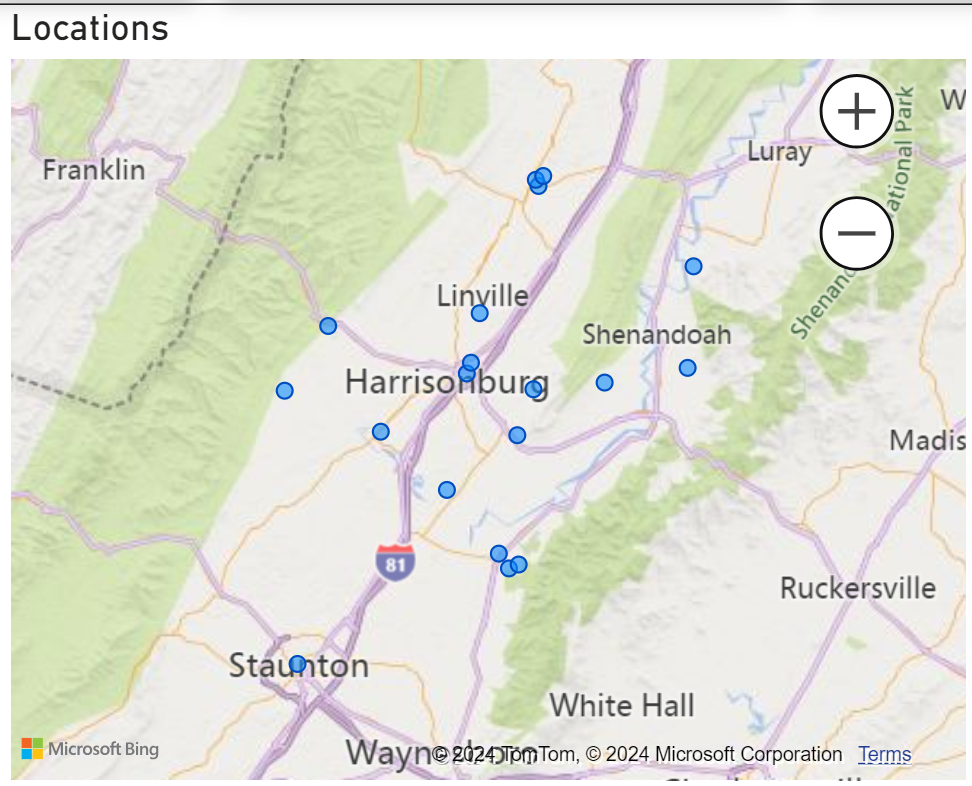
Map of approved households in line for services through the 2024 EE Outreach Grant

Every home that qualifies for weatherization through CHP receives a comprehensive energy audit prior to work being completed. Performed by a BPI certified energy auditor, this audit provides the foundation and modeling that determine what measures can be installed at a client’s home. With a few exceptions often related to health, safety, and funding source, every measure, from pipe wrap and insulation, to LEDs and Heat Pump Installs, must pay for itself at least once in realized household savings over the lifetime of the measure. For example, if insulation costs $2,000 to install and has a lifetime of 15 years, that client must save at least $2,000 in energy costs over 15 years to justify installation of that measure. All savings are projected via a comprehensive modeling software managed by the state of Virginia. This software allows CHP to provide data-driven savings estimates for households.

Additional Improvements:
With over half of homes usually needing additional home improvements and upgrades before receiving EE improvements, another $150,000 to 200,000 (Across 10+ homes) is expected to be invested in HVAC, roof, plumbing, and environmental remediation. This work improves the health, safety, and affordability of those homes, and helps keep needed housing stock available.

Lessons Learned

  • Non-profits have budget, time, and staff constraints that, despite grant funding, limited their outreach efforts, especially because of the relatively short time period.
  • Non-profit staff were quick to understand the implications of their clients’ reduced energy bills.
  • CAAV and partner non-profits were both heartened by the opportunity the grant money and the outreach presented and daunted by the scope of the effort, though enthusiastic about anticipated outcomes.
  • Non-profit staff, despite their ongoing relationships with clients they approached, met with some skepticism about the “no-cost-to-you” aspect of the CHP programs. There was also some hesitation from client renters, and concern about ‘bothering’ their landlord, or how their landlords might perceive the program/ask.
  • Despite CHP’s and the non-profit organizations’ efforts to streamline, explain, assist, and follow-up with clients during the application process, clients’ response times and rates were below what had been hoped for. CHP’s further follow-up efforts with applicants were too often not successful and some applications were closed without completion.

Conclusions

Even with the constraints and learnings listed above, the four organizations supported through this grant were able to line up 20 households for EE and other home improvements through CHP. With an average investment of $8,200 per home, this grant will invest $164,000 in EE improvements to LMI households in the Valley. With over half of homes usually needing additional home improvements and upgrades before receiving EE improvements, another $200,000 ($20,00/home across 10 homes) is expected to be invested in HVAC, roof, plumbing, and environmental remediation.

There was significant learning through this process, with unexpected challenges and constraints that will help inform future efforts. First we will need to focus more on effective methods to address and overcome cultural and language barriers in target populations. We recognize that more consistent follow up with households is critical to reach approval, and we began exploring ways to address client attrition. We also recognized a significant need to fund administrative work and communications tasks that are part of administering a grant like this. Finally, more time is needed, and seasonality matters, as our outreach missed many of the summer events and good weather that help support effective outreach.

Finally, the funding through the Clean Virginia grant has really helped spark a ‘de-siloing’ of area organizations who serve LMI households in Harrisonburg. Agencies with specific missions serving seniors, immigrants, persons with disabilities, and other populations have begun connecting and collaborating in important ways. Centering energy burden with money to support agencies in signing up their clients to reduce it has not only helped connect important programs with households in need, but has helped us build a foundation for more cross-missional work. This work is critical as both needs and funding increase.

Every agency we worked with has momentum and interest in building on this work. A case manager with Valley Program for Aging Services shared, “Thanks to this grant I was able to offer my clients a solution to their energy/weatherization problems rather than throwing money toward over inflated energy bills due to poor insulation and equipment. I have had several clients come back to me after receiving services from CHP stating they have experienced a drastic reduction in their energy bills and are enjoying being able to use their home’s heating and cooling systems without worrying about high energy bills.”

We are excited to build on this momentum as we look toward additional funding.

Respectfully submitted,

Joy Loving on behalf of Climate Action Alliance of the Valley
June 7, 2024


PDF version here: https://climateactionallianceofthevalley.org/wp-content/uploads/2024/06/2024-clean-virginia-report.pdf

Climate and Energy News Roundup – June 2024

A thing is right when it tends to preserve the integrity, stability, and beauty of the biotic [living] community. It is wrong when it tends otherwise.  —Aldo Leopold

Our Climate Crisis

From flooding in Brazil and Houston to brutal heat in Asia, extreme weather seems nearly everywhere in the past month. It’s unprecedented to have so much of the world with its weather in overdrive at the same time. Katharine Hayhoe, chief scientist for the Nature Conservancy, comments, “Climate change is loading the weather dice against us in every part of the world.”

One of the most rapid sea level surges on Earth is besieging the American South. Sea levels across the region are at least 6 inches higher than they were in 2010—a change similar to what occurred over the previous five decades.

The severe thunderstorms and high winds that recently swept through Houston and the Gulf Coast left all the destructive traces of a hurricane. As our planet warms, severe storms of all kinds are likely to deliver even bigger payloads of rain because warmer air holds more moisture. The resulting heat energy released into the atmosphere feeds thunderstorms.

The climate refugee crisis is here. Catastrophic flooding in southern Brazil recently forced hundreds of thousands of people from their homes. This is not a one off. Floods in Pakistan in 2022 displaced an estimated 8 million people. Floods in Ethiopia in 2023 and Kenya this year forced hundreds of thousands more from their homes.

Local Climate News

An informal Creation Care/Green Team mixer is being planned at the outside pavilion at Harrisonburg Mennonite Church on Saturday, June 22, at 7 pm. This mixer is an outgrowth of the Ecumenical Earth Day Worship Service, and is open to all creation care groups, green committees, and interested individuals. It will be helpful for planning purposes if you RSVP to Steve Pardini at: pardini.steven@hotmail.com.

Local nonprofit GiveSolar launched a National Solar Seed Fund Campaign at the beginning of this year. This is an effort to scale the solar programs of Habitat for Humanity and make them available to all appropriate Habitat homes nationally.  The campaign has now received a $500,000 donation from the EPA Solar for All grant designed to help low-income households to access solar. To date, the campaign has raised $614,580 toward its goal of raising $1M by July.

The Central Shenandoah Planning District Commission and RideShare joined the Virginia Department of Rail and Public Transportation in promoting May as Bike Month—a time to celebrate the joys and benefits of cycling! This promotes biking as a viable and eco-friendly mode of transportation.

The declining number of fireflies in our region is likely due to rising temperatures, housing and commercial development with closely cut lawns, and the use of pesticides. To have more fireflies in your yard and to help the insect population thrive, Virginia Tech entomologist Eric Day recommends that homeowners stop spraying their yards with pesticides and herbicides, tolerate weeds, and mow less.

Community Climate Collaborative—also known as C3—based in Charlottesville, is helping businesses reach carbon neutral emission goals. It involves energy efficiency measures such as sealing up buildings, upgrading lights or replacing appliances using fossil fuels with modern ones. Upgrades can be funded through C-PACE, an innovative way to finance clean energy and resiliency projects on commercial, multifamily, and nonprofit buildings.

Politics and Policy

During Trump’s dinner meeting with Big Oil executives at Mar-a-Lago last month, he asked them to raise $1 billion for his campaign as he outlined his pro-fossil fuels agenda for a second term. Industry officials have already begun drafting the text of executive orders to start reversing the Biden administration’s green policies on day one of a Trump presidency.

In an effort led by Gov. DeSantis, Florida—perhaps the most vulnerable state to sea-level rise and extreme weather—has stripped the term “climate change” from much of state law. The state will, instead, make energy affordability and availability its main focus.

The Vermont state Senate recently passed legislation that would require all utilities to provide 100% clean energy by 2035. This puts Vermont on track to be among the first states to fully decarbonize its power grid. This new standard will underpin other parallel state climate efforts such as electrifying its home heating sector.

In a win for Governor Youngkin, the budget deal he cut with General Assembly negotiators dropped a measure to renew the state’s membership in the Regional Greenhouse Gas Initiative (RGGI). Democrats claimed that Youngkin insisted the RGGI language come out “under threat of veto” but environmentalists fault them for folding without a fight.

The U.S. Interior Department announced that it will end new coal leasing in the Powder River Basin, which produces nearly half the coal in the United States. This is one of the biggest steps yet to keep fossil fuels in the ground with major implications for U.S. climate goals.

President Biden announced major tariffs on Chinese clean technologies that they fear will flood the U.S. market and undermine our emerging clean manufacturing. He imposed tariffs of 100% on Chinese EVs, 50% on Chinese solar cells, and 25% on Chinese lithium-ion batteries. The Washington Post editorial board claims that this will slow progress against climate change and provide next to nothing in return. Economist Paul Krugman, however, sees it as unfortunately necessary given the fragile state of our U.S. green energy transition.

Energy

Across the U.S., power companies are increasingly using giant grid batteries the size of shipping containers to address renewable energy’s biggest weakness: the fact that the wind and sun aren’t always available. Over the past three years, battery storage capacity on our grids has grown tenfold. This year, it is expected to nearly double again, with the biggest growth in Texas, California and Arizona.

New York–based startup Voltpost has announced the commercial availability of its curbside EV charging station technology package—creating modular, street-proofed systems, utilizing power from streetlights, that it hopes to deploy in cities later this year. Tapping the power already at light posts is a workaround to the high costs of installing underground electric cables for chargers in urban settings.

The surge in data center power demand in the U.S. is expected to double from 2022 levels by 2030 and reach up to 7.5% of total energy consumption—equivalent to the energy consumption of nearly a third of American homes. Virginia has the biggest data center market in the world and the exponential increase in power demand has created a huge challenge for the goal of decarbonizing its electric grid. Some Virginia lawmakers have tried to hold data centers accountable for their impact on the environment but their proposed legislation was postponed until 2025, effectively killing it.

China has a huge lead over other countries in building the technologies of the energy transition. Around $200 billion was invested in clean technology manufacturing worldwide in 2023—a 70% increase from 2022. China alone accounted for three-quarters of this investment.

Climate Justice

Norfolk, Virginia, is experiencing a double-whammy effect of climate change. Not only are storm related deluges more intense, but sea levels are rising faster here than anywhere else on the East Coast.  One climate resilience project—a winding “blue greenway”—aims to reimagine a neglected, flood-prone poor neighborhood along the city’s neglected east-side waterfront.

Virginia was all in on midsized solar installations on schools, hospitals, churches, and municipal buildings until Dominion Energy dramatically raised prices and changed the rules on interconnection fees. This now makes many of these projects economically unviable. Dominion denies that it is putting up barriers in order to maintain its market share in solar energy.

Internal oil company documents released before a congressional hearing reveal that oil executives promoted natural gas as green even when they knew it wasn’t. This evidence could end up supporting state attorneys general who are suing the fossil fuel industry. Oil companies are currently facing around 30 lawsuits for deceiving the public about the consequences of burning fossil fuels.

New coal mines continue to open each year, and oil and gas companies are still exploring new parts of the world. People—especially Indigenous communities—are, however, increasingly saying no to new fossil fuel developments on their land. And they’re using courts and legislatures to fight back and achieve some significant victories.

The new United Nations “loss and damage fund” to assist developing countries with climate related damages had its first board meeting where it sought to finalize operations and its partnership with the World Bank. The big question is who will pay. Former U.S. climate envoy John Kerry said that the world will “never see a dime” from the U.S. for anything that sounds like an admission of liability or smacks of compensation.

Small island nations won a big climate victory when the International Tribunal for the Law of the Sea unanimously ruled that governments that signed on to the United Nations Convention on the Law of the Sea have an obligation to reduce greenhouse gas emissions. This includes several of the world’s top emitters: China, India, the European Union, and Russia. The United States, also a big polluter, is not a party to the convention.

Climate Action

A growing number of ecological innovators around the world are reimagining landscapes, communities, and the way we live. Individuals and organizations are embarking on a hands-on rethinking of the future in projects that range from “ecovillages” in sub-Saharan Africa to regenerative agriculture coworking spaces in Europe, to permaculture projects in Barbados.

The Ulkatcho First Nation in remote British Columbia is installing what will likely be the largest off-grid solar project in Canada. It will provide 64% of their electricity which is currently entirely generated by diesel. Corrine Cahoose, one of their elected councilors, said, “We have to be the stewards of the land. We have to protect in every way, and this project is one of the ways.”

The Bezos Earth Fund, launched in 2020, aims to give away $10bn of the Amazon founder’s $200bn personal fortune to combat the climate crisis and biodiversity loss by the end of the decade. Some in the climate and environmental community are concerned about the level of influence this gives Jeff Bezos over critical environmental institutions. They claim that the projects do not address the key issues of the climate crisis.

Is buying carbon offsets for air flights worth it? Many of them don’t work and some might even be harmful. Better alternatives include flying less and choosing an economy seat when you do fly (premium seats contribute about four times more emissions). And, when you fly, you can donate $1,000 per ton of carbon emitted to your favorite environmental organizations.

The race is on to build California’s 220 mph high-speed bullet train network. When completed, the train network will be a major convenience for people traveling around California as well as a major win for our planet. According to one study, the trains will produce only one-seventh as much greenhouse gas emissions as commercial air travel.

Heating water gobbles energy, leading to higher utility bills and more planet-warming emissions. It’s responsible for more than 10% of annual residential energy use—the biggest share after air conditioning and heating. One way to cut down our energy consumption is to wash our laundry in cold water because heating water consumes about 90% of the energy it takes to operate a washing machine. Also limit taking long, steamy hot showers.

Earl Zimmerman
CAAV Steering Committee

Climate and Energy News Roundup – May 2024

Think about [climate] anxiety as a catalyst—born from empathy. What is it telling you to do?   —Debbie Sturm

Our Climate Crisis

The ocean has been breaking temperature records every day for more than a year by wide margins. The oceans have absorbed the vast majority of the planet’s warming from greenhouse gases but these massive increases are beyond what scientists would expect to see even considering climate change.

Throughout Virginia, scientists are documenting significant warming of water temperatures from inland freshwater streams and rivers, which has huge cascading effects on ecosystems. The rising water temperatures are a result of global climate change as well as localized changes in the environment, like loss of shading from trees that have been removed along streams.

In the past year, anomalously warm ocean temperatures have left a trail of devastation for the world’s corals, bleaching entire reefs and threatening widespread coral die back. The world is now experiencing its fourth global bleaching event, the second in the last decade.

Global levels of the greenhouse gas carbon dioxide rose to 419 parts per million in our atmosphere in 2023, around 50% more than before the Industrial Revolution. Carbon dioxide levels are currently rising at near-record rates—last year had the fourth-highest annual rise.

We’re bending the curve in global greenhouse gas emissions and may be at near peak emissions. Even so, we’re still adding to the total amount of carbon dioxide in the atmosphere. We will need to bring down emissions rapidly in the next decades to avoid the worst of global warming.  

Local Climate News

About 200 enthusiastic members of eight different congregations gathered on a chilly Sunday morning for an outdoor Ecumenical Earth Day Worship Service at Turner Pavilion in downtown Harrisonburg on April 21. Participants were thrilled by their joint energy on such a cold morning and are already talking about doing it again next year.

Climate STARR (Strategies for Climate Trauma, Action, Resilience, and Regeneration) is a three-day in-person training at Eastern Mennonite University June 10-12. It will provide individuals, communities, and climate action organizations who encounter climate angst and fatigue (or experience it themselves) a space to pause, reflect, and gain new skills for living and leading in uncertain times. As a climate activist, you will want to consider registering for the training to enhance your skills and expand your climate network.

Eastern Mennonite University, in partnership with the JMU Center for the Advancement of Sustainable Energy, is hosting a Solar Solutionary Camp for rising 8th and 12th graders June 10-14. Students will be challenged with ensuring access to electricity for the nearly one-billion people who lack it today while keeping climate change below 1.5 degrees Celsius of warming.

Politics and Policy

The Biden administration issued new rules ordering power companies to cut pollution from coal plants. This is a major plank in Biden’s efforts to fight climate change, amid complaints from progressive green voters who say he’s done too little to curb fossil fuels. Many of the progressives who helped send him to the White House in 2020 are expressing frustration at his approval of several high-profile oil and gas projects as well as his handling of the war in Gaza.

Marking a major step in US climate change mitigation efforts, the Environmental Protection Agency has set regulations aimed at slashing pollution from heavy-duty trucks. They aim to cut 1 billion tons of CO2 by 2055.

The Department of Energy released its first ever federal blueprint to decarbonize America’s building sector, which accounts for more than a third of the harmful emissions jeopardizing our air and health. The comprehensive plan would reduce greenhouse gas emissions from buildings by 65% by 2035 and 90% by 2050.

The European Union has been backpedaling on its environmental promises, yielding to agribusiness and far-right demands. In particular, they scrapped initiatives aimed at reducing pesticide usage, protecting nature, and curbing toxic chemicals.  

The Biden administration has approved the construction of a new deepwater oil export terminal off the Texas coast that will be the largest of its kind in the United States. Environmentalists claim it will lead to “disastrous” planet-warming greenhouse gas emissions. The administration, in turn, claims that it will not substantially increase oil production.

The Biden administration announced $34.7 million in grants to three Virginia projects that will help strengthen transportation infrastructure against the effects of climate change. The projects will address flooding and facilitate emergency evacuations due to extreme weather events in Virginia’s Tidewater and Chesapeake region.

Ranting against wind power during a fundraising dinner with oil and gas industry executives, former president Trump claimed that the renewable-energy source is unreliable, unattractive and bad for the environment. “I hate wind,” he told the executives over a meal of chopped steak at his Mar-a-Lago Club and resort in Florida.

Robert F. Kennedy Jr. is shaping his independent run for president on a climate platform designed to appeal to supporters of both Biden and Trump. He’s staking out some positions well to Biden’s left—such as calling for a permanent ban on natural gas exports, while criticizing the size of Biden’s subsidies for green energy. He’s adorning these positions with the anti-big-government rhetoric and conspiracy theories that he promoted during the Covid pandemic.

Energy

Massive data centers in Northern Virginia, processing nearly 70% of global digital traffic, are gobbling up electricity at a rate that power grid operators say is unsustainable. Therefore they’re planning several hundred miles of new transmission lines to coal-powered electricity plants in West Virginia that had been scheduled to go offline. Those coal plants will now keep running to fuel the increasing need for more power.

Global renewable energy capacity increased by 36% last year but that is only half as fast as necessary to meet our global climate commitments. Rising energy demand and weak electric grid infrastructure underlie our continued dependence on burning fossil fuels for energy.

Natural gas prices have plunged as the world grapples with an oversupply after a warmer-than-expected winter. The recent heyday in liquefied natural gas boosted prices and profits, spurring a huge wave of investment in the sector.

The Virginia State Corporation Commission approved more than a dozen new solar projects that will significantly expand Dominion Energy’s growing clean energy capacity. They will include four solar projects that will be owned by Dominion Energy and 13 independently owned solar projects.

An old on-demand gas plant in California is being replaced by a billion-dollar, 680-megawatt grid battery—one of the biggest batteries in the U.S. The big advantage of this giant grid battery is that it can supply power instantaneously. The old 800-megawatt gas plant took 12 hours to be fired up before coming online.

Electric vehicles, with an average equivalent of 106 miles per gallon, blow past the energy efficiency of hybrid cars. That number could more than double in the next decades to more than 200 miles per gallon. This growth in efficiency could help ease the strain that electric vehicles are expected to place on the grid and extend battery range.

Energy developers are more eager than ever to build new solar, wind, and battery projects in the U.S. but the interconnection queue is getting longer and longer. It is now taking about five years to get through the queue, which, as a result, is now more than twice the size of the entire U.S. power capacity.

Climate Justice

Installing solar panels on school buildings and big-box stores could provide one-fifth of the power that disadvantaged communities need, bringing renewable energy to people who can least afford it. Research has found that marginalized neighborhoods generate almost 40% less renewable energy than wealthy ones.

The Environmental Protection Agency selected 60 organizations that, under its Solar for All program, will receive a combined $7 billion in grants to bring residential solar to low-income neighborhoods. The funding will flow into state, municipal, and tribal governments as well as nonprofits for low-income solar and battery storage installations and to support existing ones.

The Department of Energy aims for 5 million households around the country to sign up for community solar by next year. Subscribers will pay a monthly charge and then receive a credit on their utility bills—usually larger than the fee they pay—for the power generated by their fraction of a solar array. Community solar has gained bipartisan support because of its benefits to low-income households now burdened by disproportionate energy bills.

Having lost many of their cattle due to drought, traditional herders in Kenya are trying out milk-producing camels that are more resilient to climate change. Jonathan Lati Lelelit, the governor of Samburu, a county about 240 miles north of Nairobi, comments, “We have so many other things to do with the little money we have. But we have no option.”

Climate Action

Rising global temperatures are giving new urgency to geoengineering—trying to engineer our way out of our climate crisis. Lots of resources are being poured into direct air capture systems designed to suck carbon dioxide out of the air and store it underground. Critics say such efforts are dangerous distractions from the more urgent task of rapidly reducing the use of fossil fuels.

The Virginia Department of Transportation selected 18 different sites to receive electric car chargers under the federal Infrastructure Investment and Jobs Act. This first $11 million tranche of funding focuses on electric car chargers for interstates, while the next rounds will add charging stations along state highways and for freight carriers. Virginia is set to receive about $106 million total funding over the next five years.

Germany’s greenhouse gas emissions dropped by 10% last year as renewable energy grew in importance. This puts Europe’s biggest economy on course to meet its target for cutting emissions by 65% by 2030. It aims to cut its emissions to net zero by 2045.

The European Court of Human Rights ruled in favor of a group of older Swiss women who claimed that the Swiss government had violated their rights by failing to combat climate change and meet emissions targets. The landmark case sets a legal precedent in the European Union against which future lawsuits will be judged.

America’s first fully battery-powered tugboat is being put into service at the Port of San Diego. Waterfronts are incredible sources of pollution and carbon emissions. Port officials are working to decarbonize not just tugs but also diesel cranes and trucks.

The apparel industry is responsible for somewhere between 8 and 10% of the world’s greenhouse gas emissions and about 4% of solid waste in the United States. Jeans contribute to this industry but are not all equal polluters. Chief among ways to mitigate the environmental impact of the jeans you wear is buying jeans made from organic and recycled cotton.

The “Green Islam” movement in Indonesia seeks to kindle an environmental awakening through Islam. Top clergy have issued fatwas, or edicts, on how to rein in climate change. Neighborhood activists are beseeching friends, family and neighbors that environmentalism is embedded in the Quran.

Earl Zimmerman
CAAV Steering Committee

Climate and Energy News Roundup – April 2024

Beyond the damage to our planet, climate change threatens to undermine our social fabric and the foundations of democracy. —Jonathan Foley

Our Climate Crisis

This year was the hottest February on record. Global ocean temperatures in February were also at an all-time high for any time of year. Taken together, the past 12 months have been the hottest 12 consecutive months on record. Researchers say that our weirdly warm winter has the fingerprints of climate change all over it.

Methane emissions from the fossil-fuel industry rose to near-record levels last year, despite technology available to curb this pollution at virtually no cost. Separately, a new study based on aerial surveys of methane leaks shows that US oil-and-gas infrastructure emits three times as much methane into the atmosphere as government estimates suggest.

Sinking cities along the American coastline are pushing sea level rise into overdrive. It will leave them increasingly exposed to destructive flooding by the middle of the century. Coastal subsidence is created by cities and industries pumping water from underground aquifers faster than they can be replenished, a situation exacerbated by climate change-fueled drought.

In its first risk assessment, the European Environment Agency reports that Europe is not prepared for the rapidly growing climate risks it faces. The most pressing risks are heat stress, flash floods and river floods, and the health of coastal and marine ecosystems. These urgent risks are growing faster than societal preparedness, including the need for funds to recover from disasters.

Local Climate News and Events

Approximately eight churches in Harrisonburg are coming together for a special Ecumenical Earth Day worship service downtown at Turner Pavilion (the site of the farmers market). The service will be on Sunday, June 21 at 9:45 am. All are invited.

Join the Shenandoah Sierra Club and Climate Action Alliance of the Valley for a panel discussion with city and community leaders at Court Square Theatre on Sunday, April 21 at 2:30 pm. Our city and community has made great strides and set high aspirations for meeting the challenge of the climate crisis. Come learn about those goals and what is being done to achieve them.

Senator Mark Warner met with transportation stakeholders in Staunton, Virginia to celebrate the planned expansion of Amtrak services in the city from three to seven days a week. This is good news from a climate perspective as it provides a less carbon intensive transportation option.

The Virginia Breeze bus lines could offer east-to-west service across Virginia, from Harrisonburg to Virginia Beach, starting next summer. Last December, the Breeze’s monthly ridership reached 6,126, which was 214% higher than original estimates and 13% higher than in 2022. The Breeze also contributed to a reduction of 270 metric tons of carbon emissions last December.

Volunteers with the Climate Action Alliance of the Valley (CAAV) are using a $35,000 grant from Clean Virginia to help connect low-income people with no-cost energy efficiency upgrades to their housing offered by Community Housing Partners. To do this they are partnering with four local nonprofits already serving these people. It’s a matter of listening, building trust and assisting in the application process.

A small group of local environmental activists protested outside the Department of Environmental Quality (DEQ) offices in Harrisonburg this week. They were part of a statewide action by Third Act Virginia urging the DEQ to be more forceful against the Mountain Valley Pipeline in response to its environmental violations.

The city of Harrisonburg draws all its electricity from Dominion Energy according to Harrisonburg Electric Commission general manager Brian O’Dell. It’s generating sources are therefore the same as Dominion, including 10% generated by burning coal, 41% by burning natural gas, 42% percent from nuclear power, and approximately 5% from renewable energy sources primarily solar panels.

Politics and Policy

Oil and gas executives at the CERAWeek by S&P Global energy conference in Houston blasted the Biden administration’s pause on new liquified natural gas (LNG) export infrastructure.   Secretary of Energy Jennifer Granholm sought to reassure them that it will be short-lived and not alter the U.S LNG industry’s meteoric growth to become the world’s largest exporter.

The U.S. Environmental Protection Agency is drawing up ambitious regulations that would require all new and existing fossil fuel plants to sharply cut or capture their emissions in the next decade, or else face shutdown. But now, the agency has decided to exempt the nation’s 2,000 or so existing gas plants. Officials worried the rule could be overturned in court, and that it wouldn’t help get skeptical voters on President Biden’s side before the election.

For every dollar the federal government has contributed to advancing the transition to clean energy through the Inflation Reduction Act, the private sector has kicked in $5.47, according to analysists at the Rhodium Group and the Massachusetts Institute of Technology. This has led to nearly a quarter-trillion dollars flowing into the clean economy in just one year.

Fossil fuels subsidies are the zombies of the US tax code that seem impossible to kill. The oil and gas industry enjoys nearly a dozen tax breaks, including incentives for domestic production and write-offs tied to foreign production. The Organization for Economic Cooperation and Development calculated the total subsidies to be about $14 billion in 2022.

A revitalized push for nuclear energy is gaining bipartisan support in Washington as billions of dollars are being funneled into advancing nuclear technology and domestic uranium production. Regulatory changes also aim to streamline the licensing process for advanced reactors, promising to expedite the development of cleaner, more efficient nuclear energy.

The League of Conservation Voters, a leading climate organization, pledged $120 million to President Biden’s election campaign. Pete Maysmith, the league’s senior vice president for campaigns, said, “It’s hard to imagine higher stakes in these elections. We will be communicating with voters in the battleground states and in the key races about the stakes.”

House Republican leaders announced plans to take up six energy-related bills and resolutions for what they are calling “energy week” attacking attack President Joe Biden’s “radical, anti-energy agenda.” The goal is to protect what they call American energy dominance by repealing the greenhouse gas reduction fund, make it easier to build energy projects in wetlands, curb legal challenges from environmental groups, and oppose any potential tax on carbon emissions.

In a recent campaign speech, former President Donald Trump used vivid and violent language to criticize electric vehicles. He associated EVs with significant job losses in the U.S. auto industry, using terms like “assassination” of jobs. He proposed a 100% tariff on electric cars manufactured in Mexico, predicting a “blood bath” for the country if he’s not re-elected.

The U.S. Department of Energy has awarded $6 billion to demonstration projects that aim to sharply reduce greenhouse gas emissions from heavy industrial sectors. The goal is to make industrial essentials like steel, aluminum, cement, chemicals—and even household staples like ice cream and mac and cheese—a whole lot cleaner.

Solar advocates in West Virginia were dismayed when Governor Jim Justice vetoed a bipartisan bill which would enhance solar energy capacity for utility companies. Justice claimed he vetoed the bill because he didn’t want this bill to limit coal-based energy production in the Mountain State.

Energy

Vast swaths of the United States are at risk of running short of power as electricity-hungry data centers and clean-technology factories proliferate. The numbers are staggering—the projected new energy demand in the next decade has doubled. This is leaving utilities and regulators grasping for credible plans to expand the power grid. Virginia’s 2024 legislative session wrapped up last month without any action to avert the looming energy crisis created by rapidly growing data centers in Northern Virginia.

Solar provided most of our nation’s new electricity capacity last year. Texas and California led a solar surge driven mostly by utility-scale installations, which jumped 77% year-over-year. It was the best year for renewables since the heyday of hydroelectric during the Second World War.

The natural gas company Williams plans to add over 26 miles of pipeline in the county adjacent to its existing Transco corridor in Pittsylvania County, Virginia. It’s part of a larger project to allow its system to carry more natural gas. The Southern Environmental Law Center said the project “would commit the South to methane gas for the next 30, 40, or 50 years when there are cleaner, more reliable, and more affordable energy alternatives available.”

The U.S. clean energy transition has more money behind it than ever. Last year the investment in clean energy reached a total of $239 billion, a record-breaking figure that’s 38% higher than the 2022 total. Much of that growth is due to the boom in domestic clean energy manufacturing. Investment in U.S. clean energy manufacturing in 2022 was around $19 billion. It totaled $49 billion in 2023.

Climate Justice

Native Americans are fighting back against power lines, copper mines, and other clean energy infrastructure on tribal lands. While the Biden administration has worked to repair relationships with Indigenous peoples, that effort is conflicting with another priority of expediting projects essential for the energy transition.

The Environmental Protection Agency is preparing to distribute $20 billion for green projects in underserved communities, focusing on community-driven and affordable housing projects.   Over 1,200 Community Development Financial Institutions will play a crucial role in this initiative. Targeting underserved communities with green finance will potentially transform the landscape of community lending.

Climate Action

You may be considering switching to a heat pump to heat and cool your home but wonder if they really lower carbon emissions if they run on dirty grid power. Most electric utilities still get about 60% of their power from burning fossil fuels.  Even so, the answer is an emphatic yes. Depending on their level of efficiency, heat pumps still lower household annual energy emissions on average by 36% to 64% compared to other heating systems.

The Mountain Empire Community College in Southwest Virginia will be the first community college in the state to enter into a power purchase agreement with a solar developer. The agreement with Secure Futures of Staunton, Virginia, for a 1,600 panel installation on their classroom roofs is expected to cut energy costs but the larger benefit will come from the boost to the college’s workforce training program for energy technology.

Muslim environmental scholars drew up a Covenant for the Earth presenting an Islamic outlook of the environment in a bid to strengthen actions that combat climate change and other threats to the planet. It is an endeavor to engage Islamic scholars and Muslim institutions in the effort.

The switch from diesel to electric school buses is accelerating. Thomas Built Buses, the legacy school bus company founded in 1916, has delivered its 1,000th electric school bus to a school system in Georgia.

Circ, a startup circular fashion company in Danville, Virginia, recycles textile waste into new fibers. It is an effort to reduce the fashion industry’s impact on the planet—the world’s third-largest polluting industry.

Earl Zimmerman
CAAV Steering Committee

Climate and Energy News Roundup – March 2024

“We just need more visionary thinkers who can bring together those in the ecological movement with the anti-racist realities that we’re dealing with.”— Cornel West

Our Climate Crisis

New research finds that the oceans are hotter than they’ve ever been in modern times—having smashed previous heat records for at least seven years in a row. Higher-than-normal sea temperatures cause sea level rise, stress coral reef systems, accelerate the melting of polar sea ice, redistribute fish populations, and deplete oxygen levels. Hotter oceans also create conditions for extreme weather events.

The Quinault Indian Nation, a native American coastal tribe in Washington state, has spent a decade trying to move its villages out of reach of a rising Pacific Ocean and its increasingly severe high tides. Oceanographers say this gives us a sneak peek of the future for many communities as an ever-hotter climate swells the world’s oceans.

Local restaurants are especially feeling the impact as climate change is taking a massive bite out of the global food supply chain according to recent research. José Andrés, a chef, humanitarian and founder of the Global Food Institute, responds, “This research is more than just a collection of data and insights; it’s a rallying cry for chefs, restaurateurs, food producers, policymakers, and all actors across the supply chain.”

Scientists have long been puzzled by parts of the US south-east where temperatures have flatlined, or even cooled, despite the broader warming trend in the US. This is now attributed to an aggressive US government tree-planting program involving 37million acres of reforested area in the south-east in the early 20th century. Such reforestation, however, is no substitute for the need to drastically cut planet-heating emissions, which hit a new global high last year.

Politics and Policy

The explosion of AI technology is increasing carbon emissions and millions of gallons of fresh water consumption. New legislative efforts in the U.S. and EU aim to assess and regulate AI’s environmental footprint, focusing on energy consumption and resource use.

If states support walking, cycling, public transit, and other clean options, instead of expensive, status quo projects like highway expansion, they can reduce harms and give people of all backgrounds better access to reliable, affordable, and convenient transportation. By investing in these climate-friendly choices, billions of dollars can be avoided in energy, healthcare, and vehicle costs, save lives, and prevent huge amounts of pollution.

Some rural counties in Virginia are pushing back against allowing more solar development. In response, legislation is being introduced in the Virginia General Assembly that would give state regulators the power to approve large solar, wind or battery projects when local officials balk.   Supporters see this as a necessary move because clean energy generation is a statewide issue.

A judge ruled that the lawsuit that seeks to reverse Gov. Youngkin’s administration’s  withdrawal of Virginia from the Regional Greenhouse Gas initiative (RGGI) is allowed to move forward. The Virginia General Assembly voted to join RGGI in 2020 and the Youngkin administration made an executive decision to withdraw at the end of 2023. The lawsuit claims that is illegal because it circumvents current law and the will of the General Assembly.

At least 15% of county governments in the US have effectively halted new utility-scale wind, solar, or both. Even so, a gigantic effort to build green energy is underway. Wind and solar are expected to surpass the amount of electricity made from coal this year. But green energy must increase rapidly to meet U.S. clean energy goals and local governments are making it more difficult.

The US home builder lobby is mobilizing against new state and local building codes that save energy and ease the transition to cleaner technologies by claiming that it adds substantially to the cost of new homes. A recent federal study found that they add at most about $6,500 to the price of a newly built home, not the $20,400 that the lobby claims. These code changes would actually pay for themselves in several years through lower energy costs.

Over the years, utility companies have come under fire for lobbying to stall climate policies and keep fossil fuel plants running. Our monthly energy bills may actually be paying for such efforts. While federal law prohibits utilities from recovering lobbying expenses from customers, those rules lack teeth and aren’t sufficiently enforced. Now, eight states are taking the lead to ban the practice.

Republican House leaders only want to attack Democrats on climate—not develop their own policies. And Donald Trump, the likely Republican nominee for president, has shown no signs of moving away from his denial of climate change science and his rejection of major action to reduce emissions. Even so, the Republican Conservative Climate Caucus is trying to show that they care about actively solving the climate crisis.

Energy

The U.S. is slated to build 55% more electric power capacity in 2024 than it did in 2023. Renewables, batteries, and nuclear will add up to 96% of all new power capacity constructed this year. Even so, about 60% of US electricity is still generated by fossil fuels.

U.S. electric vehicles sales are poised to rise a lot this year. Despite some challenges, EV sales were strong in 2023—up 46% from the prior year. U.S. automotive projections show increases in EV sales ranging from about 20% to more than 30% compared to 2023.

U.S. gas producers are racing to sell liquified natural gas (LNG) to Asia and those plans run through Mexico. The recent fracking boom has transformed the U.S. into the world’s largest gas producer and exporter. Piping the gas to shipping terminals on Mexico’s Pacific Coast will cut travel times to Asian nations roughly in half by bypassing the traffic and drought-choked Panama Canal.

Dominion Energy received the final two federal approvals needed to move forward with the construction and operation of its $9.8 billion, 176-turbine offshore wind farm off the coast of Virginia Beach. Construction is expected to begin in May. Once fully constructed in late 2026, the installation will produce 2.6 gigawatts of energy, which would power about 660,000 homes.

Can power plants burn clean hydrogen to make electricity? Utilities say the fuel can potentially help them achieve a carbon-free grid. Some environmentalists worry that it opens up a morass of waste and greenwashing that may impede better solutions. One impediment is the availability of affordable green hydrogen. Another is that specialized turbines that can burn 100% hydrogen are still in the developmental stage.

Americans bought 21% more heat pumps in 2023 than gas furnaces.  Even though sales were down for both heat pumps and gas furnaces, heat pumps continued to widen a lead that first emerged in 2022, when they surged ahead of gas furnaces by 12% and topped 4 million units sold for the first time.

The U.S. Department of Energy (DOE) announced the selection of three projects that will receive up to $60 million to demonstrate the efficacy and scalability of enhanced geothermal systems (EGS). The pilot projects will use innovative technology and a variety of development techniques to capture the earth’s abundant heat resources. They also support the DOE’s goal of cutting the cost of EGS 90% by 2035.

Startup Koloma is searching for underground reservoirs of naturally occurring hydrogen that have been largely ignored or lain undetected until now. They just raised an eye-popping $245 million in venture funding to develop tools and technologies to locate and eventually extract the now-coveted gas from the earth. Hydrogen is the gas of the moment because it could replace fossil fuels in certain applications, particularly in energy-intensive industrial processes.

Climate Justice

Newly unearthed documents reveal that the fossil fuel industry funded some of the world’s most foundational climate science as early as 1954. This includes the early research of Charles Keeling—famous for the so-called “Keeling curve” that has charted the upward march of the Earth’s carbon dioxide levels. This makes a mockery of their public denial of climate science for decades and their funding of ongoing efforts to delay action on the climate crisis.

Vermont, Maryland, Massachusetts, and New York are launching a multi-state effort to hold Big Oil accountable for the expensive damage wrought by climate change. Bills on the docket in all four states demand that oil companies pay for a climate Superfund to fund climate actions such as energy efficiency retrofits, water utility improvements, solar microgrids, and stormwater drainage.

Stolen Indigenous land is the foundation of the U.S. land-grant university system. Climate change is its legacy. In 2022 alone, these trust lands generated more than $2.2 billion for these schools. Most of that money comes from fossil fuel extraction and mining.

Climate Action

You’re probably underestimating the willingness of people to take action on our climate crisis. This erroneous perception could hamper climate action.According to a new survey of people in 125 countries, nearly 70% would give up 1% of their household income to stop climate change.

Climate activists are preparing for a long battle over liquified natural gas (LNG) exports even as they celebrate the White House’s recent announcement that it will pause the approval of new export facilities while they study their environmental impact. Export terminals that have already been approved will have the capacity to double those exports.

With Earth at its hottest point in recorded history, a growing number of scientists are proposing various geoengineering fixes. The latest is creating a huge sunshade and sending it to a faraway point between the Earth and the sun to block a small but crucial amount of solar radiation, enough to counter global warming.

Cheap Level 1 EV chargers may be the fastest way to get people into EVs. They’re slow (filling batteries at a rate of about 5 miles an hour) but use a standard 120-volt electrical outlet. That’s doable because most drivers leave their cars parked for at least 12 hours a day and don’t drive more than about 40 miles daily. Installing electrical outlets for Level 1 chargers at apartment complexes, condos, and workplaces is affordable and makes sense.

Parking reform is helping to transform cities. Bad parking policy, such as required parking spaces, inhibits affordable housing, neighborhood walkability, and the prospect of having a greener, cleaner city. By focusing more on housing, and less on the place to park, the barriers to a better urban environment are beginning to fall away.

Local Climate News

Harrisonburg City Public Schools recently received its first two electric school buses. Gerald Gatobu, director of the Harrisonburg Department of Transportation, said that purchasing the buses was made possible by a grant from the Virginia Department of Environmental Quality and was a part of the city’s recent push for sustainability.

The Harrisonburg City Council approved plans to install a 50-kilowatt solar system on the Turner Pavilion rooftop where the farmers market is located. The project will offset all energy usage for the pavilion, in addition to generating surplus energy that would be returned to the electrical grid as “community solar.”

Earl Zimmerman
CAAV Steering Committee