Climate and Energy News Roundup 8/25/2019

Joy Loving is the author of the summer 2019 occasional Roundups, of which this is the seventh and the last.  Les Grady will be returning from his summer hiatus in September. 

Politics and Policy

The Associated Press (AP) reports that the “US government weakens application of Endangered Species Act”.  “EPA Plans to Rewrite Clean Water Act Rules to Fast-Track Pipelines”, according to this Inside Climate News item.  The Augusta Free Press has the story from the Chesapeake Bay Foundation’s perspective.  The New York Times/Climate (NYT/Climate) said that, by changing the way the Act is applied, the plan “significantly weaken[s] the nation’s bedrock conservation law… making it harder to protect wildlife from the multiple threats posed by climate change.”  And the National Resources Defense Council (NDRC) is also unhappy about what they say is a gutting of the Endangered Species Act.

NYT/Climate notes that “Trump’s Rollback of Auto Pollution Rules Shows Signs of Disarray”.  “The White House, blindsided by a pact between California and four automakers to oppose President Trump’s auto emissions rollbacks, has mounted an effort to prevent any more companies from joining the other side.”  Bloomberg’s editors have produced a podcast and an opinion piece about recent Republican actions to address the climate crisis.

Virginia “Secretary of Natural Resources Matthew J. Strickler … released the final report to Gov. Ralph Northam on recommended actions for enhancing protection of air, water, and public health in Virginia…. Key recommendations include improving water supply and air quality monitoring, measures to hold polluters accountable, and a focus on environmental justice and public engagement. The full report and recommendations [are] available here. ” [AFP item].  The Virginia Mercury’s story called the report a blueprint to modernize the agency and noted: “Even as the Virginia Department of Environmental Quality’s scope of work has broadened to include such critical concerns as climate change and environmental justice, the agency has seen its funding cut and its programs hamstrung by outdated state regulations”.

NYT/Climate reports that “A coalition of 29 states and cities … sued to block the Trump administration from easing restrictions on coal-burning power plants, setting up a case that could determine how much leverage the federal government has to fight climate change in the future.”  Virginia is one of the states.  The Virginia Mercury also has this storyCitizens Climate Lobby (CCL) asks and answers “How Do GHG Emissions Compare Under New Carbon Tax Bills?”  The Energy News Network advises that “Virginia looks to New York green bank for possible clean energy financing”, reporting that “Virginia’s energy office is exploring whether to align the state with a billion-dollar New York clean energy financing program.”

UPI says “Bernie Sanders unveils $16.3 trillion climate change plan”.  Inside Climate News also covers the story.  WaPo’s editors are not impressed.   U.S. News reports that “A DNC [Democratic National Committee] panel on Thursday [August 22] voted down a resolution calling for a presidential primary debate focused on climate change”.  Fox News says “Protests erupt after DNC puts kibosh on climate change-focused debate”. 

Potpourri

  • AFP—Personal story about honeybees.
  • WaPo’s Joel AchenbachScience Trip (audio and great imagery included) to Fly Geyser, Ether Dome, Atchafalaya Swamp, Green Bank Observatory, Earthquake Trail, Grand Canyon of Pennsylvania, Scopes Monkey Trial, Cinder Lake, Brookhaven Relativistic Heavy Ion Collider, Cahokia Mounds, Delmarva’s Wintering Birds, Humongous Fungus.
  • Another WaPo picture story about Greenland, a large island and autonomous Denmark territory that straddles the Atlantic and Arctic Oceans (includes climate change repercussions). 
  • The Denver Post has this AP story: “Earth’s future is being written in fast-melting Greenland.  Experts say that by the year 2100, melting from Greenland alone could cause 3 or 4 feet of sea level rise”. Apparently, Mr. Trump is interested in the U.S. owning it, according to this item from the BBCWaPo’s Capital Weather Gang (CWG) says that “The U.S. is already transforming Greenland, and it’s imperiling Americans here at home”.
  • From the New York Times (NYT) comes an interactive story about how Phoenix residents try to beat the heat:  “As Phoenix Heats Up, the Night Comes Alive; That will be true for many more cities as the world gets hotter.”
  • The Guardian runs this opinion piece arguing that “The Lion King missed an opportunity to talk about the climate crisis”.  Kate Cohen (writing in WaPo) offers her opinion that “Most of us are hypocrites on climate change. Maybe that’s progress.”

Climate

What’s Happening?

WaPo, in its article titled “2°C: Beyond the limit”, says “Extreme climate change has arrived in America”.  Noting that “global warming does not heat the world evenly”, the report continues:  “A Washington Post analysis of more than a century of National Oceanic and Atmospheric Administration temperature data across the Lower 48 states and 3,107 counties has found that major areas are nearing or have already crossed the 2-degree Celsius mark.  — Today, more than 1 in 10 Americans — 34 million people — are living in rapidly heating regions, including New York City and Los Angeles. Seventy-one counties have already hit the 2-degree Celsius mark.”  WaPo’s Climate and Environment section provides” five take-aways” from its “analysis of warming climate in the United States”.

WaPo’s CWG warns “Amazon fires could accelerate global warming and cause lasting harm to a cradle of biodiversity”.  Inside Climate News has a story about the European Union’s reaction to the Amazon fires:  “Amazon Fires Spark Growing International Criticism of Brazil”.  At issue is a proposed EU trade deal with Brazil.  Also, several members of the G7 want urgent action because, as French President put it, “Our home is on fire. Literally” ….  The Amazon, the lung of our planet which produces 20 percent of our oxygen, is ablaze. It’s an international crisis.”  NBC News reports: “Record fires sweeping across the Amazon this month are bringing renewed scrutiny to Brazil’s deforestation policy and have environmental researchers and conservationists worried that the blazes will only aggravate the climate change crisis.”  This AP item says the G7 leaders have offered assistance to Brazil.

The Guardian has the story of “How US cities are scrambling to protect people from extreme heat”.  NPR explains “Why Sea Level Rise Varies Across The World”.  NPR also asks and answers “How Much Hotter Are The Oceans? The Answer Begins With A Bucket”.

We’ve heard about threats that the climate crisis pose for water.  The Virginia Mercury highlights the difficulty of one Virginia county struggling to meet its residents’ expectations in the face of reductions in its water access (from an aquifer) imposed by the Virginia Department of Environmental Quality.  Writing in NYT/Climate, Somini Sengupta and Weiyi Cai make a case that “A Quarter of Humanity Faces Looming Water Crises” [interactive].  In another piece, Ms. Sengupta explains her view that “Earth’s Food Supply Is Under Threat. These Fixes Would Go a Long Way.” 

WaPo’s CWG says “Increasing humidity, driven in part by climate change, is making even modest heat waves unbearable”.  The same folks report what we likely already know or could guess:  “July was Earth’s hottest month since records began, with the globe missing 1 million square miles of sea ice”.  The AP reports that “Blooms, beasts affected as Alaska records hottest month”.  Grist says “The climate change ‘tipping point’ has already arrived for these 70 U.S. counties”.  There’s a graph that shows cities and their level of “readiness”.  The good news is Virginia doesn’t have any on the list.  The USDA tells us “Above-normal activity predicted for hurricane season … [and] If you live or farm along the East Coast, the chances for a tropical storm or hurricane just increased….” [AFP article]

In a detailed article in Science, the authors make “The case for strategic and managed climate retreat”.  They do so because, “Faced with global warming, rising sea levels, and the climate-related extremes they intensify, the question is no longer whether some communities will retreat—moving people and assets out of harm’s way—but why, where, when, and how they will retreat.”

Who’s Doing What (or Should or Shouldn’t Be)?

This Grist article profiles “An evangelical leader calls young Christians to save the planet”.  Writing in WaPo Outlook, Jamil Zaki helps us understand “Why haven’t we stopped climate change? We’re not wired to empathize with our descendants.”  Newsweek writes about a “Fox News Host [who] Expresses Frustration That Young Americans Believe in Climate Change”.

The Columbia Journalism Review declares that there is “A new commitment to covering the climate story”.  At the urging of journalist Bill Moyers, several media outlets have formed Covering Climate Now and have agreed to “convene and inform a conversation among journalists about how all news outlets—big and small, digital and print, TV and radio, US-based and abroad—can do justice to the defining story of our time.”

Grist has a story about a recent IPCC report that “Planting trees isn’t enough to save us from the climate crisis”.

The Piedmont Chapter of the VA Sierra Club publishes a weekly list of activities and events in its area and also around the Commonwealth.  Subject matters may include gardening, electric

vehicles, bees, water, pipelines, sustainability, action alerts, and many others.  One may subscribe at this link.

Courtland Milloy, a longtime columnist for WaPo’s Local, gives his perspective on the urgent need to act on the effects of the climate crisis.  Describing one life-threatening event in the DC Metro area following serious flooding in July 2019, he declares that “Climate change is here, and we can no longer wait for someone to save us”.  Virginia Public Media has a brief story titled “Despite Growing Flood Risks, Virginia Coastal Development Continues”.  This AFP item, titled “New research could help green Virginia with blue carbon”, reports that carbon sink might be another tool in the management of the Chesapeake Bay.  “Carbon sink describes a process in which coastal sea grasses, mangroves and salt marshes capture and hold carbon.”  Another AFP article highlights a recent announcement by the New Democrat Coalition Climate Change Task Force (of which Virginia Representative Elaine Luria is co-chair) presenting “policy principles to combat climate change with the seriousness and urgency it demands.”

Prior Roundups have featured stories about Texas’ events and actions, some of which address the climate emergency and other that appear to increase it.  We’ve also heard about some actions the Dutch are taking, including providing advice on “managing” sea level rise and “recurrent flooding” (as many Virginia legislators like to call this phenomenon).  Here’s a Grist story that asks “Can the ‘masters of the flood’ help Texas protect its coast from hurricanes?”

Fortune discusses in detail the Aug 19 statement from the Business Roundtable (BR) announcing a new policy modifying its longstanding position that the purpose of corporations is to put shareholders’ interests comes first.  Steven Pearlstein offers his perspective on the statement and describes the history of the BR, which consists of the big company CEOs in U.S. business.  A search of the two articles and the statement for “climate”, “environment”, “sustainability”, “resilience”, “water”, “natural resources” yielded few results.  The Fortune article noted the book, The Trillion‑Dollar Shift by Marga Hoek, “a former construction industry CEO and founder of the Dutch Sustainable Business Association” and mentioned a few references in the statement to environment and sustainability.  Wood Mackenzie and the American Wind Energy Association have issued a report on “growing C&I [commercial and industrial] renewables opportunity [in the corporate sector].  Despite some gains, “The overall penetration of renewables in the power mix for Fortune 1000 companies remains limited at approximately 5%”.  Wood Mackenzie also provides “A peek at [its] latest outlooks for solar, wind energy storage and carbon emissions.” [Greentech Media, GTM, article]

“A group of [Virginia Tech] researchers received a $500,000 grant from the National Science Foundation (NSF) to tackle … environmental challenges with the creation of a new Ecological Forecasting Initiative Research Coordination Network (EFI-RCN).”  The challenges include “climate change, land-use, and invasive species.” [AFP article] The AFP also reports that “Virginia partners with Nature Conservancy to preserve 22K acres” in Russell County.

The AP says that California, “[h]oping to fend off the extinction of mountain lions and other species that require room to roam, transportation officials and conservationists will build a mostly privately funded wildlife crossing over a major Southern California highway. It will give big cats, coyotes, deer, lizards, snakes and other creatures a safe route to open space and better access to food and potential mates.”

ACTION ITEM—Eric King of the Shenandoah Valley Bicycle Coalition has issued this request:  “Harrisonburg recently applied to renew our status as a Bicycle Friendly Community with the League of American Bicyclists. If you are a cyclist and are interested in contributing input on the bike-friendliness of the Friendly City, the below survey will be reviewed by the League as well as shared with the City.”  Here is the link

Energy

Renewable Energy and Energy Efficiency

WJCT Public Media says that “JEA Projects No Energy Efficiency Gains As FL Utility Regulators Consider Next Decade”.  JEA is “Northeast Florida’s Not-For-Profit, Community-Owned Utility”. FLAPOL reports that the Florida Public Service Commission and Florida Power and Light are examining “a sharp decline in in-state utilities’ projected conservation, with new goals to be set.”  Utilities spokespersons were not in favor of setting goals and offered numerous explanations for the decline.  “’With goals of zero,’ countered Bradley Marshall of the Southern Alliance for Clean Energy, ‘there is little help on the way for low-income customers, however.’”

Utility Dive asserts that “Everyone loves a guaranteed discount: New financing approach drives community solar growth”.  The article explores how utility-owned utility solar’s growth has the potential to extend the benefits of solar energy to lower and middle income (LMI) customers.  It also discusses numerous projects enable by Department of Energy innovation grants.  It does not appear that many, if any, projects highlighted are customer-community-owned.  Utility Dive also reports that “North Carolina clean energy plan could reduce power sector emissions up to 70% by 2030”.  PV Magazine discusses how and why a utility’s use of solar can actually result in harmful emissions:  “Solar gets by with a little help from its friends”.

GTM’s story, “Why Long Island Could Become New York’s First Energy Storage Hot Spot”, reports that, as a result of a New York state program, “[t]he region stands to benefit from storing renewable power, and $55 million of new incentives could get the market going.”

Fossil Fuels, Utilities and Pipelines

Recent legal actions about Virginia’s two proposed pipelines:  The Roanoke Times reports the “Mountain Valley Pipeline faces new legal challenge, this one over endangered species”.  This challenge is a petition to the 4th Circuit Court of Appeals “to force the U.S. Fish and Wildlife Service to reexamine its earlier opinion that burrowing a 42-inch diameter pipe across rugged mountain slopes and through unspoiled streams will not significantly harm the threatened fish, bats and plants that live there.”  The AP also reports on this story, as does Think Progress in this piece.  The Virginia Mercury notes that the “Mountain Valley Pipeline voluntarily suspends construction that could harm endangered species”.  Blogger Bobby Whitescarver (Getting More on the Ground) offers his take on the court’s decision.  Writing in the Virginia Mercury, environmental hydrologist Jacob Hileman explains “Why the Mountain Valley Pipeline is uniquely risky”.

Not long after an editorial in the News & Advance suggesting the Atlantic Coast Pipeline (ACP) may not be viable, the same paper has this item announcing that “Amherst council approves lease to Atlantic Coast Pipeline for storage yard, staging hub”.  Energy News Network reports that opponents of the ACP in North Carolina “are attempting a novel legal maneuver to stop the gas project from ever coming to the Tar Heel State.” Blogger James Bacon (Bacon’s Rebellion) asks “Delay-and-Block for Pipelines… and Solar?”  He suggests that “delay and block” tactics used by “environmentalists” opposed to pipelines could also be used by those opposed to solar farms.

PV Magazine says “Dominion is polling its customers for pro-monopoly arguments”.  One person contacted by the pollster was asked “if she found two arguments compelling: 1) the claim that ratepayer bills will go up $100 per month if corporations are allowed to procure their own renewables, and 2) that in the states where deregulation was introduced, that customer rates rose 39%.”  The article says the questions suggest “the messages that Dominion is planning on using to fight off legal or regulatory changes that could allow corporations to bypass it and procure renewable energy directly, and challenges to its monopoly.”  Bacon’s Rebellion blogger Steve Haner asks and answers “What Does Dominion Lose When Customers Leave?”—addressing the desire by some large customers to obtain their energy from competitors who can provide it from renewable sources.  Mr. Haner also pens this blogpost.  He examines a Dominion Energy “100 percent renewable” Rider TRG” now pending before the State Corporation Commission (SCC), with a hearing date of Nov 21.  He states:  “How the monopoly utilities propose to provide “100 percent renewable” power is important to understanding their efforts to prevent anybody else selling it in their territory.  Preventing that competition is the real gain for the utilities, and state law only allows consumers a choice if the monopoly utility doesn’t offer its own 100 percent renewable product.  This is Dominion’s third try.”  He goes on to report that “renewables” include hydro plants, Dominion-owned solar fields, four generators that burn biomass (wood) and the percentage of power from wood waste coming out of one of its WV coal plants, and adds that “if the SCC approves this new tariff, no Dominion customer can sign up for renewable energy either produced or packaged by a competitive service provider (CSP)”. 

The Southern Environmental Law Center discusses a recent study “by experts in carbon lifecycle modeling” concluding that “Burning wood from ‘sustainably managed’ forests increases carbon pollution for 40+ years”.

The Rivard Report describes community concerns about the Port Aransas Oil Project that will establish a place for large tankers to take on crude and liquid natural gas (LNG).  A recent near miss between a local ferry and a LNG ship helped fuel public fears.

Writing in the Texas Observer, Amal Ahmed argues that “Climate Change Will Drive Up Energy Use in Texas and Beyond”, pointing out “[a] new study …[finding] that global energy demand could rise by as much as 58 percent in the next 30 years due to climate change… [b]ut Texas’ electric grid doesn’t exactly account for this climate impact.”  According to the North Carolina Clean Technology Center, “Forty-four states, as well as the District of Columbia and Puerto Rico, took actions related to grid modernization in the second quarter of the year, with the greatest number of actions relating to energy storage deployment, data access policies, distribution system planning, utility business model reforms, and integrated resource planning….”  Virginia is among the states.  [Solar Industry Magazine article]

Celebrating Composting

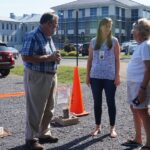
dedicationevent11Erin Murray’s creative look at wildlife composting to a Shenandoah Mountain backdrop was the focus of the “Artwork Dedication & Celebration of Composting” event held by the community Compost Drop-off program on Saturday, August 17. Coinciding with the Harrisonburg Farmers Market, event organizers encouraged market-goers to cross the green space from the Turner Pavilion to the compost collection bins’ drop-off area between 10 and 11AM to view the painting, meet the artist (shown at right), and learn from some local compost-enthusiasts.

Earlier this year, the Arts Council of the Valley awarded the Market Compost Drop-off program funds to commission Harrisonburg-based artist Erin Murray to create a compost-themed work for the outdoor, public compost drop-off bins’ site in downtown Harrisonburg. A print of the work has been installed at this location. The original work is being scheduled to rotate through area-wide public facilities including schools and dining venues.

In light of the painting’s dedication to “all composting efforts in Harrisonburg,” local composting champions were on hand at the event to share their work and expertise.

EMUComposting

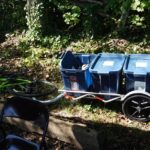
Eastern Mennonite University’s composting program is coordinated by Matthew Freed. Students haul compostables from all around campus by bicycle trailer to a central location to be composted on site.

soilcycles.amelia

Soil Cycles’ curbside compost pick up service was represented by Amelia Morrison. Her non-profit has saved over 6 tons of organic waste from the landfill this year … all moved by bicycle.

vermicompost.karenlee

Chris Bowlen, with the Headwaters Master Naturalists, showed those in attendance how to set up and maintain a worm composting operation, otherwise known as “vermicomposting.” Worm bins can be kept indoors and used year round to turn food scraps and garden wastes into valuable garden nutrients. Photo above is by Karen Lee.

dedicationevent4

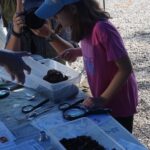
Shelley Baker (shown above) and Mary Gatling-Finks, also Headwaters Master Naturalists, guided anyone interested in discovering some of the hard working “Compost Critters” visible in decaying organic matter. Among the composting bins sampled for this activity were those of the Sunset Heights Community Composting bins hosted by Trinity Presbyterian Church.

Kathy.Waterman

Kathy Yoder coordinates the composting efforts at Waterman Elementary School. Their onsite composting bins churn out amendments for the adjacent raised-bed vegetable gardens.

timeline.segment

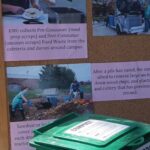
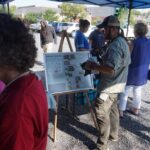
The Compost Drop-off program’s Art Fovargue devised a composting “timeline” with samples taken from along the six month process for organic waste to be turned into nutrient-rich finished compost at the valley’s only industrial scale composting facility, Black Bear Composting in Crimora.

Additional help and encouragement for this project was received by Headwaters Master Naturalists David Forrer, Stephanie Gardner, Sandy Greene, and Carl Droms; Harrisonburg Farmers Market manager Josie Showalter; Harrisonburg Parks & Rec’s Jeremy Harold; and Climate Action Alliance of the Valley member and founder Cathy Strickler.

Thanks to everyone who came out to participate and celebrate with us, reflect on and be inspired by Erin’s painting, and get excited about all we can do with composting!

– Adrie Voors
Compost Drop-off program coordinator

Unless otherwise noted, photos are by Carl Droms.
Click on an image below for a bigger version and to start a slide show of the photos.

Climate and Energy News Roundup 8/10/2019

Joy Loving is the author of the summer 2019 occasional Roundups, of which this is the sixth. 

Politics and Policy

Previous Roundups have noted both California’s requirements for vehicles and the Trump Administration’s plan to weaken standards.  From the Washington Post Climate and Environment (WaPo/C&E) comes this item titled “Major automakers strike climate deal with California, rebuffing Trump on proposed mileage freeze”.

Prior Roundups have also provided stories about actions by various federal agencies that can be perceived as contrary either to their missions or anti-environment or both.  WaPo/C&E has a story about how “Government watchdogs, environmental groups and even some top Republicans in Congress are starting to more closely examine the ways in which President Trump’s environmental deputies have attempted to control the release of public records. The recent scrutiny is focused on how two major environmental departments, the Environmental Protection Agency and the Department of the Interior, decided to follow the Freedom of Information Act, which grants members of the public the right to access records from any federal agency.” Fox13 WHBQ has a story that “An ardent critic of the federal government who has argued for selling off almost all public lands has been named the Trump administration’s top steward over nearly a quarter-billion federally controlled acres, raising new questions about the administration’s intentions for vast Western ranges and other lands roamed by hunters, hikers and wildlife.”  WaPo/C&E also covers this story, saying “Trump’s pick for managing federal lands doesn’t believe the government should have any”.  The New Orleans Times-Picayune reports on a settlement reached in a lawsuit that challenged delays by the Interior Department’s National Marine Fisheries Service (NMFS) in conducting analyses of impacts “of oil and gas development on federally protected species and critical habitat in the Gulf of Mexico”.  After cutting the size of Bears Ears National Monument in half, the Trump Administration “Officials say a new plan will protect Bears Ears. Others call it ‘salt in an open wound’”, WaPo/C&E reports.  A former intelligence analyst who resigned his post says “the Trump administration halted his report on global heating” (The Guardian).

The Augusta Free Press reports that members of Our Transportation Future “joined 300 state lawmakers, business leaders, transportation experts, and public figures in Baltimore [July 30]  at a regional public workshop on developing low-carbon investment strategies and priorities for the Transportation & Climate Initiative, a regional partnership for clean transportation in Mid-Atlantic and Northeast states.”

From CRES Forum comes a press release announcing results of a national survey showing that “Millennial GOP Voters Call on Republicans to Do More to Address Climate Change; Encourage Acceleration of Clean Energy Production in U.S.” The survey was a joint effort by “Citizens for Responsible Energy Solutions (CRES) Forum and the American Conservation Coalition (ACC).”  The Washington Examiner reports that “Republican climate hawk Francis Rooney [will] introduce carbon tax bill that cuts payroll taxes…. Rooney represents a southwest Florida district exposed to sea level rise, and is one of only two congressional Republicans who publicly support a carbon tax to fight climate change.”  On this subject, The Hill notes “Carbon tax shows new signs of life in Congress”, observing “[m]embers of Congress on both sides of the aisle are introducing competing bills that aim to put a tax on carbon.  The push to regulate greenhouse gas emissions come[s] as both [parties]s face pressure from their constituents, and in some cases the fossil fuel industry itself, to regulate carbon emissions that lead to climate change.”  The Charleston (South Carolina) City Paper has an opinion piece by Rouzy Vafaie, of RepublicEn, noting that Senator Lindsay “Graham [is] one of the few Republicans discussing climate change” and thanking U. S. Representative Alexandria Ocasio-Cortez for waking up some Republican leaders.  NYT/Climate weighs in with “In a Switch, Some Republicans Start Citing Climate Change as Driving Their Policies”.  And Yale’s Climate Connections offers:  “Conservative nonprofit leader [of Conservatives for Responsible Stewardship] David Jenkins says climate change should be [a] priority for the right”.

Potpourri

Joel Dunn, CEO of the Chesapeake Conservancy, writes in the Bay Journal that “government leaders and Wall Street must heed the call to “fund the restoration of the Chesapeake and conservation for the planet by increasing public funding and attracting sources of private capital investment. The future of our Chesapeake Bay, and indeed our planet, depends on it.”

Writing in The Guardian, Megan Mayhew Bergman describes “What I learned writing about climate change and the US south for a year”. WaPo Capital Weather Gang advises:  “Buckle up: Climate change is already contributing to bumpier trans-Atlantic flights, study finds”.  Greentech Media brings this shout out for installing solar by someone who works for the solar industry.

Climate

What’s Happening?

We know that our rising greenhouse gas emissions have grave implications for us all.  Grist offers this story about one danger we may not have thought about:  “Rising emissions are robbing us of nutrients”.  Grist also offers this advice:  “Stopping climate change isn’t enough — we need to reverse it.”  The Union of Concerned Scientists (UCS) has this thoughtful piece:  “Climate Change and Agriculture: A Perfect Storm in Farm Country”.  UCS also offers ta stark picture of what excessive heat will mean in the U.S.

WBUR Public Radio brings the story about “What The Melting Of Greenland’s Ice Sheet Means For Sea Levels”.  WaPo’s Capital Weather Gang notes that “[t]he Greenland ice sheet is in the throes of one of its greatest melting events ever recorded”.  Grist provides some “crazy visuals coming out of Greenland’s heat wave”.  And The Guardian describes “ecological grief” among Greenlanders.

The Guardian’s Jonathan West writes about “[t]hree studies published in Nature and Nature Geoscience” that conclude:  “’No doubt left’ about scientific consensus on global warming…” and “Extensive historical data shows recent extreme warming is unprecedented in past 2,000 years”.  Mr. West includes references to other studies in his article.  The Guardian also has a story about a leaked IPCC report that concludes: “We must change food production to save the world, says leaked report.  Cutting carbon from transport and energy ‘not enough’”.  NYT/Climate covers this story as well.

Like to eat blue crabs from the Chesapeake Bay?  Here’s a good-news/bad-news story from WaPo’s C&E.  Its title suggests you might not want to wait too long to try some:  “Climate change will spark a baby boom of blue crabs. Then predators will relocate from the south and eat them.”  The Wall Street Journal provides information about scientists’ efforts to find the “Best Way to Restore Oysters in Chesapeake Bay”.  Sierra Club presents this disturbing article about the adaptability of birds to climate change:  “Birds Are Adapting to Climate Change, But Maybe Not Fast Enough”.

The Oregonian warns:  “Global warming brings increasing wildfire risk to rainy parts of the Pacific Northwest”.  Grist reports that “Arctic wildfires are releasing as much carbon as Belgium did last year”.

WaPo’s Capital Weather Gang points out that this summer’s “European heat wave bears the fingerprint of climate change”.  Really?

Who’s Doing What (or Should or Shouldn’t Be)?

Previous Roundups have presented stories about trees and the roles they play in combatting the climate crisis.  Here are a few more.  Syndicated columnist Kathleen Parker has some thoughts on what “we can do” about climate change in this piece.  In brief, “Plant a tree, hug a bee”. The Sierra Club’s Michael Brune argues that “the real challenge of the climate crisis isn’t a lack of solutions. Whether it’s 1 trillion trees or 100% clean, renewable energy, the solutions are right in front of us”. He supports the Trillion Tree Campaign, while acknowledging that “reforestation alone won’t be enough to solve the climate crisis”.  Ethiopia has launched a “National ‘green legacy’ initiative [that] aims to reduce environmental degradation” and “[a]bout 350m trees have been planted in a single day” Guardian (article).  WaPo/Local reports that “Virginia’s destroyed ‘Founding Forest’ may be bouncing back”.  The story is about “a nature preserve [near Waverly, Virginia] brimming with young longleaf pine — a peculiar tree with long green needles and a taste for fire.”

Iceland is mourning the loss of one of its iconic glaciers, the Okjokull, with a monument describing how and why.  According to this WaPo/C&E story, the cause is “human-caused climate change” and the message to the reader “is hopeful, acknowledging ‘what is happening and what needs to be done.’”

NYT/Climate reports that “Moody’s Buys Climate Data Firm, Signaling New Scrutiny of Climate Risks”.  “We are taking these risks very seriously,” said Moody’s Investors Service’s spokesperson.  NYT/Climate also reports, on the other hand, that “Homes Are Being Built the Fastest in Many Flood-Prone Areas, Study Finds”.  Forbes asks and answers the question “Is There A Windfall In Climate Change For PE [Private Equity]?” noting that “approximately 200 of the world’s largest companies collectively peg their climate change exposure at nearly $1 trillion.”  The article goes on:  “Manufacturers around the globe cite changing weather patterns and rising seas and rivers as increasingly disruptive to their supply chain. Within the U.S. utility industry, executives name climate change as one reason behind increasingly fierce wildfires, which have destroyed transmission and distribution infrastructure. While all of this may portend darkening financial skies, some see a different forecast developing. One where there are not only ideas but also action and financial opportunities. Some experts even see tailwinds for investors.”

Energy

Renewable Energy

Texas continues to look to renewable energy, even while it’s continuing its long relationship with fossil fuels.  USA Today reports:  “Not blowing smoke: Wind has overtaken ‘risky’ coal for energy use in Texas for the first time.”  According to the Houston Chronicle, “Rooftop solar company sees brighter days in Texas”.  Why?  In part because:  “Texans — and Houstonians in particular — are becoming increasingly concerned about the reliability of electricity after several recent hurricanes and bad storms knocked out power for days. Grocery stores, gas stations and other businesses have installed backup generators so they don’t lose refrigerated and frozen food and can keep operations … going. Homeowners have been taking a clue by installing generators in their backyards….  Sunrun, a San Francisco-based company …[in] the U.S. residential solar market, is betting that controlling power with rooftop panels and a battery in the garage will be just the thing to make Texans take a second look at solar.”

Some good news in Virginia:  WVTF Public Radio says “A group of Communities in southwestern Virginia created a plan a couple of years ago to bring more solar energy to the region. And it appears to be working.”  WVTF has a 2nd, related story.  Appalachian Voices also reports this story, as does Kingsport Tennessee’s Times News.   More good news:  The heads of Appalachian Voices and Freedom Works penned a joint op-ed titled “A coalition in Virginia is transcending polarization to take on entrenched special interests” [WaPo].  Bacon’s Rebellion blogger Steve Haner discusses the fact that “No Appeal [Was] Filed on RGGI Regulation, Now In Force”.  Noting that the regulation is now fully in force, Mr. Haner adds that “Language inserted by General Assembly Republicans into the current state budget merely puts RGGI membership and its related carbon tax on hold.  It did not overturn the regulation, which went into effect June 26. The outcome of the November election will likely determine whether that roadblock remains in place beyond next summer, when the current budget provisions expire.”  Writing in the Virginia Mercury, Sarah Voglesong reports that, “Despite legislative blocks, one form of carbon cap-and-trade is alive and well in Virginia.”  Her story is about “The Nature Conservancy’s Clinch Valley Program in Abingdon, which oversees six forest carbon projects covering almost 145,000 acres in Virginia”.  Paragraphs 2 and 3 of this Bacon’s Rebellion blogpost suggest this project really isn’t such good news.

In WV, a professor has developed a prototype method for an environmentally and ecologically valuable use–growing a grass, giant miscanthus, on old surface coal mines.  Growing this grass in poor quality soil doesn’t require fertilizer and the grass can be harvested to produce biomass that “can be turned into value-added products like heating pellets, biofuels like ethanol, and more”.  Ohio Valley Resource has the story.  The Charlotte Observer tells us that “As electric vehicles go mainstream, companies spar over who will charge them up in NC”.

There is great interest in using batteries that store electricity generated by solar and wind to facilitate management of the electric grid as more renewable energy sources come online.  Reuters has this story about PJM Interconnection, the grid manager “whose territory spans from Illinois to New Jersey [including Virginia] [and which] is preparing to open its long-range capacity market to energy storage projects….  Under the rules, though, PJM would only recognize the full value of batteries that can supply continuous power for 10 or more hours. That’s drawn criticism from clean energy and storage industry groups who say the 10-hour threshold is ‘unworkable, arbitrary and discriminatory’ against the industry.”  A somewhat related story comes from PV Magazine.  It’s about “A research paper, The role of energy storage in deep decarbonization of electricity production, by University of Michigan scientists”, which looked at whether and how storage can enable carbon emission reduction.

S & P Global says that “Solar [is] rising in the southeastern US”, noting “After climbing 15% in 2018, utility-scale solar capacity in the southeastern US is expected to surge another 25% this year, but the geographic concentration of such growth is driven more by policy than by the quality of the sunshine”.  Greentech Media reports that “Solar ITC Extension Bills [Have Been] Introduced in House and Senate [but that] [d]espite solar energy’s broad popularity, a proposed five-year extension of the Investment Tax Credit faces a slippery climb as the 2020 election gears up.”  Meanwhile, in California, “Low on water, California farmers turn to solar farming” [Grist].

This Guardian article tells us that “Low-carbon energy makes majority of UK electricity for first time” and “Rapid rise in renewables combined with nuclear generated 53% in 2018”.

One might think that the term “renewable natural gas” is an oxymoron or a typo, but one might be wrong.  From Yale Environment 360 comes a story that asks, and answers, this question:  “Could Renewable Natural Gas Be the Next Big Thing in Green Energy?” It’s about “small-scale biogas systems [that] have collected methane from landfills, sewage plants, and farms” and that might be scaled up “as businesses capture large amounts of methane from manure, food waste, and other sources.”

Greentech Media says that, while “[t]here’s never a good time for import tariffs when it comes to keeping costs down for renewables projects”, the negative effect on wind power development will be significant and “the timing of newly proposed tariffs on imported turbine towers could not be much worse.”  The New Orleans Times-Picayune reports that “[w]ind farms could one day power New Orleans, but high cost, other issues [are] cause for concern”.

Fossil Fuels, Utilities, and Pipelines

There have been numerous articles about Dominion Energy.  This one, from Greentech Media, says “The Battle for Virginia’s Corporate Renewables Market Heats Up”.  Ivy Main, writing in the Virginia Mercury, makes a case that “Fairfax County plans a historic solar buy—if Dominion Energy doesn’t stand in the way”.  At issue is a cap on the amount of kWs that can be installed under a Power Purchase Agreement (PPA) between the installer and the county.  Ivy gives the details.  Dominion has submitted plans for a pilot battery storage project, according to this Associated Press item.  This Bacon’s Rebellion blogpost offers opinions on the viability of Dominion’s Energy Efficiency programs.

Fox13 WTVT has a story about a recent decision in Florida on a proposed power plant project.  “Over the objections of environmentalists pushing for alternative energy sources, Gov. Ron DeSantis and two Cabinet members on Thursday approved a Tampa Electric Co. power-plant project in Hillsborough County.  With little comment, DeSantis and the Cabinet … voted 3-1 to approve the project, which involves upgrading a generating unit at the utility’s Big Bend Power Station. The unit will burn natural gas.”

The Institute for Local Self-Reliance (ISLR) summarizes its investigation of “electric utility forecasts from seven of the largest ten U.S. electric utilities in the past decade”. ISLR concludes that “the average forecast overestimated demand by 17% over three years. Over longer time periods, the forecasts were even less accurate. The errors, all overestimating use, reinforce an environment in which utility companies––with no market competition––can win permission from public regulators to build unnecessary power plants. The costs can be passed to consumers while the rewards accrue to the utility’s shareholders.”  Virginia residents:  Does this ring a bell?

Grist says that “Natural gas leaks are a much bigger problem than we thought”, based on a recent study reported in Geophysical Research Letters.  Somewhat surprisingly, perhaps, Forbes reports that “Hurricane Barry Knocked 700,000 Barrels Of Oil Per Day Offline And Hardly Anyone Noticed”.  Contrasting the production losses to those from Hurricane Katrina in 2005, the reporter explains:  “The difference between the impacts of the two hurricane events spaced 14 years apart is fully attributable to the revolution in shale oil production that has taken place during those intervening years.”  The result is that the industry overall was able to recover faster from taking Gulf production offline in 2019 because U.S. shale oil production has risen considerably during the 14 years and the drop, as a percent of usual production, was much lower.

In Louisiana, ‘the president of Louisiana Oil and Gas Association has said Gov. John Bel Edwards’ push for parish coastal erosion lawsuits against companies in the gas and oil industries has hurt the state’s economy.” [Article in The Louisianan].

The Virginia Mercury reports that “Another permit [has been] overturned for beleaguered Atlantic Coast pipeline” and that “the U.S. Court of Appeals for the 4th Circuit for the second time overturned a key project permit issued by the U.S. Fish and Wildlife Service last year. The court ruling declared that the agency had been ‘arbitrary and capricious’ in assessing the impacts of the pipeline on four endangered species.”  West Virginia Public Broadcasting has a related story.  The Augusta Free Press provides a statement by Kendyl Crawford, director of Virginia Interfaith Power and Light, about the court’s decision.  Metro News in Charleston West Virginia says “West Virginia Attorney General Patrick Morrisey and 15 other state leaders are asking the U.S. Supreme Court to overturn a[nother] ruling that stopped construction of the Atlantic Coast Pipeline [because the proposed path would cross the Appalachian Trail].”  The Augusta Free Press reports that the Virginia Department of Environmental Quality (DEQ) “issued a stop work instruction to Mountain Valley Pipeline. The instruction is based on issues identified during DEQ inspections that cite insufficient erosion and sediment controls on approximately a two-mile section of the project”.  In an editorial, The (Lynchburg Virginia) News & Advance asks “Atlantic Coast Pipeline: Is It Still a Viable Project?”

Brent Finnegan

brent.finnegan
Brent at the CAAV Steering Committee meeting with member Rosie Lynch, June 18, 2019.

Brent Finnegan, winner of the primary for the Democratic nominee for the House of Delegates 26th District, spoke to the Steering Committee on June 18, 2019. Finnegan runs a community documentary film business and is a planning commissioner for Harrisonburg.

In an informal discussion with the Steering Committee, Finnegan said that he supports a 45% reduction in carbon emissions by 2031 to ensure a sustainable future for the Shenandoah Valley. He supports state senator McClellan’s Solar Freedom Bill, which failed to advance out of the Senate Commerce and Labor Committee on January 29, 2019.

When asked about a yard waste ban at landfills, Finnegan stated that he doesn’t want policies that hurt low income families, citing that half of the 26th district is in poverty. When asked about the methane that is generated from landfills as a result of organic waste, Finnegan said that he supports community composting and educating people about the effect of organic waste on climate change.

Steering Committee members cited the survey conducted by Luntz, a Republican, the results of which indicated that 70% of Republicans 40 years old and under want the government to implement fee and dividend and 55% are angry at the GOP for not addressing climate change. They also mentioned RGGI and the Green New Deal. Finnegan responded that these are all parts of the big picture on climate change.
Finnegan said that he is talking to people about climate issues. He is also a proponent of protecting waterways.

– Michele Thomas, acting CAAV recording secretary, June 2019

Compost Art Celebration

Thanks to everyone who attended and participated in our celebration! Photos from the event are posted HERE.


dedication

The Compost Drop-off program received grant funds from the Arts Council of the Valley earlier this year to commission local artist Erin Murray to create a compost-related painting for installation at the downtown Community Compost Drop-off spot.

It’s completed, a print of it has been installed at the bins spot, and it is amazing! Go by the location to view it and/or come celebrate this work and the magic of composting at a dedication event on Saturday, August 17 from 10-11AM during the Farmers Market.


Come to the Community Compost Drop-off spot at the gravel parking lot at Warren and S Liberty St on Saturday, August 17 between 10 and 11 am for a dedication of newly installed artwork, and celebration of composting. Meet the artist, Erin Murray, and local composting champions. Learn about local composting efforts and how you can compost at home.

Meant to be enjoyed by users of the compost drop-off program and passers-by alike, this public artwork is a whimsical look at the “No Waste World” of wildlife. By mimicking nature, we too can recycle much of our waste to create new life. Whether with a backyard compost bin or a community compost drop-off program, composting makes ACV logo-black.300our world richer.

Thanks to the Arts Council of the Valley and the creative talents of local artist Erin Murray for this inspiring and fun way to promote composting!

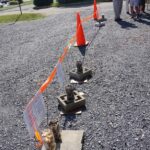
Also thanks to Harrisonburg Parks & Rec Department’s Jeremy Harold for providing the cedar logs used to create the artwork print frame and posts, and Headwaters Master Naturalist David Forrer for volunteering his time and woodworking skills to build the frame post.


More about the Artwork Dedication & Celebration of Composting Event

Erin Murray will be on hand with her original painting* and be available to discuss her work.

Representatives of Soil Cycles can let you know about what they’ve been doing to get Harrisonburg composting.

We’ll have a kids’ activity we’re calling a “compost critter safari” where we will be searching through finished compost to find and identify all the hard-working critters we have to thank for helping to turn garbage into great stuff. Of course, you don’t have to be a kid to have fun with this!

Headwaters Master Naturalist Chris Bowlen will have a worm composting set up to demonstrate for anyone interested.

Kathy Yoder, who facilitates the composting efforts and vegetable gardens at Waterman Elementary, will be on hand to tell us about her work with these projects.

Matthew Freed with Eastern Mennonite University helps manage their campus-wise composting program and will be available to discuss about it.

Also look for displays on the many benefits of composting and how you can compost at home.

* Watch for this painting to appear inside public areas around the valley over the coming year!


binspot7.22.19
Bins spot, July 2019, with artwork print recently installed.