SunRunr

JennyFrench
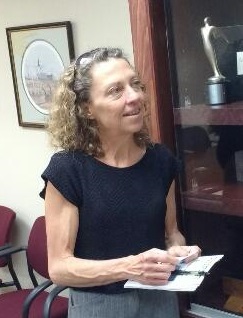
Jenny French, president of SunRunr of Virginia, Inc.

Have you ever had the experience of using a generator, perhaps when the power went out at home?  It is horrible in just about every way except for getting the lights back on.  Noisy, you can wake up the neighborhood; polluting, must be used outdoors, don’t even think about pulling it into the garage.   And be sure to keep gasoline on hand and remember to change the oil now and then—because if you don’t, the lights are not coming on.

Now consider instead that you are using a generator whose only sounds are those of a fan and controls clicking; that there are no fumes at all, and no gasoline, no oil required.  Sounds like a dream, doesn’t it?  Well, that’s what SunRunr, Inc. has come up with– A fairly compact system (160lbs) consisting of a pair of solar panels with a rechargeable battery and inverter that produces household electricity.  It can even be adapted to different currents for other countries, and is prewired to run on energy from wind and water, as well as sunshine.  It IS a dream system.

Jenny and Scott French, with the inventor, Alan Mattichak are the management team, and this home-grown company is good enough that they were the Virginia choice to be invited to the White House with just six companies from other states to show off new renewable energy technologies.  Jenny was seated next to President Obama.  That would really make me tongue-tied, I don’t know how she survived the experience.

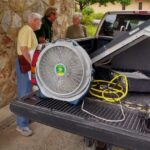
Jenny and Scott put a unit in the back of a pickup truck and brought it to the June 21, 2016, CAAV steering committee meeting for us to see.  Check out our photos!

While they sell units as backup systems for many uses and as the central system for some remote areas, the most rapidly developing market appears to be in other parts of the world:  Africa, the Canary Islands, other places that I can’t find on a map.  You can go online to get lots of details and find your system at www.sunrnr.com.

– Anne Nielsen, CAAV Coalition Building Committee

Climate and Energy News Roundup 6/17/2016

There will be no Weekly Roundup next week.  The next one will be July 1.

Climate

John Abraham, writing in The Guardian, provides some insights into the causes of coral bleaching and the failure of “managed resilience” to protect against it.  Not all is bad news, however, as a study of 2,500 coral reefs has revealed certain “bright spots” that did not have as much bleaching as might be expected, providing information about how coral reefs might be protected.

This item may be of interest to folk in business or manufacturing that you might know.  There is a sense among some that the developed world will be less affected by the impacts of climate change than the developing world because developed countries have more resources that can be brought to bear on the problem.  A new study published in Science Advances challenges that.  Because manufacturing has become so globalized and inventories are kept to a minimum, disruptions at any point in the supply chain can have cascading effects.  Consequently, we are not as immune to climate change impacts as we might think.

According to scientists with the World Weather Attribution project, preliminary analysis indicates that climate change made the recent flooding in France 90% more likely, whereas the impact of climate change on the flooding in Germany was less clear.

Warmer temperatures and the just-ended El Nino are having an impact on CO2 levels in the atmosphere.  A new paper, published in Nature Geoscience, finds that as summers warm, alpine soils are losing carbon to the atmosphere as CO2 as a result of increased microbial activity.  In other words, they are becoming sources of carbon rather than sinks.  Furthermore, according to a new paper in Nature Climate Change, El Nino has dried out tropical forests and plants, thereby reducing their ability to take up CO2 and helping the concentration in the atmosphere to increase this year by 3.1 ppm (projected) compared to an annual average increase of 2.1 ppm in past years.  Finally, a milestone was passed when the CO2 level in Antarctica exceeded 400 ppm for the first time.

El Nino helped make May the hottest May in NASA records and the 8th straight warmest month on record.  Analysis by NOAA also listed May 2016 as the hottest May on record.  Because the El Nino event is over, it is likely that the streak of record-breaking months will end.  Nevertheless, May temperatures caused the World Meteorological Agency to warn of “fundamental changes” in the global climate.

The Wall Street Journal has a long record of presenting editorials and op-ed pieces that deny the role of humans in climate change.  As a counter to that, and to provide the business community with the facts about climate change, The Partnership for Responsible Growth is taking out ads on the Journal’s editorial page.  Background research on the Journal can be found here.

Greenhouse gases released from the growing of crops and livestock increased by a little more than 1% in 2014, compared with a year prior, according to data from the U.N. Food and Agriculture Organization, whereas burning fossil fuels for energy grew by about half that amount.

In 1955 there were 10 extreme weather events in the U.S. that cost more than $1 billion each; together they killed 155 people.  Whether they were caused by climate change is a question that scientists are seeking to answer through “attribution studies.”  It’s complicated.

Energy

A new forecast by Bloomberg New Energy Finance (BNEF) plots out global electric power markets for the next 25 years and lists eight massive shifts that are coming to those markets.  Chief among them is that costs of wind and solar power are falling too quickly for gas ever to dominate on a global scale.  In addition, according to a new report by the International Renewable Energy Agency, the average cost of electricity generated by solar and wind energy could fall by up to 59% by 2025 if the right policies are in place.

A detailed study by MIT engineers, published in the journal Applied Energy looked at the potential role of energy storage in our future.  According to Greentech Media “The researchers found that it’s possible to meet stringent greenhouse gas limits without any energy storage. The energy mix in a no-storage scenario requires high levels of nuclear, though….  As the level of storage increases, it allows greater penetration of renewable sources by helping to balance the ups and downs of variable production.”  Another study from MIT examined different types of storage and found that some can be good investments, even with today’s technology and costs.

For a fascinating example of innovation with renewables and storage, check out this article about the Kodiak Electric association in Kodiak, Alaska.  It’s this sort of thing that keeps me optimistic that we can meet our energy needs in cleaner ways.

German automobile manufacturer Daimler will introduce a prototype of its new electric-powered Mercedes at the Paris Motor Show in October.  It will have a range of 300 miles.  Matthias Mueller, chief executive of Volkswagen, announced that the company plans to introduce 30 battery-powered electric vehicles over the next 10 years.  In addition, even Harley riders will be able to ride green within 5 years according to a company executive.  If advances in battery technology continue, electric cars can have a big impact on emissions from the transportation sector, provided they are charged with green energy.  This is important because transportation now emits more CO2 in the U.S. than power plants for the first time since 1979.  Furthermore, a new report from the Rocky Mountain Institute examines the impact on the grid of having large numbers of electric vehicles.  Surprisingly, many of the impacts can be positive, if energy regulators adopt appropriate regulations.

According to a report from the Department of Energy, for a variety of reasons U.S. coal production during the first quarter of 2016 fell to the lowest level seen in 35 years, when the nation was in the middle of a major coal strike.

Building transmission lines is one of the most difficult tasks in the power sector, requiring a great deal of coordination and planning, particularly if renewables are to be incorporated.  Thus it is disturbing that a new report from the Brattle Group finds that transmission planners are failing in their preparation for a new mix of energy generators.  As an example of the problems transmission planners face, in spite of having spent six years in the approval process, the Clean Line Energy project to transmit wind-generated electricity across Oklahoma, Arkansas, and Tennessee now faces blockage by a bill passed out of the Committee on Natural Resources to the full U.S. House.

For a variety of reasons, people of low income spend a greater percentage of their income on energy.  One of those reasons is that their homes often are poorly insulated, which is why CAAV is working to inform people of free weatherization programs.  What you may not realize is how bad the situation is in Virginia.  Look at the map in this article, zoom in on Virginia, and compare it to our surrounding states.  Looks like something is very, very wrong.

These news items have been compiled by Les Grady, member and former chair of the CAAV steering committee. He is a licensed professional engineer (retired) who taught environmental engineering at Purdue and Clemson Universities and engaged in private practice with CH2M Hill, the world’s largest environmental engineering consulting firm. Since his retirement in 2003 he has devoted much of his time to the study of climate science and the question of global warming and makes himself available to speak to groups about this subject. More here.


Time For Honesty On Climate

Daily News-Record, June 4, 2016
H. Bishop Dansby, Opinion (Open Forum)

Climate change continues to be the greatest challenge of our era and probably in all of human history. At first, our government tried to address the issue with comprehensive energy and greenhouse emissions legislation. Lack of Republican support caused the legislative approach to fail, but in the meantime the Supreme Court made it clear that climate change could be addressed under the existing Clean Air Act, and the Obama administration took a number of strong regulatory actions to address climate change through the Environmental Protection Agency, giving the U.S. the credibility to sign the Paris climate accord. Meanwhile, Republicans, including Donald Trump, are doing all they can to roll back these gains.

There has been relatively little debate in the scientific community on the basics of climate change and our need to reduce the use of fossil fuels for a couple of decades. However, among politicians and the public, there has been continual debate, denial and partisan divide. While Democrats have generally accepted the conclusions of the scientific community, Republicans have vigorously denied them. The position of Republicans has gone from (1) there is no climate change, to (2) there may be climate change, but it is not manmade, to (3) there is climate change and man may be contributing to it, but there is nothing we can do about it. They have never quite gotten to: There is climate change, man is the cause of it, and we can avoid its catastrophic effects if we take adequate action.

Polls show that Republican voters are more progressive on climate change than Republican politicians, with Republican political leadership being the least progressive of all.

Shenandoah Valley representatives and residents are reflective of the national picture. With the action taking place in the EPA and other regulatory agencies, the only legitimate role of state and federal legislators is to stand aside and let the regulatory process go forward. Instead, elected officials such as Rep. Bob Goodlatte, R-Ronaoke, and Sen. Mark Obenshain, R-Harrisonburg, are doing all they can to frustrate the regulation of greenhouse emissions, whether by litigation, defunding or legislation to stop the EPA and Virginia’s Department of Environmental Quality.

Climate change is an undeniably formidable challenge. Energy is the foundation of our modern economy. The discovery and development of abundant coal, oil and natural gas has made possible the modern standard of living we take for granted. Nevertheless, there is good reason to believe that as the problem of climate change forces us to develop renewable sources of energy and more energy efficient buildings and vehicles, we will emerge with an even higher standard of living. While we would not have voluntarily chosen to transition off of fossil fuels, the doing so will usher in a new era of cheaper, cleaner energy.

It should be said in no uncertain terms that political leaders such as Goodlatte and Obenshain, who are ignoring the climate-change challenge, are failing us at an historic dimension. Further, the well-educated Shenandoah Valley physician, lawyer and businessman who brushes off the climate-change problem is failing us and his descendants. This is a failure of ethics, morality and imagination, and it is a failure that will have enormous practical economic consequences. These politicians and citizens may deprive us of the next and necessary era of human prosperity, not to mention depriving our descendants a livable planet.

Possibly, the world will stumble forward to address climate change without the help of Republicans. Renewable energy is competitive with fossil fuels, so the market can help solve the problem. Thankfully, most of the other major nations do not deny climate change and are moving forward with policies to address it. Even if this happens, what does this failure by a large part of our government and citizenry say about the quality of the contemporary American culture? Republican politicians and voters need to show some integrity and join the effort to legitimately and honestly address the issues of climate change, renewable energy, and energy efficiency.

Mr. Dansby lives in Keezletown.

Climate and Energy News Roundup 6/10/2016

In last week’s Roundup I mentioned the flooding in Europe and Texas. Huffington Post published a summary article with pictures about the events.  In addition, scientists have already determined that climate change increased both the likelihood and the severity of the flooding in France.

A few weeks ago the press paid a lot of attention to Native Americans in Louisiana who had to be relocated, making them the first climate refugees in the lower 48 states.  However, Native Americans in Alaska have been facing similar problems for quite some time.  Madeline Ostrander has an essay in Hakai Magazine about the Yup’ik people of Yukon-Kuskokwim Delta of Alaska.

Professor Peter Wadhams, head of the Polar Ocean Physics Group at Cambridge University, has predicted that the Arctic will be essentially ice free (less than 1 million sq km) in September of this year or next.  If not, at the very least a new record low will be set.  Other scientists disagree, although May 2016 experienced the lowest amount of sea ice in May ever, by a significant amount.

Alaska had the warmest spring on record.  In a new study using 87,000 images from Landsat satellites collected over 29 years, NASA has found that parts of Canada and Alaska are greening as a result of climate change.  Also in the Arctic, a retrospective study published in Nature Communications finds that during the summer of 2015 the northern part of Greenland was exceptionally warm due to a blocking pattern in the jet stream.  This led to greater than normal melting in northern Greenland, greater than in the south.

Scientists using elephant seals to carry instruments deep into Antarctic waters near glacial outlets have confirmed that warm circumpolar deep water is moving onto continental shelves where glaciers rest and melting their bases.

According to NOAA’s Coral Reef Watch bleaching has occurred on reefs near at least 38 countries or island groups in what is the most widespread coral bleaching event on record.

My sense of optimism is fortified whenever I run across innovative ideas that may someday provide us with energy without the use of fossil fuels.  One idea that has been in the press recently is the “bionic leaf” invented by Daniel Nocera of Harvard and Pamela Silver of Harvard Medical School.  The latter was featured on Science Friday today and in case you missed it you can listen to it here.  The bionic leaf is just one example of “liquid sunlight”, which was written about by David Roberts at Vox.

The Union of Concerned Scientists has two interesting infographics; one is entitled “The Climate Risks of Natural Gas” while the other is about “Fugitive Methane Emissions.”  On Wednesday, a North Carolina environmental advocacy group, NC Warn, asked the EPA inspector general to investigate whether a dispute over the calibration of methane detectors used in an important study of methane emissions from oil and gas fields has risen to the level of fraud.  The Washington Post also reported on this issue.

When water and CO2 are pumped into basalt rock formations in the subsurface, chemical reactions occur that convert the CO2 into mineral forms, i.e., new rock.  Consequently, there is little possibility the CO2 will come back to the surface, providing a way to sequester the carbon.  Now, studies in Iceland have shown that the transformations occur rapidly, within 2 years, rather than decades or centuries, as feared.  How extensively this can be exploited for carbon sequestration and storage still must be determined.

In their meeting earlier this week, President Obama and Indian Prime Minister Narendra Modi reached an important agreement that will facilitate elimination of the use of hydroflurocarbons (HFCs) as refrigerants in air conditioners, refrigerators, etc.  This is particularly important because HFCs are important greenhouse gases that are 10,000 times stronger than CO2 and are widely used in India and China, both of which are seeing large increases in air conditioner sales as a result of increasing affluence and a warmer climate.  Prime Minister Modi also addressed a joint session of Congress and announced several other initiatives important to fighting climate change.

Jim Pierobon has published an analysis of Dominion Virginia Power and solar energy in Southeast Energy News.  He also wrote about a meeting of a group of stakeholders hoping to establish proposals for solar energy for next year’s General Assembly.  Nationwide, 64% of the new electricity generating capacity that came on-line in the first quarter of 2016 was solar and the total installed capacity in 2016 is expected to be 14.5 gigawatts, almost double the amount installed in 2015.

Rockbridge County Board of Supervisors has written to DEQ objecting to the approval of a proposed wind farm in Botetourt County by its Board of Supervisors.  The proposers of that wind farm have said that they will take measures to minimize bat mortality, although scientists now say that the provisions used by the wind energy industry to reduce bat mortality may need to be strengthened.

Four states had sued the Nuclear Regulatory Commission, contending that it had not properly considered safety over the long term when it established the regulation allowing nuclear power plants to store spent fuel rods on-site indefinitely.  A federal appeals court rejected that argument.  Whether new nuclear power plants will be built in the future is a question being debated within power providers and environmental organizations alike.  For example, last week a debate about nuclear energy was held at Stanford University.  Andrew Revkin provides a commentary and a link to the YouTube archive of the debate.

Beyond Extreme Energy and other activist groups shining a light on FERC and the approval process for gas and oil pipelines are having an impact on the way they do business.  Activists and environmental organizations also have shown a light on the Trans-Pacific Partnership (TPP) free trade agreement, revealing the negative impact it could have on environmental and climate rules.  This has led to a consortium of organizations calling on senators to reject the TPP when it comes to a vote this fall.

For-profit oil and gas pipeline companies are experiencing increasing scrutiny as they attempt to use eminent domain to secure right-of-way for new pipelines.  According to BP, because of lower coal use and sluggish growth CO2 emissions from energy consumption grew by only 0.1% last year, the smallest advance since 2009.

These news items have been compiled by Les Grady, member and former chair of the CAAV steering committee. He is a licensed professional engineer (retired) who taught environmental engineering at Purdue and Clemson Universities and engaged in private practice with CH2M Hill, the world’s largest environmental engineering consulting firm. Since his retirement in 2003 he has devoted much of his time to the study of climate science and the question of global warming and makes himself available to speak to groups about this subject. More here.
 

Seeds of Resistance in Virginia

Stuarts Draft6.6.16.resize

From WMRA’s coverage of the event which took place on Monday, June 6, 2016:

Activists who helped bring an end to the Keystone XL pipeline from crossing Nebraska have come to Virginia to help local landowners do the same with Dominion’s Atlantic Coast pipeline. The alliance is staging six protests across Virginia and West Virginia, planting sacred corn along the route of the proposed pipeline. WMRA’s Jessie Knadler attended one event in Stuarts Draft to learn more about these “seeds of resistance.”

Jessie Knadler’s story is here: Planting Seeds of Resistance to Pipeline

Mike Tripp created this video about the event for Staunton’s News Leader; Laura Peters wrote the accompanying story:

videosnip

For video and story by Mike Tripp and Laura Peters for Staunton’s News Leader, click on the image above taken from the video.

CAAV founder Cathy Strickler and her husband Charlie, both current CAAV steering committee members, attended the Seeds of Resistance ceremonies held in Stuarts Draft and Wingina, Virginia, on Monday, June 6. Cathy shared the photos on this page.

Climate and Energy News Roundup 6/3/2016

A special thanks to Joy Loving for handling the Weekly Roundup for me while I was away.  I greatly appreciate her help.

Need some inspiration?  Read this blog post by David Rivka at Citizens’ Climate Lobby about the efforts of Jim Probst in West Virginia.  On the other hand, if you want to be brought back to Earth you might consider Richard Heinberg’s comments at the Post Carbon Institute.  Or you can read the rather long essay by Naomi Klein in The London Review of Books on how our tendency for “othering” influences how we respond to the human tragedies of climate change.

The big news locally was that Dominion Virginia Power lost the $40 million grant from DOE that it had been given to help finance the off-shore wind demonstration project.  This puts the entire project in jeopardy.  In other Virginia news, the Department of Environmental Quality has imposed precedent-setting protections against greenhouse gases and other air pollutants from Dominion Virginia Power’s proposed gas power plant in Greensville County.  Finally Ivy Main has a new blog post about Dominion and the Atlantic Coast Pipeline.

The G7 nations (U.S., UK, Canada, France, Germany, Italy, Japan, and the EU) have pledged to stop most fossil fuel subsidies by 2025.  The rub comes from how they define “most.”

The Yale Program on Climate Change Communication and the George Mason University Center for Climate Change Communication have released a new report entitled Climate Change in the American Mind: March 2016.  Since spring 2015 the proportion of Americans who think global warming is happening has increased by 7 percentage points, to 70%.  Furthermore 58% now say that they are “somewhat” or “very” worried about the issue.

According to the Australian Bureau of Meteorology, the current El Nino has ended.  It still remains uncertain, however, whether it will be followed by La Nina.  The Atlantic hurricane season began on June 1.  There is a 45% chance that it will be near-normal, with 10 to 16 named storms, of which 4 to 8 will be hurricanes with 1 to 4 category 3 or higher.

According to a report from the US Geological Survey, Alaska may be a net sink for carbon throughout the 21st century, rather than a source as many had feared.  It should be noted, however, that this conclusion is controversial because of some potential sources or sinks not considered due to insufficient knowledge.  What is clear, however, is that wildfires must now be recognized as a significant driver of climate change.

More than one-third of the coral reefs in the central and northern regions of the Great Barrier Reef died in the huge bleaching event that occurred earlier this year.  In some regions mortality exceeded 50%.  Interestingly, the Australian government scrubbed all reference to Australia from a draft UNESCO report on the danger that climate change poses for World Heritage sites, of which the Great Barrier Reef is one.  This was done out of fear of the impacts of the report on tourism.  Graham Readfearn of The Guardian has a commentary on the affair and Amy Davidson summarizes what made it into the report in The New Yorker.

In a recent paper in Nature Geoscience lead author Dr. Kyle Armour stated: “When we talk about ‘global warming’, there is a tendency to imagine that the warming will occur everywhere at the same rate. Yet, we’ve seen very rapid warming in the Arctic and very slow warming over the ocean around Antarctica over the last 50 years.”  His paper reports on studies of the Southern Ocean around Antarctica and why its warming rate is low.  Robert McSweeney of CarbonBrief reports on the major findings from the paper as does Alister Doyle of Christian Science Monitor.  Meanwhile, a new study raises concern about the stability of another large glacier in West Antarctica, although it is currently stable, but retreating.

Hydroelectric power does not produce greenhouse gases, but it has other environmental and social impacts.  Thus, it is disturbing that the Democratic Republic of Congo is moving forward with construction of the Inga 3 dam on the Congo River even though environmental and social impact studies have not been completed.  Nevertheless, when done properly, hydroelectric power can serve an important role in a grid with a large percentage of solar and wind power.  On a similar note, the easing of the California drought has increased its springtime hydroelectric generation to the highest level since 2011.

Proponents of nuclear energy as part of the mix of generation systems for carbon-free electricity are counting on fourth-generation reactors.  One of the most promising is molten salt reactor (MSR) technology, which Oak Ridge National Laboratory is working on with China, as well as with others.  Meanwhile, in spite of arguments within the scientific community about the best direction to take, efforts are underway to keep existing second-generation nuclear reactors running in the U.S. as a source of carbon-free electricity.

A new meta-study published Monday by researchers from the Brookings Institution suggests that rooftop solar actually benefits all consumers — regardless of whether they have solar panels.  The findings from the study should be considered by all regulatory and legislative agencies considering actions regarding rooftop solar.  If you are buying a new home and wish to install solar panels Fannie Mae will allow you to roll their cost into your mortgage through their HomeStyle Energy Mortgage.  Also this week, California power companies cancelled $192 million worth of transmission upgrades because they are no longer necessary, thanks to improved energy efficiency and increased rooftop solar.

An analysis of China’s energy strategy by Greenpeace suggests that its coal use and carbon emissions could be 10% lower than expected by the end of the decade.  Furthermore, the Renewables Global Status Report by REN21 found that investments in renewables worldwide in 2015 were more than twice the amount spent on coal- and gas-fired power plants.  With China leading the way, developing nations spent more than developed nations on renewable power for the first time.  This is very important because as the world heats up and developing nations become more affluent, the demand for air conditioning will increase markedly, driving up electricity usage.

Sierra Club presented its electric vehicle buyer’s guide.  One of those vehicles is a Volkswagen, which is  targeting sales of one million electric vehicles by 2026 and is also considering building its own battery plant.  The International Energy Agency’s (IEA) report Energy Technology Perspectives 2016 indicates that the electric vehicles sector is the only one on track to meet a 2C scenario.

As the developing world becomes more affluent, millions of buildings will be built for offices and residences.  Fatih Birol, executive director of the International Energy Agency, told The Guardian that the number one priority in tackling climate change must be to ensure that those buildings meet higher standards of energy efficiency or they will commit the world to high greenhouse gas emissions for decades to come.

On Wednesday, environmental groups said they would not comply with a sweeping request for information about climate change and ExxonMobil from the House Committee on Space, Science and Technology led by Chairman Lamar S. Smith (R-Tex).

These news items have been compiled by Les Grady, member and former chair of the CAAV steering committee. He is a licensed professional engineer (retired) who taught environmental engineering at Purdue and Clemson Universities and engaged in private practice with CH2M Hill, the world’s largest environmental engineering consulting firm. Since his retirement in 2003 he has devoted much of his time to the study of climate science and the question of global warming and makes himself available to speak to groups about this subject. More here.


Deb Fitzgerald

debfitzgeraldThe coalition visitor to the May 17th meeting of the CAAV steering committee was Deb Fitzgerald, chair of the Harrisonburg Planning Commission.

She told us that “Harrisonburg’s Comprehensive plan is due for an update.  This document lays out the strategic goals localities aim to achieve over the short and long run, and describe a set of prioritized targets and strategies used to achieve them.   Environmental/sustainability  goals and strategies have featured prominently in the plan. According to Section 15.2-2230 of the Code of Virginia, every five years the city’s Comprehensive Plan shall be reviewed by the Planning Commission to determine whether it is advisable to amend the plan. The Comprehensive Plan was last officially updated and amended between 2009 and 2011. City Council adopted the current Comprehensive Plan on May 10, 2011.

During the regular June Harrisonburg Planning Commission meeting, members will begin discussion of the process for this next required update of the city’s Comprehensive Plan.  The meeting is on Wednesday, June 8th at 7PM in Harrisonburg City Council Chambers.

Interested folks can visit:

https://www.harrisonburgva.gov/sites/default/files/CommunityDevelopment/files/Planning-Zoning/Planning-Commission/packets/2016/06%20June%202016%20Packet.pdf

and read pages 82-84 for a bit of history about the process used during the last 2 comp plan updates.  Note that the comp plan discussion is item 7 of 7 items of new business for the June meeting, somewhat later on the agenda.”

The meetings are open and those concerned about the sustainability future of the area are urged to attend. Both transportation and environmental issues will become a part of this update.   Planning commission meetings are somewhat more interactive than City Council meetings, but as this item appears late in the agenda, be prepared for that.

Thanks, Deb!


Deb Fitzgerald, current chair of the Harrisonburg Planning Commission, was our May coalition speaker.  City council appoints members of the commission.  While appointment (as opposed to election) preserves independence, there is a cost. Another member of the commission will be appointed shortly.

The required periodic Comprehensive Plan update was begun in March of this year.   Three council members think the Comprehensive Plan should be stripped down to the bare minimum required.  Two of those will remain on council after the November election but the two replacements elected will have strong influence.  Many of the goals of the Plan are aspirational, and some citizens have pushed hard on environmental impacts, building code updates etc. and some council members are reacting to that.  Aspirational goals may be endangered by the direction of city council.  Unless concerned citizens remain aware and on top of the process, it is likely that nothing will change.

The part of the Comprehensive Plan that is specifically in question is Objective 8.3:  To create a set of environmental performance standards for public and private development and redevelopment projects.

Barriers to implementation:  The city must build three schools.  The population is exploding, primarily through immigration.  The city manager’s office may not be equipped to run a city growing this fast (and over 50,000 now).  The city school population is now majority Hispanic.  Also, other “model” locations in Virginia (C’ville, Fairfax, Roanoke, Blacksburg) apply environmental performance standards to public facilities and programs only.  Private participation is voluntary except for compliance with existing state/federal applicable regulations and codes.  Some localities do provide incentives for private development to meet voluntary performance standards.

An advisory committee may be created, similar to the one that functioned to develop and implement new stormwater management regulations and programs.  They would compile an inventory of existing standards followed by the City and institute a public input process including Council-desired and citizen-desired additional standards, followed by a report to Council.  CAAV should at least keep tabs on progress of creation of the advisory committee and who is on it.

– Anne Nielsen, CAAV Coalition Building Committee