Climate News Roundup 4/29/2016

Representatives from 175 nations gathered at the U.N. headquarters in New York City last Friday, Earth Day, to sign the Paris Climate Agreement.  According to Mark Trumbull of the Christian Science Monitor, the signing is evidence of the changed mind-set that made the accord possible.  On the other hand, writing in The Guardian, Suzanne Goldenberg reminds us that we have a long way to go to put the promises of Paris into action.

This next item comes under the category of “Why didn’t I think of that?”.  It is widely recognized that for intermittent generators like wind and solar to become major sources of electricity, large scale energy storage will be required.  One technique currently in use at nuclear power plants (which work best with constant output) is pumped storage.  Unfortunately, building reservoirs has large environmental impacts and can only be done where there is adequate water.  So, how about moving something else up and down hill, such as electric trains carrying heavy loads that use electricity to get up the hill and generate it coming down?  That is what a company called ARES is doing.

Peter Sinclair has a new video entitled “Surveilling the Scientists” in his Climate Denial Crock of the Week series.  Meanwhile a new poll by Yale and George Mason Universities finds that the Republican electorate is showing increased acceptance of the threat posed by climate change.

Leaders of the World Bank, the International Monetary Fund and other major global institutions say cutting CO2 emissions enough to prevent the worst effects of climate change will not be possible unless all fossil fuel polluters are forced to pay for the CO2 they emit.  Toward that end, the first High Level Assembly of the Carbon Pricing Leadership Coalition (CPLC) was held at the World Bank recently.  The mission of the CPLC is to identify and advance ways to build effective, transparent, and equitable carbon pricing into the national climate action plans of the parties to the Paris Accord.

The count of oil and gas rigs in the U.S. has dropped by 78% from its high in October 2014 to the lowest number since Baker Hughes began compiling data in 1944.  On Monday, The Hill published a special magazine on energy and environment policy, “The Future of Energy in the United States.”  On Wednesday, the Institute for Energy Economics issued a report questioning the necessity for building both the Atlantic Coast pipeline and Mountain Valley pipeline.  Speaking of energy, infrastructure is indeed important.  Blocking pipeline projects is an important tool in the effort to keep fossil fuels in the ground, but what about blocking transmission lines carrying wind power from the mid-west to the east or west?

China has issued new energy guidelines halting construction of new coal-fired power plants in many parts of the country until at least 2018.  Meanwhile, here in Virginia our legislature and governor continued their battles over coal in the one-day veto session.  Ivy Main provides her thoughts on the outcome.  The use of coal in the U.S. has declined 29% since 2007.

Research by the International Institute for Applied Systems Analysis and the World Resources Institute has found that while micro-grids have brought light to poor families in India and Nepal, they have not provided sufficient electricity to help business or spur industry.

In partnership with Geostellar, a national solar installer, Etsy will help its sellers install solar panels on their home studios or businesses as a way to reduce Etsy’s carbon footprint.  Meanwhile, according to a new report from the Center for Biological Diversity, 10 states account for more than 35% of the total rooftop-solar technical potential in the contiguous U.S., but less than 3% of total installed capacity, thanks to weak or nonexistent policies. Virginia is among them.

The Internet offers us a wealth of information.  Unfortunately, much is of unknown credibility.  This is particularly true of articles about climate change.  Now a new resource is available to us to help us assess the credibility of articles about climate: Climate Feedback.  An article in The Guardian by the founder and an editor explains what they do and how they do it.

In prior Weekly Roundups I have linked to articles about the importance of framing issues to the values of the target audience.  Now a new paper in the Journal of Experimental Social Psychology has shown that when climate issues were re-framed in terms of patriotism, loyalty, authority and purity, values important to conservatives, conservatives were more likely to adopt favorable attitudes.

Tracking the extent of Arctic sea ice is very important for a number of reasons, not least of which is its value as an indicator of global warming.  Tracking is done by satellite using an instrument that detects microwaves emitted from Earth.  The value of this type of sensor is that it can collect data in the presence of clouds and the absence of sunlight.  Unfortunately, the major satellite that scientists have been relying on experienced operational failures that compromise its data, other satellites are getting old, and currently there are no plans to launch a new one.  Satellites have proved useful for tracking climate change in other ways.  For example, using data from satellite sensors collected over the past 30 years, an international team of scientists has been able to document a greening of Earth’s vegetation due to fertilization by the added CO2 in the atmosphere.  Their results have been published in the journal Nature Climate Change.

Although satellites have proven to be useful for tracking climate change, the record available from them is relatively short.  For longer term records, scientists must turn to surrogate measurements or direct observations kept over long periods.  Perhaps the longest continuous record of observations is that made by Shinto priests in the Kino Mountains of central Japan, who have recorded the date of appearance of an ice ridge on Lake Suwa each year since 1443.  Or, consider the glaciers in the Austrian Alps, which have been measured by a variety of groups since the 1800’s.  Both of these provide important records against which to compare surrogate measurements.

Berkshire Hathaway will hold its annual shareholder meeting on April 30 and investors everywhere will pay attention to every word uttered by Warren Buffett.  Once again consideration will be given to a shareholder resolution requiring the company to disclose climate risks facing its insurance business.  James Hansen will speak, urging Buffett to consider the future of young people in his investment strategy.  Writing in Inside Climate News, Nicholas Kusnet describes the extensive fossil fuel holdings of Berkshire Hathaway, Buffett’s response to climate change, and investor’s attempts to change it.  However, as pointed out by Mindy Lubber in Forbes, not all business is standing on the sidelines of the climate change fight.

Only a handful of states have enacted a price on carbon and all of them use cap-and-trade.  A ballot initiative in Washington seeks to make that state the first to adopt a revenue neutral carbon tax.  John Upton at Climate Central describes the arguments going on over the initiative.  Closer to home, in an editorial posted late on Tuesday, the Richmond Times-Dispatch has come out in favor of a carbon tax.

New research published in the journal Global Biogeochemical Cycles has found that as the world warms more low oxygen zones will develop in the oceans, impacting life there.

These news items have been compiled by Les Grady, member and former chair of the CAAV steering committee. He is a licensed professional engineer (retired) who taught environmental engineering at Purdue and Clemson Universities and engaged in private practice with CH2M Hill, the world’s largest environmental engineering consulting firm. Since his retirement in 2003 he has devoted much of his time to the study of climate science and the question of global warming and makes himself available to speak to groups about this subject. More here.

Climate News Roundup 4/22/2016

I recently got around to reading the April 4 issue of Chemical and Engineering News, the weekly magazine of the American Chemical Society, and read an article I thought I should share with you.  It is an opinion piece by Jack N. Gerard, the president and CEO of the American Petroleum Institute.  I am including it this week just so you can read what the other side thinks.  Along those same lines, carbon capture and storage (CCS) is seen by some as a way for the fossil fuel industry to continue, although as this article shows, CCS faces significant financial hurdles.  The battle to leave fossil fuels in the ground will indeed be long and difficult.

Eduardo Porter had a thought-provoking column in the Economy section of The New York Times entitled “Liberal Biases, Too, May Block Progress on Climate Change“.

The current issue of Yes! magazine is devoted to “Life after Oil”, with articles by Bill McKibben, Richard Heinberg, and more.

On Wednesday the Senate passed a bipartisan energy bill that has some good clean energy provisions but also some things that groups concerned about climate change find disturbing.  Among the latter is a provision that declares the burning of biomass “carbon neutral.”  The Senate bill must be reconciled with the bill passed earlier by the House.  Closer to home, the Virginia General Assembly failed to override Governor McAuliffe’s veto of a bill that would have extended tax credits associated with coal.

The World Resources Institute (WRI) has issued a new paper entitled “Shifting Diets for a Sustainable Food Future.”  The concepts presented in the paper have been summarized in 12 charts by the authors and Chelsea Harvey has a summary in The Washington Post.  Meanwhile, a new paper in Nature Communications reports on a thought experiment that investigated scenarios for meeting the world’s food needs in 2050 within the constraint of no more deforestation.  Finally, another interesting article from WRI summarizes six climate milestones that have occurred since Paris.

It is only April, yet many places in India are experiencing temperatures in excess of 40 C (104 F).  On the other hand, a new study published in Nature has found that over the past 40 years Americans have experienced warmer (i.e., more pleasant) weather in January, while July temperatures have not increased sufficiently to be uncomfortable.  Thus, Americans’ experience with the weather has not served as a motivation for climate action.

Houston, Texas experienced record rainfall Sunday night and Monday, with one unofficial weather station reporting 20 inches.  Houston is 50 miles inland and has an elevation of 50 ft, so things are pretty flat there.  Consequently, there was lots of flooding.  This is the second time in a year that Houston has experienced severe flooding.  So what do they mean by a 100 year flood?

On Monday faith leaders signed an Interfaith Statement on Climate Change, which urges “all Heads of State to promptly sign and ratify the Paris Agreement.”  More than 80 groups and 3,600 individuals of Jewish, Buddhist, Hindu, Christian, and Muslim faith signed on.  Some, however, question just how soon ratification should occurCarbon Brief explains the difference between adoption, signing, and ratification of the Paris Climate Agreement.  The World Resources Institute unveiled its interactive Paris Agreement Tracker this week to help us keep track of progress toward ratification and The New York Times presented a status report on where the major players lie in meeting their pledges.

The Paris Climate Agreement pledged to “hold the increase in the global average temperature to well below 2 C above pre-industrial levels and pursue efforts to limit the temperature increase to 1.5 C.”  This raises the question of how much less the impacts of a 1.5 C world will be.  To try and answer that question researchers at Climate Analytics in Germany ran simulations with the models used in the 2013 IPCC report and the results were published Thursday in the journal Earth Systems Dynamics.  Roz Pidcock of Carbon Brief summarizes their results and provides a graphic for easy comparison of the impacts at the two temperatures.

There was still more bad news this week about coral in the Great Barrier Reef of Australia.  Scientists have finished a survey of the entire reef and have found extensive bleaching in all three regions, with more than 99% in the north, 90% in the central, and 75% in the south.  Interestingly, scientists say that Queensland’s largest newspaper, the Courier Mail, is not adequately covering the coral bleaching event and consequently, they have taken out a full page ad in the paper to inform the public about what is happening.  Later in the week bleaching was also reported in western Australia.

In a paper published Monday, Canadian scientists report on the effect of declining sea ice on polar bear populations in the Beaufort Sea and Hudson Bay. The scientists worked with data from GPS collars that detailed the bears’ movements and compared them with satellite imagery detailing the extent of sea ice.  They found that only one-quarter of the bears had to swim more than 30 miles in 2004, whereas the number had risen to two-thirds by 2012.  Scientists at the meeting of the European Geophysical Union in Vienna have told Robert McSweeney of Carbon Brief that several signs suggest that the extent of Arctic sea ice could shrink to a new record low this summer.

A recent essay in Nature Energy argues that solar still has some hard economic obstacles to overcome before it can become a major energy source.  As adoption of solar expands, a significant problem will be “value deflation”, in which the electricity generated by solar panels gets less and less valuable as more panels come online.  Writing for Vox, Brad Plummer discusses this problem and explains how the solar industry might overcome it.  Joe Romm has an extensive article in Climate Progress debunking once again the idea that we need a miracle to get off of fossil fuels.  We can do it with existing technologies.

Apex Clean Energy has initiated the process for approval of their proposal to site 25 wind turbines atop North Mountain in Botetourt County.  Globally, though, China dominates the wind energy market with more capacity installed than anyone else.

In an earlier Weekly Roundup I provided a link to an article about Wrightspeed, a company that has been converting garbage trucks and other heavy vehicles to electric motors.  Now New Zealand’s biggest urban bus company has signed a contract with them to convert their fleet of over 1000 buses.

There were a couple of articles this week dealing with trees.  One reported on a new report from Woods Hole Research Center about the state of tropical forests, which are still being lost at significant rates.  Part of that article was devoted to the role of indigenous people in maintaining intact forests.  The other article deals with the threat of climate change to the coastal redwoods of the North American west coast.  These are such magnificent trees of such unimaginable age that it is particularly sad to think that we are still threatening their existence.

These news items have been compiled by Les Grady, member and former chair of the CAAV steering committee. He is a licensed professional engineer (retired) who taught environmental engineering at Purdue and Clemson Universities and engaged in private practice with CH2M Hill, the world’s largest environmental engineering consulting firm. Since his retirement in 2003 he has devoted much of his time to the study of climate science and the question of global warming and makes himself available to speak to groups about this subject. More here.

Teshome Molalenge

TM.crop
Teshome Molalenge, Director of Bridgewater College’s Center for Sustainability, on left, spoke at the CAAV steering committee meeting on April 19, 2016. CAAV members Bishop Dansby and Alleyn Harned are on right.

The Climate Action Alliance of the Valley’s (CAAV) steering committee welcomed Teshome Molalenge to our meeting April 19. He is the first Director of the Bridgewater College Center for Sustainability, created in 2012. The good news is that he has already had the support of three college presidents, and outreach to faculty and the student body.  Stewardship and Sustainability are now a part of the strategic plan for the college and a part of its students’ experience and college actions across the campus. There is an annual “Water Day,” a focus on energy efficiency and conservation, recycling, a grant to work on implementing solar technology. On Earth Day there is an annual tree planting event. They are working toward installation of water bottle filling stations on the campus in order to reduce the use and discard of plastic water bottles, an effort begun by an individual student whose action resulted in financial support from both faculty and administration. The continuing actions of Mr. Molalenge and others have landed Bridgewater College on the national list of “Green Colleges in America.”

Eighty percent of undergraduate classes now incorporate sustainability issues. Dr. Bushman, the new President, is an enthusiastic supporter, and is pushing to extend the message into the surrounding community.

We at CAAV are glad to learn about all the efforts of Mr. Molalenge and cheer for him and his collaborators as they work to make Bridgewater College and its environs a truly earth-friendly, sustainable community.

– Anne Nielsen, CAAV Coalition Building Committee

Catching the Sun

CatchingSun.orange.300Free screening of the movie Catching the Sun followed by a panel discussion.

Sunday, May 22, 2016
7:00 PM

Court Square Theater
41 Court Square
Harrisonburg

An unemployed American worker, a Tea Party activist, and a Chinese solar entrepreneur race to lead the clean energy future. But who wins and who loses the battle for power in the 21st century?

Through the stories of workers and entrepreneurs in the U.S. and China, Catching the Sun captures the global race to lead the clean energy future. Over the course of a solar jobs training program, Catching the Sun follows the hope and heartbreak of unemployed American workers seeking jobs in the solar industry.  With countries like China investing in innovative technologies and capitalizing on this trillion-dollar opportunity, Catching the Sun tells the story of the global energy transition from the perspective of workers and entrepreneurs building solutions to income inequality and climate change with their own hands. Their successes and failures speak to one of the biggest questions of our time: will the U.S. actually be able to build a clean energy economy?

Filmed in four countries over the last five years, Catching the Sun is not a gloom and doom climate change film. It focuses on the human stories of real people who are working towards tangible solutions. Solving climate change can unleash innovation and transform an inefficient, polluting energy system into something radically better for our economy.

“A must-see film. An eye-opening look at workers and entrepreneurs on the forefront of the clean energy movement that will transform, and enliven the way you see the future. What is clear is the wonderful opportunity the transition to clean energy represents.”  – MARK RUFFALO

trailersnip.300Movie running time: 75 minutes

Click on the image at left to view the trailer.

More about this movie here: http://www.catchingthesun.tv/

The movie screening and discussion are being hosted by the Climate Action Alliance of the Valley with financial assistance from the Harrisonburg Voluntary Gas Tax group and the Shenandoah Group of the Sierra Club.

Climate News Roundup 4/15/2016

Talking about climate change is difficult for a whole host of reasons.  This article in Grist by Amelia Urry has lots of good sound advice about how to do it.  On the other hand, a recent study published in Nature Climate Change found that focusing on risk reduction is a worthwhile strategy for convincing people of the need for action.  Perhaps Apple’s new initiative, called “Apps for Earth”, will increase the public’s conversations about climate change and other environmental issues.  It is pretty hard to summarize it in a sentence so you’ll have to read about it if you’re an Apple user.

In a recent Weekly Roundup I included an item about Dominion Power filing a brief supporting the Clean Power Plan.  In a post on her blog, Ivy Main presents her take on why they did this.  One possible reason is that Dominion’s parent company transmits and sells natural gas.  However, there are real questions about whether the shift to natural gas from coal for electricity generation will have the desired effect of slowing climate change because of the leakage of methane (the main component of natural gas and a powerful greenhouse gas) into the atmosphere.  Chris Mooney ofThe Washington Post had a good retrospective this week on the methane issue.  Finally, climate scientist James Hansen offers his opinion on how fracking and methane impact the presidential election.

Over 130 nations, including the U.S. and China, have announced that they plan to be present at the U.N. headquarters in New York City on April 22 to sign the Paris Climate Agreement.  The strong interest in signing now has arisen because if 55 countries accounting for at least 55% of global greenhouse gas emissions sign the agreement before the end of President Obama’s term of office, the next president would have a difficult time pulling out of the agreement should he/she want to.

Sammy Roth had an interesting essay in USA Today about the “Keep it in the ground” movement.  He writes about Kaitlin Butler, a Salt Lake City-based researcher with the Science and Environmental Health Network and “Keep it in the ground” supporter, who thinks climate advocates can win that battle if they promote an “empowering” message.  Her message of choice: “that if we make good decisions today, we can improve the lives of our children, grandchildren and thousands more generations.”  Isn’t that what we all want?

Recognizing that limiting warming to 2 C may not provide adequate protection to vulnerable areas of Earth, the Paris Climate Agreement included an aspirational goal of limiting warming to 1.5 C.  Given the fact that 85% of the world’s energy use is from fossil fuels and that time will be required to wean us from them, it is likely that meeting the agreed-upon 2 C limit, let alone the aspirational goal, will require the use of “negative emission technologies.”  In other words, we will have to remove CO2 from the atmosphere.  This week Carbon Brief presented a series of articles on negative emission technologies: 1, Ten negative emission technologies; 2, feasibility of negative emissions; 3, History of bioenergy with carbon capture and storage (BECCS); 4, Do we need BECCS to avoid catastrophic climate change?; and 5, Analysis, is the UK relying on negative emissions to meet its climate targets?

One proposed pathway to a clean energy future is to rely on hydrogen gas for many uses, with the hydrogen being produced by electrolysis of water using electricity generated from solar or wind facilities, or by steam reforming of methane, with the resulting CO2 being captured and stored.  Now it looks as if the city of Leeds in the UK will be the first to try this on large scale, with complete conversion by 2025-2030.

Peabody Energy, the largest U.S. coal company, announced early Wednesday that it was filing for Chapter 11 bankruptcy.  Concerning the cause, Benjamin Hulac of E&E News wrote: “Cheap and plentiful natural gas, as well as an oversupplied market of inexpensive coal — not environmental regulations — are the primary forces behind Peabody Energy Corp.’s bankruptcy and others in the U.S. coal industry, a wide range of financial experts said.”  Meanwhile, Norway’s sovereign wealth fund sold its shares in 52 coal-dependent companies, thereby divesting from coal.

In addition to the melting of glaciers due to global warming, there are several natural phenomena that contribute to sea level rise.  Now a new paper, published in the journal Nature Climate Change, has found that over the period 1970 to 2005, two-thirds of sea level rise was due to human influences.  In addition, subsidence, both natural and human-caused, is making a significant contribution to “recurrent flooding” in a region from Delaware to northern North Carolina, according to a new study in the journal Geophysical Research Letters.  Finally, another new paper in Nature Climate Change has found that many more small island will become arid in the face of climate change than had been thought previously.  Now it is thought that 73% are at risk of aridity, rather than 50%.

An analysis by the World Resources Institute has found that dedicating just a small percentage of a carbon tax to the redevelopment of communities in West Virginia’s coal country would have a major impact on preventing economic collapse in the region.  That information was presented at a national energy conference in Morgantown focusing on the future of West Virginia.  A more detailed accounting of the conference can be found here.

For the first time in three years, U.S. solar panel manufacturer First Solar Inc. is producing panels for less than China’s largest supplier, Trina Solar, Ltd., thereby justifying more than $3 billion in loan guarantees from the U.S. government.

A new meta-analysis of the various papers estimating the percent of climate scientists that agree that humans are causing climate change by emitting long-lived greenhouse gases to the atmosphere has confirmed that the value is between 90% and 100%.

The start of the melt season in Greenland is defined as the day the percent of the ice sheet undergoing melting equals or exceeds 10%.  The record earliest start date was May 5, 2010.  Well, on Monday (April 11, 2016) 12% of the Greenland ice sheet was melting, setting a new record for earliest start.  Perhaps that was because January through March was the hottest three month start to any year on record, according to NASA.  Also, March 2016 was the hottest March on record according to both NASA and the Japan Meteorological Agency.

Although wind turbines kill far fewer birds than do buildings and domestic cats, bird mortality, particularly for eagles and other raptors, is still a concern.  At a recent American Wind Energy Association (AWEA) conference in Charleston, SC two new technologies were showcased that help detect birds and bats flying near wind farms.  Also AWEA announced in Denver this week that wind produced 4.7% of the nation’s electricity in 2015.

Information continues to come to light concerning what and when the oil and gas industry knew about the link between CO2 emissions and climate change.  This time the focus is on the American Petroleum Institute (API), the trade organization for oil and gas.  The Center for International Environmental Law has revealed that the Stanford Research Institute presented a report to API in 1968 that warned the release of CO2 from burning fossil fuels could carry an array of harmful consequences for the planet.  Meanwhile, ExxonMobil has sued to block a subpoena issued by the attorney general of the U.S. Virgin Islands seeking more of its documents on climate change.

More bad news about coral this week.  A new paper in the journal Science has found that there has been a mechanism operating in the Great Barrier Reef that protects the coral from death when it experiences a bleaching event due to elevated temperature.  Unfortunately, in the future as temperatures continue to warm that mechanism will no longer happen.

These news items have been compiled by Les Grady, member and former chair of the CAAV steering committee. He is a licensed professional engineer (retired) who taught environmental engineering at Purdue and Clemson Universities and engaged in private practice with CH2M Hill, the world’s largest environmental engineering consulting firm. Since his retirement in 2003 he has devoted much of his time to the study of climate science and the question of global warming and makes himself available to speak to groups about this subject. More here.


Democracy Spring

brucelynden.charlie.dc.4.16.16.cs2.700

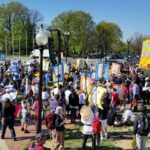
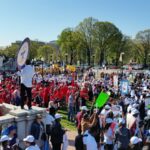
CAAV members Cathy and Charlie Strickler participated in the Democracy Spring demonstrations in front of the U.S.Capitol on Saturday, April 16, 2016, and Democracy Awakening rallies, marches and demonstrations on Sunday and Monday, April 17 and 18 in central D.C.

Saturday’s demonstrations and mass arrests for acts of civil disobedience were part of a weeks-long effort “protesting the influence of money in politics.” USA Today covered some of this here.

In addition to the top photo of Bruce Lynden and Charlie Strickler holding up signs, Cathy sent us these photos from Saturday:

From Sunday, April 17:

From Monday, April 18:

April 2, 2016, Meeting of the Fairfax Faith Alliance for Climate Solutions

Report submitted by Bishop Dansby:

faithallianceLaura and Bishop Dansby attended on April 2, 2016, a meeting of the Fairfax Faith Alliance for Climate Solutions at the Unity of Fairfax Church, Oakton, VA. The Faith Alliance is a working partner of Interfaith Power and Light.

The main part of the program was a panel of John W. Foust, Fairfax County Board of Supervisors; Pat Hynes, Chairman, Fairfax County School Board; and Brian Moran, Secretary of Public Safety and Homeland Security, who also serves as Virginia’s Chief Resilience Officer, charged with leading the effort to prepare Virginia for the current and future effects of climate change. Also in attendance were Catherine M. Hudgins, Fairfax County Board of Supervisors, who also spoke to the group. In the audience were a number of notable personages, including the individual who drafted the LEED standards for schools.

Pat Hynes said that Fairfax County School has scores of school buildings, and that they have more energy star rated buildings than any county in the nation. They have Eco Schools and Green Flag schools, the highest level of green. They emphasize renovation and stipulate that 1/3 of the renovation budget is for energy efficiency. She discussed they were taking bids on solar systems for their school buildings.

Both Hynes and Foust discussed the energy use Dashboard that allows the public to see online the energy use for each of the buildings in the county. The Federal government committed to 40% reductions in 10 years, and 30% of energy derived from renewable energy. The Faith Alliance says Northern Virginia governments should do no less. Energy dashboards – widely used across the nation – provides a way to measure progress and results in saving taxpayer money. The Energy Dashboard has been approved by Fairfax County as a result of the efforts of the Fairfax Faith Alliance for Climate Solutions under the leadership of Eric Goplerud, past Executive Director.

Secretary of Public Safety Brian Moran.
Secretary of Public Safety and Homeland Security Brian Moran

Brian Moran confirmed that Virginia was implementing the EPA Clean Power Plan. He said a number of efforts to stimulate renewables had been defeated by the republicans, who control the legislature. The Governor has vetoed the legislation that would have given the General Assembly the right to pass on the Clean Power Plan produced by the Department of Environmental Quality (DEQ), as well as the coal industry subsidy, but that it will not be known until April 20 whether those vetoes will be overridden. Apparently, there are some democrats that might vote to override. Further, the General Assembly is now using the budget process to defund the DEQ as to the clean power plan.

When the panel ended, Laura Dansby delivered the Climate Action Alliance of the Valley’s April 2 Action Day petition with 177 signatures to Brian Moran for delivery to the Governor. The petition supported implementation of the Clean Power Plan and renewable energy efforts beyond that.

Eric Goplerud announced that the Fairfax Faith Alliance had been chosen by the Interfaith Power and Light as the most successful faith alliance for climate in the nation, news that he got the day before the conference. The Faith Alliance has members from a large number of churches, but does not require the church itself to pass a resolution or otherwise join.

After the panel, the attendees (about 75) broke into discussion groups. The panel members stayed for the whole program and participated in the discussion groups. Bishop Dansby had an opportunity to tell in his group, which included Brian Moran and Pat Hynes, the story of our effort in Harrisonburg to get a net zero school, and that while that effort has probably resulted in getting a highly energy efficient school, it is likely that solar panels will lose out to other priorities. Bishop suggested that it would be useful for schools to have a state incentive or at least the governor’s imprimatur that schools implement solar systems for political cover for the local school boards.

Climate News Roundup 4/8/2016

There was an important decision this week in the children’s lawsuit against the federal government over the government’s failure to protect them from the impacts of climate change.  Lawyers from the government and the fossil fuel industry had asked to have the lawsuit dismissed, but the judge refused, noting that the go-nowhere political debate about climate change “necessitates a need for the courts to evaluate the constitutional parameters of the action or inaction taken by the government.”  The judge’s ruling is here.

There were a couple of articles this week about sea level rise that weren’t all doom and gloom.  One deals with how Norfolk is responding in a positive way, seeing opportunities for developing the city to be more resilient and becoming a case study for others to emulate.  The other describes how the UNC Institute of Marine Science in Morehead City, North Carolina is working with NOAA on a citizens’ science project to document where flooding occurs during King Tides as a way of anticipating what the future may bring.  While neither will stop the inevitable rise of the sea, they both demonstrate a willingness to tackle the problem in a positive way.  We can also learn from what others are doing all over the U.S. and the rest of the world to adapt to higher seas, as outlined in an article in Smithsonian.  Speaking of sea level rise, NASA unveiled a new site this week that allows you track what’s going on around the world.

If you suffer from seasonal allergies caused by airborne pollen, then climate change brings bad news.  Climate change is causing longer growing seasons and warmer temperatures are increasing the rate of plant growth.  In addition, CO2 is a plant “food” because it provides the carbon needed in photosynthesis.  Combined, these factors mean more pollen and as a result, doctors are seeing an increase in the number of people with allergies and in their responses.  Other health related impacts of climate change are documented in a massive new report issued by the Obama administration on Monday.  The White House issued a fact sheet and Rebecca Leber does a good job of summarizing the key findings on Grist.

Growing rice the traditional way in flooded fields results in significant methane emissions.  Since methane is a potent greenhouse gas, it would be great if growing techniques could be modified to reduce those emissions.  Well, U.S. rice farmers and the Environmental Defense Fund (EDF) have done that and EDF is working with rice farmers in India and Vietnam to see if the technique will work there as well.  EDF has also been working with utilities to apply a new sensor that allows detection of methane leaks from natural gas distribution systems in cities.  The work has shown that cities with old distribution systems can have a much larger number of significant leaks than cities with newer systems.  The good news is that the sensor allows the utilities to pinpoint exactly where in their distribution system the worst leaks are occurring, allowing them to be repaired on a priority basis.

When Saudi Arabia starts moving out of oil, is that an indication of a major shift in the oil industry?  Thirty-year-old Deputy Crown Prince Mohammed bin Salman has revealed that the country will begin selling shares in its oil company and transfer the assets to the Public Investment Fund, creating over a 20 year period the world’s largest sovereign wealth fund.

Strip mining and mountain top removal for coal have left a legacy of destroyed landscapes across the U.S.  Coal companies are supposed to remediate their damage and must post a bond to cover the costs in case they go out of business and the government has to do the job.  A provision in the law allows larger companies to self-bond.  Unfortunately, as coal declines, several of those companies are in bankruptcy and others may also declare.  This raises the question as to who will pay for the restoration of the land?  Also, what will happen to the laid-off coal miners?

Another economic article of interest concerns a modeling study published in the journal Nature Climate Change.  It found that climate change could cut the value of the world’s financial assets by $2.5 trillion, but if action was taken to limit warming to 2 C the losses would be reduced $1.7 trillion, even after the cost of limiting warming was accounted for.  Another account of the study can be found here.

A group of current and former lawmakers, as well as several tech companies, has filed a brief supporting the EPA in the lawsuit challenging its authority to regulate CO2 emissions from coal-fired power plants.  And, wonder of wonders, so has Dominion Power.  Several other friendly filings were made this week ahead of an impending deadline.

In a run-up to a Bloomberg New Energy Finance Conference in New York this week, Joe Ryan surveys the major players in renewable energy and asks whether one will become dominant, much like John D. Rockefeller did in the emerging oil market of the late 19th century.  Speaking of renewable energy, it is worth noting that it grew at the fastest rate on record in 2015.  Still new ideas are in the pipeline; columnist David Ignatius writes about some of the innovative ideas coming out of the ARPA-E program at the Department of Energy.

Carbon capture and storage (CCS) of CO2 emitted by power plants is a technology that has been difficult to make effective and economic at large scale.  Nevertheless, a new study in Nature Climate Change has found that it will be essential if we are to keep atmospheric levels of CO2 low enough to limit warming to 2 C.  Perhaps Net Power has the answer on how to make CCS economic (both in dollars and energy efficiency).

Also in the good news category this week is an analysis that shows that 21 countries have reduced their CO2 emissions while also managing to grow their economies.  Carbon Brief extended the analysis to a greater number of countries, finding an additional 14 that have cut the tie between economic growth and CO2 emissions.  On a similar note, the University of Notre Dame has released the latest rankings in its Global Adaptation Index, indicating which countries are doing the best and worst in preparing for climate change.

And then there are the good news/bad news items, such as the impacts of retreating sea ice.  Some whales are evidently prospering right now (long-term prospects are unknown), in both the Arctic and the Antarctic, whereas polar bears in the Arctic are hurting, having lost significant weight because of reduced opportunity to hunt seals on ice.  If you want to know more about sea ice Roz Pidcock at Carbon Brief has an analysis of ice behavior this year.

A new study published this week in Science examines the role of mixed-phase clouds (i.e., those containing both ice and liquid water) in the reflection of sunlight and the absorption of infra-red radiation from Earth, factors that contribute to the global energy balance.  Although the press release from Yale, where the study was done, emphasized that the results from the study show that climate models underestimate the amount of warming associated with increased CO2 in the atmosphere, Chris Mooney quotes NASA’s Gavin Schmidt as saying such a conclusion is premature.  Like many things in climate science, it’s complicated.

The World Bank, the world’s biggest provider of public finance to developing countries, said it would spend 28% of its investments directly on climate change projects, and that all of its future spending would account for global warming.

There was more information about food waste and its impact in the news this week.  A new study by the German Potsdam Institute for Climate Impact Research, published in the journal Environmental Science and Technology, found that up to 14 percent of emissions from agriculture in 2050 could be avoided by managing food use and distribution better.

These news items have been compiled by Les Grady, member and former chair of the CAAV steering committee. He is a licensed professional engineer (retired) who taught environmental engineering at Purdue and Clemson Universities and engaged in private practice with CH2M Hill, the world’s largest environmental engineering consulting firm. Since his retirement in 2003 he has devoted much of his time to the study of climate science and the question of global warming and makes himself available to speak to groups about this subject. More here.

Free Weatherization Info Meeting

Community Housing Partners and the Climate Action Alliance of the Valley invite you to learn how income-qualified families can get their homes weatherized for free.

craftsmen-158689_640Simms Center
640 Simms Avenue, Harrisonburg VA
Monday, April 11th
7:30 pm

Through the federally-funded Weatherization Assistance Program (WAP) adminstered by the Virginia Department of Housing and Development (DHCD), Community Housing Partners‘ (CHP) weatherization services reduce energy costs for families by improving the energy efficiency of their homes, while also assessing and eliminating related health and safety issues. The Energy Solutions team completes a site-specific energy audit of a home that includes blower-door-directed air leakage diagnostics, heating system safety and efficiency diagnostics, duct leakage diagnostics, and insulation needs. Following the energy audit, CHP’s weatherization team performs repairs and improvements to home heating and cooling systems and provides for the installation of energy-saving measures in the house, such as improved insulation and air sealing.

CHP’s weatherization services are for low-income families, particularly for households with elderly residents, individuals with disabilities, and families with children. Households are typically qualified based on income and recipients must be residents of the state of Virginia.

Facebook event page here.

More about CHP’s program here.

Letter to Gov. McAuliffe

rememberparis

March 3, 2016

Dear Governor McAuliffe:

The organizations and individuals in the Harrisonburg-Rockingham area have signed this letter as an expression of support of a robust and timely compliance with the EPA Clean Power Plan.

We also strongly support going beyond the Plan with policies that incentivize and support the development of renewable energy, energy efficiency, sustainable agriculture, and environmental protection in the broader sense.

We oppose the continued expansion of fossil fuel infrastructure, as that will only delay
addressing climate change and creating a renewable future.

We are certain that such policies will benefit Virginia’s economy and quality of life, and that failure to do so will put Virginia’s future at risk.

Signed:
Climate Action Alliance of the Valley
and 177 other signatures collected throughout March

300x224xApril-2-Day-of-Action-Cut-Carbon-Now-300x224This letter was prepared and circulated in support of the April 2, 2016, Virginia Day of Action to Cut Carbon organized by a coalition of regional environmental groups “… to call on Gov. McAuliffe to live up to his commitment to deliver to the people of Virginia a truly Clean Power Plan that cuts carbon pollution long-term and safeguards health and prosperity for generations to come.” – Appalachian Voices

Climate Action Alliance of the Valley (CAAV) members Laura and Bishop Dansby collected over 175 signatures on CAAV’s letter to Governor McAuliffe asking that he ensure Virginia’s Clean Power Plan (CPP) reduces carbon emissions and employs renewable energy. The letter, with its signatures (including the local chapter of the Sierra Club, Harrisonburg Rockingham Green Network, and the Voluntary Gas Tax group) carried a cover picture of attendees at the November “Postcard to Paris” event in Harrisonburg. Laura delivered the letter to Brian Moran, Secretary of VA Homeland Security (which includes resiliency and climate change), during the April 2 “Day of Action” Event in Fairfax: Working Faithfully With Our Leaders on Climate Solutions, at which Secretary Moran was a speaker, for delivery to the Governor. The cover picture showed the November event’s attendees displaying the large postcard asking the Governor not to forget Paris’ climate agreement. Read Bishop Dansby’s report of this event here.