Harrisonburg’s Arts Council of the Valley hosted their 3rd annual 24 Hour Project at Court Square Theater from 5:00 pm, March 18 until 5:00 PM, March 19, 2016. “Featuring music, drama, comedy, dance, poetry, workshops, and many other forms of performance art, the event is a celebration of community and collaboration through a non-stop, 24-hour run of performances by artists both local and broad,” and is used to help raise funds for the Arts Council.
For the second year in a row fossil fuel-driven climate concerns made an appearance at this event. At 3PM on Saturday, March 19, CAAV members Cathy Strickler and Joy Loving, along with several other volunteers from the area, presented a 20-minute skit at Court Square Theater’s 24 Hour Project. The skit was a follow-up to the November 29, 2015, Postcard to Paris event in downtown Harrisonburg held to add our voices to “the global plea sending an urgent message to the pivotal United Nations Conference on Climate Change convening in Paris. (And to) help create a new coalition of faith groups, student and environmental groups, business and government, to build positive changes in the Valley.”
The performance included drummer Nic Melas playing his unique box drum, participants reading the postcard’s actual messages and several other sayings about our need to nurture and protect the earth. In addition the skit presented a reenactment of the transition of the world from fossil fuels to a renewable energy future by Earl Martin and a young girl representing the next generation being forced to deal with our climate issues. Throughout the skit, a slide show of colorful pictures of people helping nature displayed on the screen behind the participants. The postcard itself was also displayed on stage throughout the skit.
The skit is available for use by anyone interested. It could provide local students a great opportunity to present its message to their classmates. If anyone is interested in obtaining the materials, email contactcaav[at]gmail[dot]com.
Click on the image at right for a one minute segment of the performance.
In a new essay in The Nation, entitled “Global Warming’s Terrifying New Chemistry,” Bill McKibben summarizes recent research on methane emissions and the impact of the fracking “revolution” on global warming.
Another new essay this week, also appearing in The Nation, is by Madeline Ostrander, a freelance writer and contributing editor to Yes! Magazine. It introduces readers to the Conceivable Future project, an organization cofounded by Meghan Kallman (partner of climate activist Tim DeChristopher) and Josephine Ferorelli (former Occupy activist) to help people deal with the difficult question of whether to have children. I found this essay to be very moving and thought-provoking.
A significant event this week was the publication of a paper entitled “Ice melt, sea level rise and superstorms: evidence from paleoclimate data, climate modeling, and modern observations that 2°C global warming could be dangerous” in the journal Atmospheric Chemistry and Physics. The paper was written by former NASA scientist James Hansen and 20 other scientists. I point this paper out to you for two reasons. First, is its content. If Hansen and his coauthors are correct (note that some disagree), the impact of global warming will be quicker and more catastrophic than heretofore thought. Chris Mooney of The Washington Post summarizes the major findings, as does Dr. Hansen in a video. If you prefer to read a transcript of the video, it can be found here. Second, it provides a window into peer review. Peer review is the process that journal papers must go through before being accepted for publication. This journal makes all of the peer review information public, which is unusual. So, if you are interested you can go to the journal’s website, click on the “peer review” tab, and scroll down to the section “Peer review completion.” There you will see the reviews by the referees, the author responses, and the editor’s decisions. This journal is also unique in having an open “interactive discussion” during the review process and in revealing the referees names.
Hydroelectric dams have been the power generation method of choice in the Amazon basin, with 191 dams already present and almost 250 more being planned. While such dams provide carbon-free electricity, a new paper in the journal Biodiversity and Conservation suggests that construction of the planned dams can significantly negatively impact the area in three ways.
Last week I provided a link to an article about coral bleaching resulting from warmer oceans. Now for some good news about coral. Researchers at UC San Diego’s Scripps Institution of Oceanography have reported that coral around remote islands is much healthier than coral around inhabited islands. This suggests that efforts to reduce pollution around coral reefs is indeed worthwhile to the survival of coral as oceans warm.
After negotiators in Paris agreed on a goal of limiting global temperature increases, climate activist Bill McKibben said: “We’re damn well going to hold them to it. Every pipeline, every mine.” His promise is playing out all over the country and around the world as activists challenge new fossil fuel infrastructure projects. In fact, consulting engineering firm Black and Veatch recently reported that the most significant barrier to building new pipeline capacity was “delay from opposition groups.” As an example, more than 300 climate activists protested in New Orleans on Wednesday morning at a federal auction of oil and gas drilling leases in the Gulf of Mexico.
If people in developed countries were to eat less red meat and move steadily toward a vegetarian or vegan diet, they could live longer and lower medical costs while reducing greenhouse gas emissionsfrom food production by 29 to 70% by 2050, according to a study published in the Proceedings of the National Academy of Sciences. (Note: At least one news source incorrectly reported that total greenhouse gas emissions would be reduced by 29 to 70%.)
Two related news items this week painted a pretty dim picture for life on Earth. First, the World Meteorological Organisation (WMO) was uncharacteristically blunt in its Status of the Global Climate report. In releasing the report, WMO Secretary-General Petteri Taalas stated “The future is happening now…The alarming rate of change we are now witnessing in our climate as a result of greenhouse gas emission is unprecedented in modern records.” Second, a new paper in Nature Geoscience reports that humans are currently releasing CO2 to the atmosphere 10 times faster than at any time in the past 66 million years, including during the PETM, which caused a warming event that lasted 100,000 years and had major impacts on biodiversity. There is some good news about meteorologists in the U.S., however: more than 95% now think climate change is happening and more than 80% estimate human activities are at least half-responsible (more than 66% “mostly” responsible).
Yale Climate Connections has an interesting post about the history of sea level rise in North Carolina and the techniques that have been used to estimate it. In addition, a study published in Nature Climate Change found that about 70% of the shoreline from Virginia to Maine could evolve naturally to meet rising sea levels, slowing the loss of land that has been projected by other research. The resilient shoreline comprises mostly natural ecosystems, which is what allows it to adapt.
China plans to increase its total wind power capacity by 22% in 2016. After adding 33 GW in 2015, it plans to add an additional 31 GW, the National Energy Administration announced on Monday. China is having to limit some local authorities’ planning of new wind projects because of the inability of the grid to handle new power flows, suggesting that once that problem is solved they will expand wind power even more rapidly. On a similar front, Germany is working on a plan to reduce its greenhouse gas emissions 95% from 1990 levels by 2050. The last coal-fired power plant in Scotland closed on Thursday. A new report, Global Trends in Renewable Energy Investment 2016, released Thursday by the United Nations Environment Programme, contains both good and bad news about the global energy outlook. The good news: the world spent more money setting up new wind, solar and other renewable installations than it spent on all new coal, gas, and nuclear plants. The bad news: “the outlook for power sector emissions remains alarming — despite the agreement at COP21 in Paris, and despite the growth of renewables detailed in this report.”
Although the adoption of electric cars has been hindered by high prices, limited range, a lack of charging stations, and competition from cheap gasoline, heavier-duty systems are undergoing rapid innovation for applications like battery-powered city buses, delivery trucks, freight loaders, and ferries.
The best winds for land-based wind energy are in the southwestern and midwestern U.S., but the major needs are in the east and far west. Thus new transmission lines are required to move electric power from source to point of use, but such lines are running into increased opposition. Approval is also complicated by the fact that it must be obtained in each state that must be passed through and each state has its own unique regulations.
These news items have been compiled by Les Grady, member and former chair of the CAAV steering committee. He is a licensed professional engineer (retired) who taught environmental engineering at Purdue and Clemson Universities and engaged in private practice with CH2M Hill, the world’s largest environmental engineering consulting firm. Since his retirement in 2003 he has devoted much of his time to the study of climate science and the question of global warming and makes himself available to speak to groups about this subject. More here.
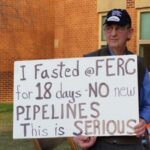
AWARD-WINING DOCUMENTARY DIRECTOR JOSH FOX AND FIVE OTHERS ARRESTED IN ANTI-PIPELINE PROTEST AT THE FEDERAL ENERGY REGULATORY COMMISSION.
March 24, Washington, DC — Gasland filmmaker Josh Fox, Megan Holleran and five others were arrested in the driveway of the Federal Energy Regulatory Commission (FERC) while waiting for commissioners to join them for pancakes topped with the last drops of maple syrup from the Holleran family farm in New Milford, Pa. They and about two dozen other activists were protesting FERC’s approval for the clear-cutting of a wide swath of maple trees at the Holleran farm.
Blocked by guards from entering the FERC building, Fox repeatedly called on the commissioners to come down for “the last dregs of syrup” and a conversation about fracked-gas infrastructure and climate change.
“Everyone I know is fighting a pipeline or a compressor station or a power plant that is in front of FERC for approval,” said Fox, wearing an apron that said “Pancakes not Pipelines.” “It is clear to me that FERC has to be the most destructive agency in the United States right now. They are faceless, nameless, unelected and ignore citizen input. I think of FERC as the Phantom Menace. The agency’s commissioners have been rubber-stamping fracking infrastructure all over country that threatens local communities and the planet by accelerating climate change.”
Climate activist Tim DeChristopher, wearing a chef’s cap and a “Pancakes not Pipelines” apron,” cooked the pancakes on a solar-powered cooktop set up on the sidewalk in front of FERC. DeChristopher said FERC had “cut down life-giving maple trees to make room for a death-dealing pipeline.” The agency has been “able to get away with this shameful behavior by operating in the shadows. We’re here today to invite FERC employees into the open, to engage in a human way with the people whose lives are impacted by FERC’s decisions.”
Protesters carried banners that said “Stop the Methane Pipeline” and “Pancakes not Pipelines.” Led by singer-songwriter Bethany Yarrow, who was also arrested and is the daughter of Peter Yarrow, protesters sang songs, including “We Shall Not Be Moved” and “Ain’t Gonna Let Nobody Turn Me ‘Round.”
While seated at a table, eating pancakes and waiting for FERC commissioners or employees to join them, several people hurt directly by the agency’s permits also spoke.
Holleran, among those arrested with Fox, said FERC had given approval for the trees to be cleared before the pipeline had all the required permits. “We followed all the rules. We asked them to wait before doing irreparable harm to our farm. This could happen to anyone,” she said. “FERC, come on down and chat with me. FERC has a chance to be accountable now.”
Nancy Vann, a Westchester, NY, landowner who blocked tree-cutting on her land for the Spectra Energy’s Alqonquin Incremental Market (AIM), said, “Each tree that is cut is another step toward an uninhabitable planet. I’m here for Megan and her family and for the 20 million people living within a 50-mile radius of the pipeline that’s planning to go 105 feet from the Indian Point nuclear power plant and two earthquake fault lines.”
Activist and psychiatrist Lise van Susteren said, “We are here to tell [FERC] we will not stand by while you have this unholy alliance with industry.” Psychiatrists and other health-care professionals have to report to authorities any child abuse, she said. “Every child stands to suffer because of what we are doing to the climate.”
“We can not afford to think what is happening now doesn’t affect us all,” said Aria Doe, co-founder of the Action Center for Education and Community Development in Rockaways, NY, where neighborhoods were inundated by Hurricane Sandy. Much of the pollution ends up in poor communities of color, she said. “I’m here for my future grandchildren.”
Robin Maguire from Conestoga, PA, said the Atlantic Sunrise pipeline is routed through sacred burial sites.
Also at the action was Karenna Gore of the Center for Earth Ethics.
In addition to Fox, Holleran and Yarrow, those arrested were: Gabe Shapiro from New Hampshire; Jane Kendall from New York City; Don Weightman, a BXE organizer from Philadelphia; Ron Coler, a Select Board member of Ashfield, MA, who’s fighting the NED pipeline and Connecticut Expansion.
Yarrow’s 9-year-old daughter, Valentino Ossa, watched in tears as her mother, still singing, was handcuffed and put in a Homeland Security van.
Beyond Extreme Energy organized the action, one of many the group has led at FERC. BXE is working with groups and individuals across the United States to revoke FERC’s mandate to operate an arm of the oil and gas industry. It seeks an end to FERC permits for new pipelines and other projects that allow the expansion of the fracked-gas industry. BXE has made this demand in an escalating series of protests at FERC beginning in 2014 and including disruptions at the monthly FERC meetings, described in the March 20, 2016, New York Times article “Environmental Activists Take to Local Protests for Global Results.” http://www.nytimes.com/2016/03/20/science/earth/environmental-activists-take-to-local-protests-for-global-results.html
BXE will continue its actions at FERC during the Rubber Stamp Rebellion planned from May 15 to 22.
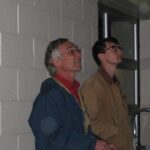
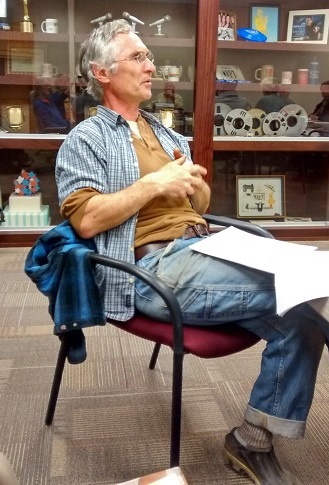
One of CAAV’s favorite Coalition partners came to the March 15 meeting of the steering committee. Tom Benevento of Vine & Fig (new name for New Community Project in H’burg) always has a lot going on. He keeps interns, visitors and locals engaged and amazed by what is happening onsite at the North Main St. Sustainable Living Center. They have recently improved the outdoor shower by using a biomass heater instead of solar. It is essentially a composter, and channels the heat from the process to warm the water in the shower. When it gives out, the compost is ready to use on the gardens—a genuine “twofer.” This shower is available not only to those working in the gardens, but also to homeless persons in that area, who often have no place to wash up. As the center has always served to promote the health and well-being of marginalized people, it extends that mission just a little further into the community in need.
The national New Community Project has recently refocused on addressing climate change because of its threat to humanity–especially to the most vulnerable people across the globe. Vine & Fig was central to the November 2015 Postcard to Paris event, and now they are doubling down on the issue. The “Renew Rocktown” project is subtitled “Harrisonburg Climate Recovery and Resiliency Strategic Plan.” In the Plan, “Citizens lead the way, build diversity, positive and fun, focus on actions and effective results, supportive of city council and staff, work for justice and build relationships.” The goal is a 50% CO2 reduction by 2035 and 100% reduction by 2050. To that end, both “citizens and government must become educated on the subject and action oriented.” In their sights at the beginning is a big push on energy efficiency, continuing focus on biking/pedestrian paths with interconnections across the city, an improved city bus system, more local sustainable food production, attention to waste reduction and recycling, with multicultural integration throughout. There is a very thorough long term plan with stepwise implementation through both government and nongovernment agencies, aimed to make Harrisonburg a model city. This is really exciting stuff. Look for their upcoming website for more information, and invite Tom to share his vision with your group.
– Anne Nielsen, CAAV Coalition Building Committee
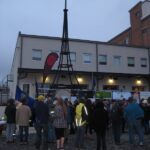
Photos below by Anne Nielsen taken at the Post Card to Paris event on November 29, 2015.
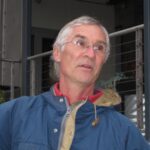
Tom with Vine & Fig intern Jordan Luther
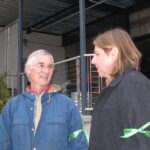
Tom with Pete Bsumek of the Sierra Club
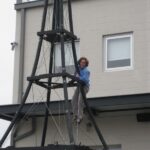
Corey Maxa stringing lights on the tower
Each month, the CAAV Coalition Building Committee invites a community member or group to present to the CAAV steering committee about projects with which they are involved. We are grateful to be working with so many other groups and individuals passionate about creating a more resilient, healthy and just world.
One thing that makes preparing the Weekly Roundup interesting is that you never know what you’re going to find. Who would have known that when I clicked on a link to an article about Mennonites building climate resilient bridges in West Virginia I would learn that the bridge in the article was designed by Harrisonburg’s own JZ Engineering? Way to go Johann and team! You can find a wonderful video about the project on Johann’s website.
Because there are farmers in the Valley using many of the techniques in the cover story of the March 7 issue of Chemical and Engineering News, I thought you might find it of interest. There is also an article about biochar in the same issue.
It is now official: February 2016 was the hottest February on record, not just in the U.S., but globally, according to both NASA and NOAA. Not only that, according to NASA the average global surface temperature in February was 1.35 C warmer than the average temperature for the month between 1951-1980, a far bigger margin than ever seen before.
Sulfates and other aerosols can block solar radiation from reaching Earth, thereby exerting a cooling effect. Because such aerosols are part of the air pollution emitted from coal-fired power plants, many have suspected that as those plants are cleaned up and fewer aerosols are emitted, their cooling effects will be lost, allowing CO2’s warming effect to be even more evident. Now, two new research papers provide evidence that more severe warming is occurring, particularly in the Arctic, which is heavily influenced by emissions from Europe.
One impact of a warming world is warmer oceans because they store most of the extra heat. That, in combination with El Nino, has put the world in the grips of the third global coral bleaching event, with the northern region of Australia’s Great Barrier Reef being hit especially hard.
Writing in The Guardian, John Abraham provides a summary of three articles that appeared recently in the Proceedings of the National Academy of Sciences about current and future sea level rise. In addition, a new study by University of Georgia scientists, published in Nature Climate Change, projects future populations of coastal counties in the U.S. and couples the data with projections of sea level rise to estimate the number of people who will be at risk of flooding. Under the worst-case scenario, with 1.8 m of sea level rise, 13.1 million people could be impacted. This study prompted noted shoreline geologist Orrin H. Pilkey and his children to write an opinion piece in The Guardian about the failure of developers to grasp the implications of climate change.
I missed an article that appeared a couple of weeks ago, perhaps because of its title, but upon finding it I thought it was important enough to call to your attention now. It concerns a paper that appeared recently in the journal Nature Climate Changedealing with the carbon budget. Apparently, the carbon budget given by the IPCC in the Fifth Assessment Report published in 2013 was too optimistic, suggesting that we will exhaust it more quickly than we originally thought. This too suggests that it will be difficult to limit warming to 2 C.
FERC has rejected the application of Veresen Inc. to build a liquefied natural gas export terminal in Oregon. FERC also denied Veresen’s plan to build a pipeline with Williams Partners LP to supply gas to the terminal.
Climate scientists have been extremely cautious when attributing any particular severe weather event to climate change. That may now change, according to a new report from the National Academies of Sciences, Engineering, and Medicine that has found that with appropriate studies it is indeed possible to state that a heat wave or prolonged drought has been influenced by climate change. Chris Mooney has a summary of the report’s findings at The Washington Post while Roz Pidcock takes a deeper dive at Carbon Brief, with interviews with a number of scientists.
These news items have been compiled by Les Grady, member and former chair of the CAAV steering committee. He is a licensed professional engineer (retired) who taught environmental engineering at Purdue and Clemson Universities and engaged in private practice with CH2M Hill, the world’s largest environmental engineering consulting firm. Since his retirement in 2003 he has devoted much of his time to the study of climate science and the question of global warming and makes himself available to speak to groups about this subject. More here.
We tend to think of the biosphere [all the plants, animals and microorganisms living on the surface of the Earth (excluding the oceans)] as a net “sink” for CO2, due to its uptake by plants as they photosynthesize. However, CO2 is not the only greenhouse gas associated with the biosphere. Methane, CH4, and nitrous oxide, N2O, are both strong greenhouse gases that are given off by microorganisms living in soil, pond sediments, and rice paddies. Ruminants (cows, sheep, etc.) also release CH4. Now a new study, published this week in Nature, has found that because of modern agriculture, and its associated releases of CH4 and N2O, the biosphere is now a net contributor of greenhouse gases, rather than a sink. Furthermore, atmospheric concentrations of CH4 are increasing after being stable for several years. A new paper in the journal Scienceattributes that increase primarily to agriculture, although others disagree.
As I have mentioned in previous Roundups there are two types of temperature records, from surface thermometers and from satellites. Peter Sinclair has a new video explaining why scientists trust the surface thermometers more.
President Obama and Canadian Prime Minister Justin Trudeau have agreed to new, coordinated measures to fight climate change. (The relevant part of the linked-to article starts just below the video.) They also pledged to institute new Arctic initiatives, including shipping corridors with low environmental impact and new protections on marine areas. Ed King of Climate Home focuses on one statement in the announcement and what it may mean for the decarbonization of the U.S. economy after President Obama leaves office.
On Wednesday, 21 teenagers appeared in an Oregon courtroom as part of a lawsuit against the federal government contending that it has failed to protect the children against harm from climate change. The lawsuit, brought by the organization Our Children’s Trust, asks the court to hold the government responsible for violating the children’s constitutional rights to life, liberty, property and equal protection under the law. This lawsuit is the second attempt to sue the federal government under public trust doctrine. The first federal lawsuit, which was dismissed, had local ties to climate activists Garrett and Grant Serrels, who, together with their cousin, Alec Loorz (founder of Kids vs Global Warming and iMatter), were plaintiffs on the lawsuit, along with other youth from the iMatter Youth Council. You can find James Hansen’s thoughts on the suit here.
The changing climate is having a severe impact on the world’s lakes with some on the verge of disappearance due to increased evaporation, lower input from rainfall, and increased withdrawals for irrigation. This can greatly decrease the agricultural productivity of areas dependent on the lakes for irrigation. On a similar note, scientists from 14 laboratories and institutions warn in the journal Global Change Biology that climate is changing faster than tree populations can adapt. As a result, even eastern forests “are vulnerable to drought and could experience significant changes with increased severity, frequency, or duration in drought,” according to the authors.
Germany’s second-largest energy company, E.ON, has confirmed that it is planning to launch a residential PV-plus-storage offering for the German market in April. The product will be based on Solarwatt’s MyReserve battery systems. It is refreshing to see an energy company embrace distributed storage and work to make it part of their power grid.
Solar Power Rocks is a website that advises consumers on getting solar power and they have just released their 2016 solar power rankings. Because of a variety of factors, Virginia ranks 35th in the nation, with an overall grade of D. Still, if you want to put on panels to cut your fossil fuel use you’ll get an internal rate of return (IRR) of 6.8%, giving a payback time of 14 years for a 5 kW system.
Much of sub-Saharan Africa will become unsuitable for growing key crops during this century if CO2 emissions continue as usual, according to a new study published in Nature Climate Change. Up to 60% of areas that currently grow beans, and up to 30% of areas that grow maize and bananas would no longer be suitable in a warmer climate. The study suggests that fundamental changes to farming may be needed to maintain food security.
Ever wonder why Americans aren’t concerned about climate change? Perhaps it’s because they never hear about it on television. During 2015 less time was devoted to climate change by the major news media than in 2014, even though 2015 was filled with climate related events, such as the Paris Summit and several record setting hot months.
The spring issue of Yes! magazine is entitled “Life after Oil.” It contains an explanation by Bill McKibben of why we need to keep 80% of known fossil fuel reserves in the ground.
These news items have been compiled by Les Grady, member and former chair of the CAAV steering committee. He is a licensed professional engineer (retired) who taught environmental engineering at Purdue and Clemson Universities and engaged in private practice with CH2M Hill, the world’s largest environmental engineering consulting firm. Since his retirement in 2003 he has devoted much of his time to the study of climate science and the question of global warming and makes himself available to speak to groups about this subject. More here.
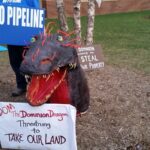
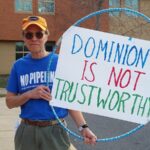
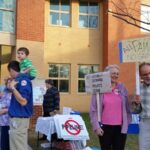
Four CAAV members participated in an afternoon of pipeline fighting in Churchville on March 8, 2016. A Dominion-organized open house about the Atlantic Coast Pipeline (ACP) scheduled from 5-7:30PM prompted groups like Friends of Augusta and Wild Virginia to organize peaceful action outside the open house venue at Churchville Elementary School. Senator Tim Kaine held a Kaine Connects event from 3-4pm at the Churchville Branch of the Augusta County Library hosted by his representative Gwen Mason.
Cathy Strickler offered this report on the group’s Churchville trip:
Anne, Bishop, Charlie and I went to the public meeting that Sen. Kaine’s staff person, Gwen Mason, held at the library. We got there 15 min. late, the room was SRO with about 40 people and the only topic was the ACP. A new voice was Tom Dirman(?), an expert on pipelines with life long professional experience. The discussion focused on what a terrible idea the ACP is, what a terrible player Dominion is, what FERC and Sen. Kaine can do to stop the project. Toward the end I commented on the need for more frontline community action and what Beyond Extreme Energy (BXE) is doing. We left at 4:45 and the meeting was still going.
We walked next door to the elementary school and joined other protesters, 40-50, lining the sidewalk into the Dominion open house to explain the new proposed route. There was a fairly steady stream of people going into the building. There was a lot of interest shown to the information the protesters were sharing, lots of conversations. We left at 6.
If you tend to worry too much about climate change, then perhaps Andrew Revkin’s interesting and introspective essay will help. I particularly like his climate change “serenity prayer”: “Change what can be changed, accept what can’t, and know the difference. Science can help clarify which is which.”
I subscribe to a blog called RealClimate that is run by climate scientists. I don’t normally include links to posts in it because they tend to be pretty technical. However, while I was out of town there was a post about sea level rise that I thought you would appreciate. Scientists have been able to reconstruct historical sea levels back around 2500 years. This shows that what has happened during the 20th century is indeed extraordinary. Similarly, The Atlantic had an article on how scientists study sea level rise, which gives a good perspective, but lacks the graphics in the RealClimate post. Meanwhile, German scientists, using Copenhagen as a case study, have concluded that damage costs increase much more rapidly than sea level rise itself, which seems logical.
Utility Dive has released its 2016 State of the Electric Utility Survey. It revealed that for the second year in a row, electric utility executives responding to the survey ranked energy storage first among the technologies for future investment. DOE’s Advanced Research Projects Agency – Energy (ARPA-E) claims to have made significant advances in battery technology so things may be happening rapidly in the future. The Utility Dive survey provides interesting insights into how electric utilities are planning to respond to the changing energy landscape. In addition, 91% of respondents indicated they expect utility-scale solar to increase significantly or moderately in their fuel mixes over the next five years, while 77% see wind doing so.
Heather Clancy writes on GreenBiz: “Despite uncertainty surrounding the future of the Clean Power Plan and contractual nuances that make even the smallest project feel unnecessarily complex, big businesses seem more committed to renewable energy than ever.” In fact, new data just released by the U.S. Energy Information Administration suggest that in the coming year, the solar sector will add more new electricity-generating capacity than any other — including natural gas and wind.
A draft inventory of US greenhouse gas emissions reports that emissions in 2014 were 1% higher than they were in 2013, marking the third year in a row that they have increased. Most disturbing was a 27% increase in methane emissions, causing EPA to hold off on publishing an official value until they have reviewed the data more thoroughly.
French-speaking Indians who live deep in a Louisiana bayou, some 50 miles south of New Orleans, became the United States’ first official climate refugees last week when the federal government awarded them $48 million to relocate.
ClearPath is a foundation whose mission is to accelerate conservative clean energy solutions. They have recently released a survey of voters concerning their views on energy. Their website allows you to view state and district level opinions on energy by party affiliation. The results for the 6th congressional district are quite interesting. Meanwhile, Ivy Main reports on the fate of renewable energy bills in the Virginia General Assembly this year. Perhaps the members of the GA should examine the results of the ClearPath poll.
Satellite images suggest tropical forests from the Amazon to the Philippines are disappearing at a far more rapid pace than previously thought, a University of Maryland team of forest researchers say. Others, however, disagree with the methods used.
A new study published in the journal The Cryosphere finds that Greenland is darkening, contributing to a positive feedback loop in which melting leads to a “darker” surface, increasing heat absorption, leading to more melting, etc. I have put darker in quotes because the darkening is not necessarily visible to the naked eye, but may occur at wavelengths outside of our visual range. Unlike other studies, this one did not find that soot from wildfires elsewhere on Earth was a significant factor.
A couple of weeks ago I provided links to a study that showed that middle and high schools teachers were often unprepared to teach effectively about climate change. Now John Cook, founder of the Skeptical Science website and Climate Communication Fellow at The University of Queensland in Australia, has written about an effective technique for teaching “controversial” topics.
These news items have been compiled by Les Grady, member and former chair of the CAAV steering committee. He is a licensed professional engineer (retired) who taught environmental engineering at Purdue and Clemson Universities and engaged in private practice with CH2M Hill, the world’s largest environmental engineering consulting firm. Since his retirement in 2003 he has devoted much of his time to the study of climate science and the question of global warming and makes himself available to speak to groups about this subject. More here.

 Harrisonburg’s Arts Council of the Valley hosted their 3rd annual 24 Hour Project at Court Square Theater from 5:00 pm, March 18 until 5:00 PM, March 19, 2016. “Featuring music, drama, comedy, dance, poetry, workshops, and many other forms of performance art, the event is a celebration of community and collaboration through a non-stop, 24-hour run of performances by artists both local and broad,” and is used to help raise funds for the Arts Council.
 Click on the image at right for a one minute segment of the performance.



 March 15, 2016