Climate News Roundup 5/29/2015

  • Nationwide (not just here in Harrisonburg) elders are taking up the cause of climate change, feeling that they must do all they can for their children’s and grandchildren’s future. They are even planning a rally in D.C. in September.
  • Doug Hendren has a new song about the TPP, called Fast Track Blues.
  • Ivy Main discusses Virginia Sierra Club’s latest General Assembly scorecard on climate and energy.
  • Extreme heat in India has killed more than 1300 people, which is not surprising because the combination of high temperature and humidity made it impossible for perspiration to evaporate and cool the body. Katherine Bagley of Inside Climate News has a roundup of what the latest science says about climate change and extreme weather.
  • Experts think that hurricanes will move further north in response to climate change, with more hitting the mid-Atlantic region. With 2015 shaping up to be a strong El Nino year, the Atlantic hurricane season is expected to generate fewer storms than average, whereas the Pacific is likely to see more storms.
  • As we approach COP21, the Paris Climate Change Conference, an informative infographic has been posted on visual.ly. It might be useful in explaining the climate change issue to family and friends.
  • Skeptical Science has a very informative post about the slowdown in global surface warming over the past 15 years or so, providing a rational explanation for why it has occurred. While the text is fairly long and detailed it is accompanied by a six minute video that summarizes the information in a very clear, succinct manner. I encourage you to watch the video so you’ll be prepared next time you hear someone say that global warming has stopped.
  • Drought has been severe in southern Africa and as a result people in Zimbabwe face disastrous food shortages and hunger.
  • Michael Grunwald has an analysis of the real “war-on-coal”, the one being waged by the Sierra Club, with the help of funding by Michael Bloomberg. This war is being fought on the economic front, not just the environmental one, and Sierra Club’s Beyond Coal campaign is winning.
  • A group of NGOs is working to convince 100 top corporations to set their greenhouse gas emissions policies in line with what scientists say is necessary to keep the global temperature rise less than 2 degrees C. Some are doing a great job, others not so great.
  • China’s coal use may have already peaked, and along with it, its CO2 emissions, but there may be lots of reasons.
  • In another installment of its series on “carbon bombs” The Guardian looks at the Canadian tar sands.
  • An analysis of rainfall data across the U.S. shows a pattern of more intense rainfall across many regions.
  • Chris Mooney examines the skeptics’ argument that we don’t need to worry about the loss of polar sea ice.
  • Jennifer Francis of Rutgers University and coworkers have argued that the warming Arctic is contributing to a wavy jet stream, which in turn impacts severe weather in the Northern Hemisphere. She and colleagues recently published a paper providing additional evidence for their hypothesis. Robert McSweeney, writing in The Carbon Brief, summarizes their latest data and what other climate scientists are saying about it.

These news items have been compiled by Les Grady, member and former chair of the CAAV steering committee. He is a licensed professional engineer (retired) who taught environmental engineering at Purdue and Clemson Universities and engaged in private practice with CH2M Hill, the world’s largest environmental engineering consulting firm. Since his retirement in 2003 he has devoted much of his time to the study of climate science and the question of global warming and makes himself available to speak to groups about this subject. More here.

Merchants of Doubt at CST June 2nd

MoDsnipThe Climate Action Alliance of the Valley (CAAV) has been working hard to bring this great film to Harrisonburg so we need to fill up the theater. Bring your skeptical friends and relations, bring people who are not aware of climate change, bring everyone you know. Share this post with your email lists.

Merchants of Doubt at Court Square Theater!
The Climate Action Alliance of the Valley, Visulite Cinemas and the Arts Council of the Valley are partnering to host a showing of Merchants of Doubt, on Tuesday June 2nd at 7 pm. The film Merchants of Doubt is a documentary based on the book of the same name by Naomi Oreskes and Erik Coway first published in 2010. It looks at pundits-for-hire who present themselves as scientific authorities, whose services are bought and paid for by corporations, think tanks and other special interests to cast doubt and delay public and governmental action on climate change.

A Question and Answer session will be held in Court Square Theater after the film, moderated by Les Grady (CAAV) and with a panel that includes Doug Hendren and Bishop Dansby.

WhatMerchants of Doubt showing plus Q and A
When: Tuesday June 2nd at 7pm
Where: Downtown Harrisonburg’s Court Square Theater
Cost: $9.50 Adult / $8.50 Senior, Student

You can buy tickets online here or at the door before the show.

Court Square Theater is located at 41-F Court Square in Harrisonburg, Virginia.

 
[youtube https://www.youtube.com/watch?v=j8ii9zGFDtc&w=560&h=315]


THOM POWERS on Merchants of Doubt, the film
Toronto International Film Festival

Documentarian Robert Kenner (Food, Inc.) investigates the shadowy world of professional skeptics, whose services are bought and paid for by corporations, think tanks and other special interests to cast doubt and delay public and governmental action on climate change.

“I’m not a scientist, but I play one on TV,” says Marc Morano, a man frequently cited as a specialist on climate change. Merchants of Doubt explores the shadowy world of purported experts who stake claims contrary to scientific consensus. Their efforts have spread confusion and delayed action over cigarettes and toxic chemicals. Now their main battleground is denying the man-made causes of climate change.

Director Robert Kenner previously investigated how corporations affect what we eat in his breakthrough documentary Food, Inc. Here he reveals how corporations affect what we think. He traces the birth of the doubt industry to the 1950s, when tobacco companies began fighting the perception that cigarettes are harmful. Those efforts succeeded for decades, and have been replicated as a model for climate-change denial.

A vast majority of legitimate scientists warn that we can’t afford to delay action any longer. So what drives the merchants of doubt: is it money, ideology, or both? Kenner profiles key climate skeptics, uncovering their credentials and motivations. He shows how they navigate the media, think tanks, and government circles. He interviews scientists such as James Hansen, who raised a prominent alarm about global warming in the 1980s only to see his work attacked. “Most scientists are not good communicators,” Hansen concedes.

Kenner also introduces us to figures who have crossed the political divide, such as Republican Congressman Bob Inglis from South Carolina. Inglis originally thought climate change was “hooey,” but reversed that opinion after deeper research. The fact that the Congressman now considers the environment a “moral issue” proves that other minds can change too.


Climate News Roundup 5/22/2015

  • Ivy Main has a new blog post entitled “If the power grid goes down, blame the war on solar.”
  • Jason Mathers has some surprising numbers about fuel use and greenhouse gas emissions by the trucking industry.
  • New research shows that much of the heat that has been taken up by the Pacific Ocean over the last decade has been transported to the Indian Ocean, where it could impact India’s monsoon rains.
  • A new study shows that the shapes of mountains are not as we typically imagine them. Their actual shape will influence the ability of animals and birds to change their range in response to climate change.
  • At a time when we badly need to reduce the emissions of CO2 and other greenhouse gases, governments around the world are still spending trillions of dollars in subsidies to the fossil fuel industry. Also reported on here.
  • Climate models provide the only means we have of estimating what the future may look like in the face of continued CO2 emissions. But are 95% of them in error, as claimed by Maurice Newman, top business adviser to Australian Prime Minister tony Abbott? John Cook answers that question in The Conversation.
  • A new study published in Nature Climate Change finds that climate change is impacting hurricanes in two contradictory ways: it is making them stronger while decreasing their number.
  • Another impact of increasing the concentration of CO2 in the atmosphere by burning fossil fuels is to make the oceans more acidic. This increased acidity makes it more difficult for marine organisms to form shells, which has the impact of making them smaller.
  • Global warming will make trees shorter and scrubbier. Since large trees store more carbon, this may exacerbate warming.
  • The next generation of wind turbines, which are much larger, will be able to reach winds at higher elevation, thereby making wind energy feasible in more states.
  • A new report by German and Austrian scientists suggests that it is still possible to keep global warming below 1.5C, but it will take rapid changes in the global energy system and will likely require the removal of CO2 from the atmosphere.
  • After reviewing the presentations at four technical conferences across the country the Federal Energy Regulatory Commission (FERC) has concluded that contrary to claims from some states, there is nothing in EPA’s Clean Power Plan that will make the lights go out.
  • Several glaciers in the southern Antarctic Peninsula suddenly began shedding ice in 2009, according to a recent report in Science. Another article about it is here.
  • Fusion remains the holy grail of energy production because it would provide an endless supply of energy. A new reactor configuration increases the likelihood of achieving the dream, maybe even within five years.
  • If an El Nino event materializes this year as expected, it could increase rainfall in California, but it could also increase drought in west Africa, which would be very bad.

These news items have been compiled by Les Grady, member and former chair of the CAAV steering committee. He is a licensed professional engineer (retired) who taught environmental engineering at Purdue and Clemson Universities and engaged in private practice with CH2M Hill, the world’s largest environmental engineering consulting firm. Since his retirement in 2003 he has devoted much of his time to the study of climate science and the question of global warming and makes himself available to speak to groups about this subject. More here.
Solarize Harrisonburg Celebration & Solarize Hburg 2.0

MapSnip
Red markers indicate completed installations as of April 21, 2015. Orange markers are locations of scheduled installations.

As of April 21, 2015, Solarize Harrisonburg had succeeded in gathering 66 contracts for residential photovoltaic solar panel installations through Sigora Solar with over half having been installed.

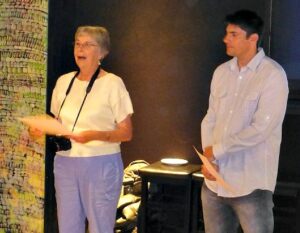
This was cause for a celebration which is step number 9 in the solar coop process. Wednesday evening, May 13, found many of the Solarize Harrisonburg members gathered at Clementine’s Ruby’s Lounge to socialize over appetizers provided by Sigora Solar, view photos of the installations and offer appreciation for the individuals and groups involved in the project’s success.

VA SUN’s program director Aaron Sutch handed out awards to:

  • Dave Pruett for his excellent outreach work through his Huffington Post article, The Great Transition, which appeared on March 19, 2015
  • Bishop Dansby for his policy work promoting solar energy
  • Zach Nyce and Brian O’Dell of the Harrisonburg Electric Commission with additional recognition of Jason Burch with the Shenandoah Valley Electric Coop
  • Joy Loving for her amazing local leadership
  • The City of Harrisonburg for becoming a Solar City
  • The Climate Action Alliance of the Valley for their partnership:

As our on the ground organization partner of the year for their excellent work in making Solarize Harrisonburg our most successful Virginia Solar Co-op to date. They prove that a small, passionate group of people are capable of empowering others to act locally while making a global impact. For this we recognize CAAV on this day Wednesday, May 13, 2015.

Finally Aaron announced plans to launch a second round of Solarize Harrisonburg in August 2015! More here.

VASUN Communications Manager Ben Delman wrote about this in his May 20 post to the VASUN website here: Solarize Harrisonburg Builds on Success to Start New Group

The Daily News-Record’s Elaina Sauber covered this project in an article published on June 20, 2015: ‘Solarize Harrisonburg’ Shines Bright

Wisdom to Survive

WtS.6.9.15.600.5.28

Climate change is taking place. Will we have the wisdom to survive? The film features thought leaders and activists in the realms of science, economics and spirituality. The focus: how we can live creatively and even joyfully in the face of this catastrophe. Because they are doing the work that needs to be done, they inspire the viewer to want to join the “team.”

Featured in the film: Bill McKibben, Joanna Macy, Gus Speth, Roger Payne, & more!

This film is deeply moving and profoundly engaging. Indeed, it has the potential to transform lives because it provides visions of how we should live in the midst of massive environmental challenges. I cannot recommend it more highly! – Mary Evelyn Tucker, Forum on Religion & Ecology at Yale

Please join the Climate Action Alliance of the Valley for two community showings of this film on Tuesday, June 9, 2015, at Harrisonburg’s downtown library, 174 S. Main St., at 3:00PM and 6:00PM. These screenings are part of “the 1st ever Valley DocFilmFest.”  The film is just under an hour long. Please stay for a discussion about it after each screening.

Click on this image to find the movie trailer:

Screenshot 2015-05-15 17.06.16.200

Climate News Roundup 5/15/2015

  • Bill McKibben had an op-ed piece in the New York Times entitled “Obama’s Catastrophic Climate-Change Denial“.
  • There has been a lot of interest lately in the 2 degree C goal for global warming. First, there is controversy over whether it can be achieved, particularly given some of the assumptions in the models showing how to get there. Then several reasons were cited as to why we are missing the mark. Finally, we were told that the 2 degree goal is too high and that we should shoot for something lower lest low-lying island nations suffer.
  • David Roberts has a very interesting conversation with libertarian Jerry Taylor about climate change and the type of policy against it that would get libertarian support. In a follow-up conversation they discussed why Taylor favors a carbon tax for addressing climate change. You might want to share both conversations with any libertarian or Tea Party acquaintances you have.
  • The World Bank doesn’t think that pricing carbon is adequate for solving climate change. Instead, it recommends five policies for establishing a thriving low-carbon economy.
  • Stage 3 of climate denial is to accept that climate change exists and we are the cause, but to deny that it is really a problem. People who think this way are called “lukewarmers.” Dana Nuccitelli examines whether the rise of lukewarmers is a good or bad thing.
  • As part of its “Keep it in the ground” campaign The Guardian is starting a series of stories about the five biggest “carbon bombs.” The first deals with the Galilee basin coal project in Australia, which would dig up and make available a huge amount of coal. If you don’t look at anything else in this Roundup, look at this story. It is beautifully done.
  • While it is tempting to attribute every extreme weather event to climate change, many are just due to the vagaries of “the weather.” The Economist has an interesting article about the advances in attribution, i.e., the science behind scientists ability to determine when an event is really due to climate change.
  • Both the Larsen A and Larsen B ice shelves in Antarctica have already collapsed and now it looks as if the massive Larsen C ice shelf may also collapse. Although total collapse of the ice shelf will take a very long time because of its massive size, it is still a concern for those interested in sea level rise. Meanwhile, Larsen B ice shelf appears to be in the final stages of disintegration, which will allow faster calving of ice bergs from the glaciers behind it.
  • New research on sea level rise published recently in Nature Climate Change has revealed both good news and bad news. The good news is that sea level hasn’t risen as much as previously thought. The bad news is that sea level rise is accelerating.
  • Because of recent volcanic eruptions, Robert McSweeney and Roz Pidcock have queried climate scientists to determine the impact of volcanoes on the climate.
  • Does the lack of renewable energy from Dominion and Duke Energy threaten the choice of Virginia and North Carolina as locations for large data centers, and therefore the jobs they provide? Greenpeace has studied the renewable energy availability in the two states and its relationship to the data centers.
  • Yale Climate Connections has a new website. On it they have articles as well as 90 sec podcasts of their public radio program. Perhaps we could get WMRA to work their program into its schedule.
  • It now looks as if the long-awaited strong El Nino is here. If so, it will be good for the western U.S. but bad for Australia.
  • January through April 2015 was the hottest Jan – April on record, and the records are likely to continue to be broken this year, especially with the developing El Nino.
  • An international group of scientists has just published a study showing that the organic carbon in the thawing permafrost is rapidly eaten by microbes and released as carbon dioxide, providing a significant new input of fossil CO2 to the atmosphere.


These news items have been compiled by Les Grady, member and former chair of the CAAV steering committee. He is a licensed professional engineer (retired) who taught environmental engineering at Purdue and Clemson Universities and engaged in private practice with CH2M Hill, the world’s largest environmental engineering consulting firm. Since his retirement in 2003 he has devoted much of his time to the study of climate science and the question of global warming and makes himself available to speak to groups about this subject. More here.
“On the Chopping Block” with Brian Bellew

brianbellew

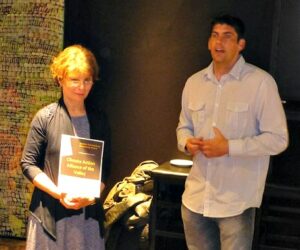
Please join the Climate Action Alliance of the Valley for a public presentation by Friends of Blackwater Climate Outreach Coordinator Brian Bellew: “On the Chopping Block: Climate Change and the Allegheny Highlands – What’s at Stake, What’s at Risk, and What Are Our Choices?”

Tuesday, May 19, 6:00 PM, Massanutten Regional Library, 174 S. Main St., Harrisonburg

The Allegheny Highlands includes on its eastern edge Virginia’s Shenandoah National Park – and the magnificent Monongahela and George Washington National Forests, and much more. For generations, an intricate web of life based on the Highlands’ high-mountain climate has been central to the region’s vibrant forestry, agricultural, recreation, and hospitality economy.

But we can no longer take the Allegheny Highlands’ historic climate for granted.
Climate change impacts are already affecting temperatures, precipitation, weather, growing seasons, streams, forests, plants, animals and humans – and future impacts will be severe, unless global warming is reined in.

Today, the distinctive Highlands ecology and economy — that have enriched so many generations of residents and visitors — are “on the chopping block.”

Brian Bellew, staffer with Friends of Blackwater, an environmental and conservation organization headquartered in Davis, W.V., will present a program that highlights the scientific research that was presented at a June 2014 conference at Blackwater Falls State Park featuring a dozen experts.

Les Grady, Climate Action Alliance of the Valley member, will also talk about the effects of climate change on our bird population.

Contact Joni Grady at 540-209-9198 for more information.

Friends of Blackwater is a non-profit conservation organization working effectively in the Mid-Atlantic Appalachian Highlands with a mission to protect key landscapes and watersheds, natural and human communities, and to support economic development that maximizes biodiversity and outdoor recreational opportunities for future generations. 

The Highlands region straddles the Appalachians’ highest peaks — including parts of Pennsylvania, Maryland, West Virginia, and Virginia. Hundreds of thousands of people live and work in the Highlands, and each year thousands of visitors come to enjoy the distinctive highmountain climate. But unless the pace of global warming and climate change is slowed, the future of the ecology and economy that have enriched so many generations of residents and visitors is on the chopping block.

Friends of Blackwater is leading an Allegheny Highlands Climate Change Impacts Initiative highlighting the growing, dangerous impacts and risks from global warming and climate change to the Highlands’ economy and ecology.

Friends of Blackwater Climate Outreach Coordinator Brian Bellew is doing community presentations about their new Report, “On the Chopping Block – the Impacts of Climate Change on the Mid-Atlantic Allegheny Highlands.” You can read and download a copy of the Report here.

Climate News Roundup 5/8/2015

  • Hannah Devlin, writing in The Guardian, addresses eight myths about climate change that need to be exploded, some from people who deny human-caused climate change and some from people who are concerned about it.
  • Will framing climate change as a moral issue change the transition to a carbon-free economy? David Roberts at Vox argues that it will.
  • Commitments made by world governments to reduce carbon emissions are inadequate to keep global warming below 2C.
  • In the final video of the Post Carbon Institute’s four-part video series, Richard Heinberg discusses what a more resilient society would look like.
  • Ivy Main has a new blog post, this one about Governor McAuliffe’s veto of coal subsidy bills. She also has a post about AG Herring’s ruling that municipalities may ban fracking.
  • The nature of Arctic sea ice is changing, which will bring about changes in its vulnerability to melting as well as the absorption of solar energy in the Arctic.
  • Gayathri Vaidyanathan of E&E Publishing has a moving and riveting account of the fate of two explorers surveying ice thickness in “The Last Ice” region of the Arctic.
  • The drought in California should be a wake-up call for everyone that our food production system is deeply flawed. Natasha Geiling reports on how our dependence on California for so much of our food came about and what would be required for us to grow more food closer to home.
  • Climate scientist James Hansen has an interesting 13 minute interview on Australian radio about why allowing a temperature rise of 2C is a recipe for disaster. Just click on “Listen now”.
  • The route of the Keystone XL pipeline in South Dakota must be recertified and that has led Native Americans to vow to fight it.
  • If you have been frustrated by TV weather forecasters and their reluctance to address climate change, relief may be on the way.
  • The MIT Energy Initiative has issued a new report entitled “The Future of Solar Energy.” It concludes that solar energy has great potential, provided there is increased emphasis on developing lower-cost technologies and more effective deployment policy. The executive summary can be found here.
  • The co-creators of the 2013 composition “A Song of Our Warming Planet” are back with a new composition entitled “Planetary Bands, Warming Worlds.”
  • Bank of America has announced that it will continue to reduce credit for financing of coal extraction projects.
  • Earthjustice, on behalf of Chesapeake Climate Action Network, the Patuxent Riverkeeper, and the Maryland Sierra Club, has filed suit to rescind federal approval of the Cove Point natural gas export terminal proposed by Dominion.

These news items have been compiled by Les Grady, member and former chair of the CAAV steering committee. He is a licensed professional engineer (retired) who taught environmental engineering at Purdue and Clemson Universities and engaged in private practice with CH2M Hill, the world’s largest environmental engineering consulting firm. Since his retirement in 2003 he has devoted much of his time to the study of climate science and the question of global warming and makes himself available to speak to groups about this subject. More here.

Climate News Roundup 5/1/2015

  • CNN columnist John D. Sutter will spend the rest of the year reporting on 2 degrees C as a target for maximum global warming and its significance to the future Earth. To begin, he asks and answers 7 questions about the 2 degree value. You can signup there to receive his 2 degree newsletter.
  • Thawing permafrost may release significant amounts of carbon to the atmosphere
    in the form of carbon dioxide and methane.
    Its impacts should be considered in climate models and in efforts to keep global warming below 2 degrees C.
  • EPA’s Clean Power Plan will have a positive effect on the economy, generating more than 270,000 new jobs.
  • The Post Carbon Institute has released Part 3 of its four-part video series made in conjunction with the release of Richard Heinberg’s new book, Afterburn: Society Beyond Fossil Fuels. In case you missed them, you can still watch Part 1 and Part 2.
  • China claims to have significantly reduced both its carbon dioxide emissions and its coal consumption in 2014. If confirmed and sustained this could be good news for all.
  • According to a new study about 75% of extremely hot days and 18% of extreme rain events can be attributed to climate change.
  • South Dakota regulators have delayed a decision on whether to renew the expired permit for the Keystone XL pipeline’s route through the state.
  • The Premier of Alberta in Canada hopes to turn their First Nations into pipeline proponents by letting them share in oil and gas profits.
  • We don’t normally think of climate change as triggering earthquakes, but some geologists think that it can.
  • It has been asserted that the recent report by the North American Energy Reliability Corporation (NERC) on the impacts of EPA’s Clean Power Plan on the reliability of our electricity supplies is based on several flawed assumptions.
  • Last week the U.S. government released the first Quadrennial Energy Review.
    It lays out six ways we can create a climate resilient energy infrastructure.
  • Matthew England, an Australian climate scientist, explains his recent article showing that the “hiatus” in global average surface temperature will have little effect on the long-term increase in temperature due to climate change.
  • NASA has prepared a set of interactive visuals showing the impact of climate change on Arctic sea ice, sea level, and global temperature. They also have one on how the carbon dioxide concentration in the atmosphere has changed.
  • For those who are interested in the concept of climate sensitivity, Dana Nuccitelli has an interesting piece on where things currently stand in trying to estimate it.
  • According to a new analysis, one in six of the planet’s species will go extinct if world leaders fail to act adequately on climate change.

These news items have been compiled by Les Grady, member and former chair of the CAAV steering committee. He is a licensed professional engineer (retired) who taught environmental engineering at Purdue and Clemson Universities and engaged in private practice with CH2M Hill, the world’s largest environmental engineering consulting firm. Since his retirement in 2003 he has devoted much of his time to the study of climate science and the question of global warming and makes himself available to speak to groups about this subject. More here.