If you qualify* as a low-to-moderate income household, Community Housing Partners can help reduce your energy bills and make your home more comfortable, energy efficient and affordable year round.
Clients approved for the Weatherization Assistance Program will receive a FREE ENERGY AUDIT, which will determine the work that can be done to your home. This may Include:
Energy-Saving measures to reduce heat loss, such as attic and wall insulation, caulking and weather-stripping
Inspection of heating equipment and duct work in order to assure safe and efficient operation
Assessment and remedy of unsafe conditions (carbon monoxide emissions, back-draft conditions, fire hazards, bad wiring etc.)
Other energy-related improvements
To learn more or obtain an application, please contact:
Karen Vincent 540-949-5879 x 5108
Community Housing Partners/ Energy Solutions
126 S. Bayard Ave., Waynesboro, VA 22980
Several large insurance companies are calling upon the Federal Government to revamp its disaster relief system to put more emphasis on preparedness before a disaster.
Lester Brown and colleagues at the Earth Policy Institute have released a new book entitled The Great Transition.
John Cook and colleagues at the University of Queensland have a developed a Massive Open Online Course (MOOC) entitled “Making Sense of Climate Science Denial” that is available free through EdX. A description of it can be found at RealClimate.
Ivy Main’s blog reports on the Virginia Attorney General’s opinion letter concerning the 2014 Virginia law prohibiting HOAs from banning solar panels. The short answer is that they can’t do it unless the prohibition was written into the founding documents of the HOA. She also reports on Gov. McAuliffe’s comments at a forum on climate change in Richmond on Earth Day.
Chesapeake Climate Action Network has launched a new website entitled domtruth. Check it out.
A new report finds that China could feasibly get 60% of its energy and 85% of its electricity from renewables by 2050.
March 2015 set the record for the hottest March ever recorded and the period Jan-March 2015 set the record for the warmest Jan-March ever.
The Dutch have developed a way to retrofit existing housing in 10 days to make it net zero energy housing. The occupants don’t even have to vacate during the retrofit.
Peter Sinclair has a disturbing new video about Totten Glacier in East Antarctica. Recent research indicates that it is being destabilized by warm ocean waters coming under it, much like two glaciers in West Antarctica.
Climate scientists have a difficult enough time communicating their results without people misinterpreting them. Read how one climate scientist has had to work to clear up misuse of his findings.
One of the weakest links in climate models is how clouds will influence future warming. Recent research provides new insights and the findings are not encouraging: clouds can amplify global warming.
In the April 3 Weekly Roundup of Climate News I gave you a link to a new book on climate change economics by Wagner and Weitzman. In this post they explain how rapidly the likelihood of exceeding a temperature increase of 6 degrees C goes up as the average temperature increase goes up. Scary, but well worth reading.
Panelists at the Electric Power Conference and Exhibition gave their opinions on how the electric power industry can meet the goals of the Clean Power Plan. The plan is achievable, but the industry faces large challenges in meeting it.
Planting forests in places where they haven’t been before can help to remove carbon dioxide from the atmosphere. A recent study indicates a positive impact from such efforts, although there are some potential negative impacts as well.
A Federal Court of Appeals today dismissed a challenge to the fuel efficiency and greenhouse gas standards for big trucks.
These news items have been compiled by Les Grady, member and former chair of the CAAV steering committee. He is a licensed professional engineer (retired) who taught environmental engineering at Purdue and Clemson Universities and engaged in private practice with CH2M Hill, the world’s largest environmental engineering consulting firm. Since his retirement in 2003 he has devoted much of his time to the study of climate science and the question of global warming and makes himself available to speak to groups about this subject. More here.
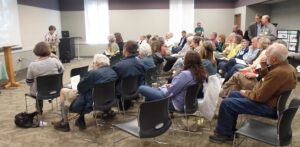
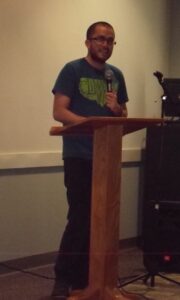
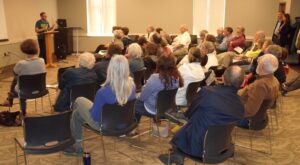
CAAV member and former steering committee chair Les Grady presented a talk about climate change at the Massanutten Regional Library, downtown Harrisonburg, on Monday, April 20, 2015, entitled Help! My Planet’s in Trouble and I Don’t Know What to Do.
The Daily News-Record‘s Elaina Sauber was there along with photographer Nikki Fox. The below article was published in the Daily News-Record on Tuesday, April 21, 2015.
Climate Change Talk Hopes to Educate
by Elaina Sauber
Photo by Nikki Fox for the Daily News-Record, April 21, 2015.
HARRISONBURG – Les Grady thinks the first step to slowing down climate change is simply talking about it.
“Bringing up climate change in a polite society stops the conversation,” said Grady, member of the steering committee for the advocacy group Climate Action Alliance of the Valley. “We just don’t want to think about it, because we feel really helpless.”
The licensed professional engineer, who has taught environmental engineering at Purdue and Clemson universities, spoke to about 30 people Monday about addressing and alleviating the effects of climate change to commemorate Earth Day, which is Wednesday. The event was held at Massanutten Regional Library’s main branch in Harrisonburg.
Grady has also worked part time for the last two decades for CH2MHILL, the world’s largest environmental engineering consulting firm.
While 97 percent of climate scientists agree that warming trends of the last century are likely due to human activities, he said, a new study from Yale University shows that only 52 percent of Americans are concerned about climate change.
Skeptics argue that the Earth experiences natural shifts in climate, and any perceived changes aren’t being driven by the burning of fossil fuels.
Grady said the first thing to recognize when it comes to climate change is that a variety of research sources confirm its existence – not just temperature records.
“In fact, temperature records are probably the least reliable in the sense of indicators,” he added, due to natural variability and the fact that only about 1 percent of the Earth’s heat is in the atmosphere.
The oceans contain most of the planet’s heat. According to research from the National Oceanic and Atmospheric Administration, oceans’ heat content has risen almost continually since the mid-1990s.
Accepting climate change as reality also means accepting the role carbon dioxide plays in exacerbating it, Grady said.
As rising carbon dioxide levels contribute to higher temperatures, precipitation and sea levels also increase, Grady said.
“The more carbon we put into the atmosphere, the warmer it’s going to be,” he said.
Developing countries in Africa, South America and Indonesia are more vulnerable to issues stemming from climate change because they don’t have the economic resources to deal with the problems it presents, Grady said.
“Many people say this is a moral and ethical question, because their contributions to the problem are negligible – they haven’t emitted very much carbon dioxide,” Grady said.
Grady listed steps people can take to help address climate change in their own lives.
In Virginia, he said, transportation is the major source of carbon dioxide emissions, followed by electricity generation through the burning of coal. While anyone can make changes to their transportation and electricity use, Grady said the political process is crucial in persuading energy providers to follow suit.
“We as citizens need to be active,” he said. “State electric generators really have not done very much, nor are they planning to, about this problem.”
He also encouraged attendees to calculate their carbon footprint using programs found on the Environmental Protection Agency’s website.
But the main course of action Grady advocates is implementing a carbon fee and dividend.
“We allow all of us to dump the waste from burning fossil fuels into the atmosphere,” he said.
A better solution, he said, is to charge households a fee commensurate with the impact of their carbon footprint, “so that when we buy it, we’re not socializing those costs anymore; they become privatized, just like the profits are.”
Contact Elaina Sauber at 574-6278 or esauber@dnronline.com
Here is a brief, hopeful essay about why the “Merchants of Doubt” will lose in the end.
In a Guardian column, economics editor Larry Elliott asks “Can we imagine a future that is cleaner, greener and sustainable – one that avoids climate Armageddon – without abandoning the idea of growth and, thus, forcing living standards into decline?” To see what he concludes, go here. It is a very thought-provoking essay.
Libertarian science writer and author Ronald Bailey asks what evidence would it take to persuade you that man-made climate change is real. His essay is one you might want to share with your conservative and/or libertarian friends and relatives.
The Post Carbon Institute is releasing a series of four videos by Richard Heinberg in conjunction with the release of his new book, Afterburn: Society beyond Fossil Fuels. The first is here.
The Yale Project on Climate Change has released an interactive map that shows public opinion on a variety of climate change issues down to the county level. It is interesting to note that Rockingham County is more accepting of man-made climate change than surrounding counties.
The Risky Business Project issued its third report, this one on the economic impacts of climate change. This report focuses on California, particularly the impacts on agriculture.
The National Environmental Education Foundation is offering a free course entitled “Extreme Weather 101” through UDEMY.
Two members of the Natural Resource’s Defense Council staff have published a paper outlining how the federal flood insurance program can be used to encourage people to retreat from shore lines and move away from flood prone areas.
A new study shows that cities with extensive urban sprawl will have a difficult time decreasing their CO2 emissions from transportation, even if they increase housing in the city center.
The Rocky Mountain Institute, an energy policy think tank, has issued a new report on how we will get our electricity in the future. Chris Mooney has a description of the major findings from the report.
As Shell moves drilling equipment near Alaska, environmental groups maintain that drilling for oil in the Arctic is just not compatible with President Obama’s pledge to lead on climate change.
A new study confirms that significant amounts of organic carbon are stored in permafrost. While it is unlikely that they will be abruptly emitted as CO2 or methane, they are expected to serve as a continuous carbon source over long time periods.
One impact of increasing the CO2 content of the atmosphere is to make the oceans more acidic. BBC News summarized a recently published study that provided evidence that the Permian-Triassic mass extinction (252 million years ago), in which over 90% of marine species went extinct, was likely caused by increased ocean acidity caused by CO2 released by volcanic activity.
A recent study demonstrated that marine ecosystems can be disrupted by climate events on timescales of multiple decades, but recovery can require a thousand years.
These news items have been compiled by Les Grady, member and former chair of the CAAV steering committee. He is a licensed professional engineer (retired) who taught environmental engineering at Purdue and Clemson Universities and engaged in private practice with CH2M Hill, the world’s largest environmental engineering consulting firm. Since his retirement in 2003 he has devoted much of his time to the study of climate science and the question of global warming and makes himself available to speak to groups about this subject. More here.
Wed., April 22 5:30-7:15 PM MRL
174 S. Main St.
Harrisonburg
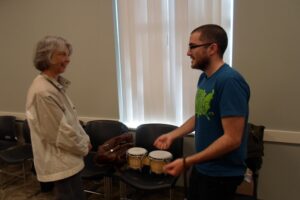
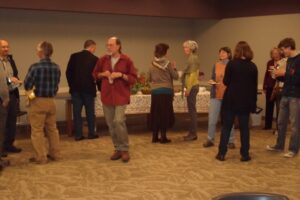
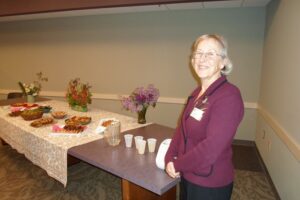
Climate Action Alliance of the Valley invites you to join a 35th anniversary celebration of Earth Day at Massanutten Regional Library in downtown Harrisonburg!
Lee will share his experiences walking across the U.S. from Los Angeles to Washington DC last year in order to bring awareness of the challenge of climate change. We’ll also find out how this journey has inspired his current work with Beyond Extreme Energy and Loudoun 350.org.
All welcome! Free and open to the public. Bring your friends and family!
After our library program, we’ll continue the party at Ruby’s Lounge, 153 S. Main St., across the street from the library, to socialize, visit with Lee and find out more about Beyond Extreme Energy and how we can support them with their work.
The U.S. Episcopal Bishop said that climate change denial is immoral.
The drought in California is having a major impact on the state and global warming is thought to be influencing it. (The second article is from The Washington Post).
So far, corporate America is reluctant to sign on to EPA’s Clean Power Plan.
Other items of interest:
There is a new book examining the economic consequences of a hotter planet.
The amount of water used for fracking gas wells is twice that used for oil wells.
The Washington Post has an interesting graphic showing where the world’s CO2 is coming from.
Polar bears were back in the news with articles discussing the impacts of a need for a change in their diet as a result of sea ice loss.
Blue crabs have been found further north than they typically live.
Ivy Main has a new post, this one about sea level rise and coastal property.
These news items have been compiled by Les Grady, member and former chair of the CAAV steering committee. He is a licensed professional engineer (retired) who taught environmental engineering at Purdue and Clemson Universities and engaged in private practice with CH2M Hill, the world’s largest environmental engineering consulting firm. Since his retirement in 2003 he has devoted much of his time to the study of climate science and the question of global warming and makes himself available to speak to groups about this subject. More here.

 If you qualify* as a low-to-moderate income household, Community Housing Partners can help reduce your energy bills and make your home more comfortable, energy efficient and affordable year round.